

Manual testing interview questions help assess a candidate's understanding of software testing concepts, processes, and practical scenarios. They are useful for preparing for QA interviews at both beginner and experienced levels.
- Covers important manual testing interview questions and answers.
- Suitable for both beginners and experienced testing professionals.
- Includes testing concepts, methodologies, and real-world interview scenarios.
Manual Testing Interview questions for Freshers
1. Explain Software Testing and Manual Software Testing.
Software Testing is the process of evaluating a software application to identify defects and ensure that it meets specified requirements. Its goal is to assess the quality and reliability of the software before release.
Manual Software Testing is an approach in which testers execute test cases manually without automation tools. Testers interact with the application, observe its behavior, and report defects when actual results differ from expected results.
| Software Testing | Manual Software Testing |
|---|---|
| Covers the overall process of evaluating software. | Represents one approach used to perform testing. |
| Can use different testing methods and techniques. | Primarily depends on human judgment and interaction. |
| May include both manual and automated approaches. | Particularly effective for exploratory and usability testing. |
2. What are the Advantages of Manual Testing?
Manual Testing offers several advantages, especially when human observation, judgment, and flexibility are important. It allows testers to evaluate an application from a real user's perspective and identify issues that automated tests may miss.
- Effective for usability, exploratory, and ad-hoc testing.
- Requires less initial investment compared to automation testing.
- Easily adaptable when requirements or application features change.
3. What are the Limitations of Manual Testing?
Manual Testing has certain limitations because it depends heavily on human effort and requires testers to execute test cases manually. It can become less efficient for large, repetitive, or time-consuming testing activities.
- Time-consuming and slower than automated testing for repetitive tasks.
- More prone to human errors and inconsistencies.
- Difficult to perform large-scale regression and performance testing efficiently.
4. What is Quality Control(QC) in testing?
Quality Control (QC) is the process of identifying and correcting defects in a software product through testing and inspection to ensure it meets the required quality standards before release.
- Involves activities such as testing, reviews, and inspections.
- Ensures the software meets specified quality requirements.
- Product-oriented process that verifies the quality of the final software.
5. List the Key Challenges of Manual Testing.
Manual Testing involves several challenges because it relies heavily on human effort, time, and tester expertise. These challenges can affect testing speed, consistency, and overall test coverage.
- Managing repetitive test cases and large regression test suites can be time-consuming.
- Frequent requirement changes may require continuous updates to test cases and test data.
- Limited time, complex applications, and human errors can make it difficult to achieve complete test coverage.
6. How is Manual Testing different from Automated Testing?
The following table highlights the key differences between Manual Testing and Automated Testing.
| Manual Testing | Automated Testing |
|---|---|
| Test cases are executed manually by testers. | Test cases are executed using automation tools and scripts. |
| No programming knowledge is required. | Requires programming and automation skills. |
| Best for exploratory, usability, and ad-hoc testing. | Best for regression, repetitive, and performance testing. |
| Slower for repeated test execution. | Faster and more efficient for repeated execution. |
| Lower initial cost. | Higher initial setup cost but cost-effective in the long run. |
| More prone to human errors. | Provides consistent and accurate test execution. |
7. Who is a Manual Tester and What is the work they have to do?
A Manual Tester is a software testing professional who verifies an application's functionality and quality by executing test cases manually without using automation scripts. They identify defects and ensure that the application meets specified requirements and user expectations.
- Analyze requirements and create test scenarios and test cases.
- Execute tests, identify defects, and report them to the development team.
- Retest fixed defects and perform regression testing to verify overall application stability.
8. What is the Role of Documentation in Manual Testing?
Documentation provides a structured way to manage testing activities and maintain important testing information throughout the software development process.
- Guides testing through test plans, test scenarios, and test cases.
- Tracks test execution, results, and reported defects.
- Maintains requirement traceability and supports test coverage analysis.
- Supports regression testing, maintenance, audits, and project reviews.
9. What are Priority and Severity in Software Testing?
Severity indicates the impact of a defect on the application's functionality, while Priority indicates how urgently the defect should be fixed.
| Severity | Priority |
|---|---|
| Measures the impact of a defect on the software. | Measures the urgency of fixing a defect. |
| Determined by the tester or QA team. | Determined by the project manager, product owner, or business team. |
| Focuses on technical impact. | Focuses on business needs and release schedules. |
| Categories: Critical, High, Medium, Low. | Categories: High, Medium, Low. |
10. What is Test Harness?
A Test Harness is a collection of supporting components and tools used to execute and evaluate tests. It provides the required test environment, test data, drivers, and other utilities needed to run test cases.
- Helps automate and manage test execution in a controlled environment.
- Uses components such as test drivers, stubs, test data, and reporting mechanisms.
- Makes testing more consistent, repeatable, and easier to evaluate.
11. What is a Test Bed?
A Test Bed is a configured environment containing the hardware, software, network, tools, and other resources required to perform software testing. It provides conditions similar to the intended environment where the application will run.
- Includes the required systems, configurations, and dependencies for testing.
- Helps testers execute tests under controlled and consistent conditions.
- Ensures the application can be tested in an environment suitable for the required test scenarios.
12. What is Test Data?
Test Data is the set of input values used to execute test cases and verify whether a software application produces the expected results under different conditions.
- Used to validate application functionality.
- Includes valid, invalid, boundary, and edge-case inputs.
- Can be created manually or generated automatically.
13. What is Test Closure?
Test Closure is the final phase of the Software Testing Life Cycle (STLC), where all testing activities are completed, results are evaluated, and the testing process is formally concluded.
- Verify that all planned tests have been executed.
- Prepare the test closure report and summarize results.
- Document defects, lessons learned, and test metrics.
4. What is Random Testing?
Random Testing, also known as Monkey Testing, is a software testing technique in which random inputs and actions are used to test an application without predefined test cases. It helps uncover unexpected defects and application crashes.
- Uses random and unpredictable inputs for testing.
- Helps identify hidden defects and unexpected failures.
- Useful for testing application stability and robustness.
- Can save time by quickly exposing critical issues in complex applications.
Manual Testing Questions for Intermediate
In this section, we have compiled the top manual testing interview questions for intermediate. So if you have one or two years of experience, then this section is totally for these types of software testers.
15. What is Defect Cascading?
Defect Cascading occurs when a defect in one component affects dependent components and leads to failures in other parts of the application.
- It usually results from dependencies between modules or system components.
- One root defect can create multiple symptoms across different areas of the application.
- Root cause analysis and impact assessment help identify and control cascading issues.
16. What is a Test Driver?
A Test Driver is a temporary program or component used during testing to call and execute a module that is being tested. It provides the necessary inputs and captures the outputs when the higher-level calling component is not available.
- Commonly used in Bottom-Up Integration Testing.
- Simulates the behavior of the calling module.
- Helps test lower-level components independently before full system integration.
17. What is a Stub?
A Stub is a temporary program that simulates the behavior of an unavailable lower-level module by returning predefined responses. It is primarily used in Top-Down Integration Testing.
- Simulates unavailable dependent modules.
- Returns predefined or dummy responses.
- Allows testing to continue before all modules are developed.
18. What is Defect Triage?
Defect Triage is the process of reviewing, analyzing, and prioritizing reported defects to determine their severity, priority, ownership, and resolution timeline. It helps ensure that critical defects are addressed first and resources are used effectively.
- Reviews and prioritizes reported defects.
- Assigns defects to the appropriate team members.
- Determines defect severity, priority, and release impact.
19. What is API Testing?
API Testing is a software testing technique that verifies the functionality, reliability, performance, and security of an Application Programming Interface (API) by sending requests and validating the responses without using the user interface.
- Verifies functionality, performance, reliability, and security.
- Ensures correct HTTP status codes, data, and error handling.
- Commonly performed using tools such as Postman, REST Assured, and Swagger.
20. What is Alpha Testing?
Alpha Testing is a type of acceptance testing performed by the internal testing team or developers at the developer's site before releasing the software to external users. Its purpose is to identify and fix defects before the product enters Beta Testing.
- Conducted by the internal QA team or developers.
- Performed before Beta Testing.
- Identifies defects before public release.
21. What is Beta Testing?
Beta Testing is a type of acceptance testing in which the software is released to a limited group of real users in a real-world environment to evaluate its functionality, usability, and reliability before the final public release.
- Conducted by real users or customers.
- Identifies defects and gathers user feedback.
- Validates the software in a real-world environment.
22. What are the types of Manual Testing?
Manual Testing includes different testing approaches that testers use based on the application's requirements and testing objectives.
- Functional Testing: Verifies whether features work according to requirements.
- Exploratory Testing: Involves learning, designing, and executing tests simultaneously.
- Ad-hoc Testing: Informal testing performed without predefined test cases.
- Usability Testing: Evaluates the ease of use and user experience.
- Regression Testing: Checks whether existing functionality is affected by recent changes.
- Smoke Testing: Verifies whether critical functionalities are working correctly.
- Sanity Testing: Checks specific functionality after minor changes or fixes.
23. List the Roles and Responsibilities of Manual Testers.
Manual Testers are responsible for ensuring that an application meets specified requirements and works correctly from a user's perspective. Their responsibilities cover the complete testing process, from requirement analysis to defect reporting and test completion.
- Analyze requirements and identify testable scenarios.
- Design and execute test cases using appropriate test data.
- Identify, document, and track defects until resolution.
- Retest fixed defects and perform regression testing when required.
- Maintain test documentation and communicate testing status with the team.
24. Describe the Manual Testing Process.
The Manual Testing Process is a systematic approach followed by testers to verify that a software application meets specified requirements, identify defects, and ensure the software is ready for release.
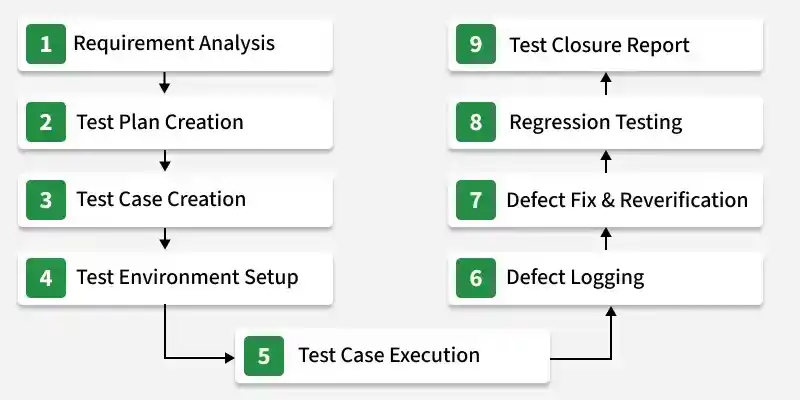
- Requirement Analysis: Understand the business and functional requirements of the application.
- Test Plan Creation: Define the testing scope, strategy, resources, and schedule.
- Test Case Creation: Prepare test cases, test scenarios, and test data.
- Test Environment Setup: Configure the required hardware, software, and testing environment.
- Test Case Execution: Execute test cases and compare actual results with expected results.
- Defect Logging: Record and report defects identified during testing.
- Retesting: Verify that the reported defects have been fixed successfully.
- Regression Testing: Ensure that recent changes have not affected existing functionality.
- Test Closure Report: Summarize testing activities, results, and lessons learned.
25. What are the Different Levels of Manual Testing?
Levels of Manual Testing define the stages at which software is tested to identify defects and ensure that each component and the complete application function correctly before release.
Levels of Manual Testing
- Unit Testing: Tests individual components or modules to verify they work correctly.
- Integration Testing: Verifies that integrated modules communicate and function correctly together.
- System Testing: Tests the complete application to ensure it meets specified requirements.
- User Acceptance Testing (UAT): Performed by end users or clients to validate that the software meets business needs and is ready for deployment.
26. What are the Skills required for Manual Testing?
Manual Testing requires a combination of technical knowledge, analytical ability, and communication skills to identify defects and evaluate software effectively.
- Analytical and problem-solving skills to understand requirements and identify potential issues.
- Knowledge of software testing concepts such as SDLC, STLC, test cases, and defect life cycle.
- Communication skills to clearly report defects and collaborate with team members.
- Domain knowledge and basic technical understanding to better understand the application and its requirements.
27. When to Use Manual Testing over Automation Testing?
Manual Testing should be preferred when human judgment, flexibility, or direct user interaction is more valuable than automated execution. It is particularly useful when automation is not practical or cost-effective.
- Exploratory and usability testing requires human observation and judgment.
- Frequently changing features may not justify the effort of maintaining automation scripts.
- One-time or small-scale testing is often faster and more cost-effective to perform manually.
28. What are Manual Testing Tools?
Manual Testing Tools are applications that help testers plan, manage, document, execute, and track testing activities. They support the testing process but do not automatically perform test steps like automation tools.
- Test Management Tools: TestRail, Zephyr, and TestLink for managing test cases and test execution.
- Defect Tracking Tools: Jira and Bugzilla for reporting and tracking defects.
- Collaboration and Documentation Tools: Confluence and spreadsheets for maintaining testing documentation and sharing information.
Manual Testing Interview Questions for Experienced
This section contains manual testing interview questions for experienced. So, if you have years of experience and are looking for change, then explore this section. Here you will find all the interview questions for the software testing experience profile.
29. List some Manual Testing Tools.
- Jira: Used for defect tracking, Agile project management, and workflow management.
- TestRail: Used to design, organize, execute, and report manual test cases.
- HP ALM (Quality Center): Provides end-to-end test management, requirements traceability, and defect tracking.
- Azure DevOps: Integrates test planning, execution, bug tracking, and CI/CD workflows.
- Zephyr: Enterprise test management solution with seamless Jira integration.
- Bugzilla: Open-source defect management tool used for logging, tracking, and monitoring bugs.
- MantisBT: Lightweight web-based issue tracking system for managing software defects.
- Redmine: Project management and issue tracking tool with customizable workflows.
- Xray: Jira-based test management tool for managing manual and automated test cases.
- qTest: Enterprise test management platform supporting Agile, DevOps, and end-to-end test lifecycle management.
30. What are the best practices for writing test cases for Manual Testing?
Best practices help create clear, reliable, and maintainable test cases that support effective testing and good requirement coverage.
- Understand requirements and maintain traceability between requirements and test cases.
- Write clear test steps with specific expected results using a consistent format.
- Cover positive, negative, and boundary scenarios with appropriate test data.
- Avoid duplicate cases and prioritize testing based on risk and business impact.
- Keep test cases reusable and update them whenever requirements change.
31. Can Automation Testing replace Manual Testing?
Automation Testing cannot completely replace Manual Testing because both are required for effective software testing.
- Automation Testing is used for repetitive, regression, and performance testing.
- Manual Testing is needed for exploratory, usability, and ad-hoc testing.
- Combining both approaches provides better test coverage and software quality.
32. List the differences between the Test Case and Test Scenario.
A Test Scenario describes a high-level functionality or condition that needs to be tested, while a Test Case provides detailed steps for verifying that functionality.
| Test Scenario | Test Case |
|---|---|
| Describes what to test. | Describes how to test it. |
| Provides a high-level testing objective. | Contains detailed test steps and expected results. |
| One scenario can have multiple test cases. | A test case is created to verify a specific condition or behavior. |
| Helps identify the overall test coverage. | Helps execute and document the testing process. |
33. What is Smoke Testing?
Smoke Testing is a preliminary level of testing performed on a new build to verify whether its critical functionalities are working correctly. Its main purpose is to determine whether the build is stable enough for detailed testing.
- Focuses on the major and essential features of the application.
- Helps identify critical issues early in the testing process.
- A failed smoke test usually means the build is rejected for further testing.
34. List the differences between Sanity Testing and Smoke Testing.
Smoke Testing checks whether the major functionalities of a new build are stable enough for further testing, while Sanity Testing verifies specific functionality after minor changes or bug fixes.
| Smoke Testing | Sanity Testing |
|---|---|
| Performed to verify the overall stability of a build. | Performed to verify specific changes or fixes. |
| Covers major and critical functionalities. | Focuses on affected or related functionality. |
| Usually performed on a new build. | Usually performed after minor changes or bug fixes. |
| Determines whether the build is suitable for detailed testing. | Determines whether the modified functionality works as expected. |
35. What is Top-Down Integration Testing?
Top-Down Integration Testing is an integration approach where testing starts with high-level modules and progressively integrates lower-level modules. Stubs are used as temporary replacements for modules that are not yet integrated.
- Follows a hierarchical approach from top-level to lower-level components.
- Allows early testing of the application's main control flow.
- Helps identify integration issues before the complete system is assembled.
36. Differences between Regression Testing and Retesting.
Regression Testing checks whether changes have introduced unintended issues in existing functionality, while Retesting confirms whether a previously reported defect has been fixed.
| Regression Testing | Retesting |
|---|---|
| Focuses on identifying unintended effects of changes. | Focuses on verifying a specific defect fix. |
| Has a broader scope covering affected and related functionality. | Has a narrow scope focused on the reported issue. |
| Test cases are selected based on change impact and risk. | Relevant test cases are executed again to verify the fix. |
| Performed after changes, enhancements, or defect fixes. | Performed after the developer provides a fix. |
37. List some Test Management Tools.
- QACoverage: A cost-effective test management tool that improves QA productivity and provides complete traceability between requirements, test cases, and defects.
- TestRail: A web-based tool used to organize test cases, manage test execution, and generate real-time testing reports and insights.
- SpiraTest: A test management platform that helps agile teams manage requirements, test cases, and defects in one place.
- Testiny: A lightweight and user-friendly tool designed to simplify manual testing and QA management processes.
- TestMonitor: An end-to-end testing tool that supports advanced test case management, result tracking, and smart reporting features.
38. What is Bug Lifecycle?
Bug Life Cycle, also known as Defect Life Cycle, is the process through which a defect or bug passes during its entire life, from identification to closure. The diagram below represents the workflow of the Defect Life Cycle.
States in the Defect Life Cycle
- New: When a tester identifies a new defect, it is marked as New. This is the initial stage of the bug life cycle.
- Assigned: The newly identified defect is reviewed and assigned to the development team for fixing.
- Open: In this stage, developers analyze and work on fixing the defect. If the defect is not valid or cannot be fixed immediately, it may be moved to Rejected or Deferred status.
- Fixed: After making the necessary code changes, the developer marks the defect as Fixed.
- Pending Retest: Once the fix is completed, the updated application is sent to the testing team for retesting, and the defect status becomes Pending Retest.
- Retest: The tester retests the application to verify whether the defect has been fixed successfully.
- Reopened: If the defect still exists after retesting, the tester changes the status to Reopened, and the defect cycle starts again from the Open state.
- Verified: If the tester confirms that the defect is fixed and no issue remains, the defect is marked as Verified.
- Closed: This is the final stage of the Defect Life Cycle. After successful verification, the tester marks the defect as Closed.
39. List some Bug Tracking Tools.
- Jira: A widely used bug tracking and project management tool that helps teams track defects, manage workflows, generate reports, and monitor issues efficiently.
- BugHerd: A simple bug tracking tool for websites that captures screenshots, browser details, OS information, and CSS details to help reproduce and fix issues quickly.
- Bugzilla: An open-source bug tracking tool used to manage and track software defects with integration support for test management tools.
- Axosoft: A bug tracking and Scrum project management tool that supports both cloud-based and on-premises applications.
- Backlog: A web-based project management and bug tracking tool that provides features like task management, subtasks, status tracking, and mobile app support.
40. List the differences between Quality Assurance (QA) and Quality Control (QC).
| Quality Assurance (QA) | Quality Control (QC) |
|---|---|
| QA is a process-oriented approach that focuses on preventing defects. | QC is a product-oriented approach that focuses on identifying defects. |
| It ensures that proper processes and standards are followed during development. | It verifies that the final product meets the required quality standards. |
| QA activities include process improvement, audits, and defining testing standards. | QC activities include testing, defect identification, and validation. |
| QA is performed throughout the software development lifecycle. | QC is mainly performed during the testing phase. |
| QA is a proactive approach to avoid defects. | QC is a reactive approach to find and fix defects. |
| Example: Defining testing guidelines and reviewing development processes. | Example: Executing test cases and reporting bugs. |
41. What is Pesticide Paradox?
Pesticide Paradox is a testing concept that states repeating the same set of test cases again and again may fail to find new defects because the software becomes resistant to those tests.
- It highlights the need to regularly review and update test cases.
- Testers should add new test scenarios to improve defect detection.
- It helps increase test coverage and identify hidden issues.
42. What is a Critical Bug?
A Critical Bug is a high-severity defect that causes major failure of an application or prevents users from performing essential functions.
- It can cause application crashes, data loss, or system failures.
- It requires immediate attention and should be fixed with high priority.
- Critical bugs usually block further testing or product release.
43. What makes a good test engineer?
A good test engineer has strong technical knowledge, analytical skills, and the ability to identify defects while ensuring the quality and reliability of the software.
- Understands business requirements and user expectations clearly.
- Has strong knowledge of testing concepts, techniques, and tools.
- Creates effective test cases with proper coverage.
- Possesses good analytical and problem-solving skills.
- Reports defects clearly with accurate details and evidence.
- Continuously learns new technologies and testing practices.
- Communicates effectively with developers and team members.
44. List the differences between Alpha testing and Beta testing.
| Alpha Testing | Beta Testing |
|---|---|
| Alpha Testing is performed by internal teams such as developers and testers. | Beta Testing is performed by real users or customers outside the organization. |
| It is conducted at the developer's site in a controlled environment. | It is conducted at the user's location in a real-world environment. |
| It is performed before Beta Testing. | It is performed after Alpha Testing and before the final release. |
| It focuses on finding major bugs and improving product quality. | It focuses on collecting user feedback and identifying real-world issues. |
| Testing is usually done using a stable but incomplete version of the software. | Testing is done on a near-final version of the software. |
| Example: Internal testing of a mobile app before releasing it to customers. | Example: Releasing a trial version of an app to selected users for feedback. |
