Showing posts with label Atmosphere. Show all posts

Monday, August 9, 2010

In the Shadow of a Giant: Observing Io in eclipse

One technique scientists use to monitor Io's active volcanism and atmospheric processes is by observing the moon while it is in eclipse.  Every Io day, the satellite passes into the shadow of Jupiter for a period of 2 hours and 20 minutes, plunging the entire moon into darkness.  But as first faintly seen by the Voyager 1 spacecraft when it flew by in 1979, Io glows in the dark.  These glows come from a variety of sources on Io's surface and atmosphere, such as thermal emission from lava flows and lava lakes, and aurorae from the interaction between gases in the atmosphere and Jupiter's magnetic field.  In this article, we will explore what scientists can learn from observing Io while in the darkness of Jupiter's giant shadow.

A few hours after its flyby of Io on March 5, 1979, Voyager 1 observed the moon while it was in eclipse.  It was a very long exposure, wide-angle-camera image designed to capture the night-side of Io against the background of stars at the end of the encounter.  The image contained multiple exposures of the night-side with a camera slew between each exposure.  It (FDS 16395.39, PICNO 0376J1 + 000) revealed a number of faint glows across Io.  Cook et al. in 1981 examined this image, and found that most of the faint glows, smeared as they were by the multiple exposures, were related to the plumes detected in Voyager 1's daylight images of the satellite, including faint flows from Pele, Marduk, Amirani-Maui, Prometheus, and Volund.  The poles of the moon were also faintly illuminated, with the north pole being a bit brighter than the southern one.  No thermal emission from Io's volcanic hot spots were observed on this occasion because the vidicon sensors used by the Voyager camera system could not detect photons with wavelengths longer than the orange portion of the visible spectrum.  This is much too short to detect thermal emission from all but the hottest of volcanic eruptions.  Cook et al. concluded that the glowing gases were not the result of extremely hot plasmas, but were glowing due to being excited by electrons from Jupiter's magnetosphere.  They suggest, however, that the polar glows are the result of gases emitted from numerous small vents, as opposed to plumes, which as we shall see from Galileo's results, may not be the correct interpretation.

The Galileo spacecraft arrived at Jupiter 16 years after the Voyager encounters, and stayed to observe Io every few months until its eventual destruction in Jupiter's atmosphere in September 2003.  On Galileo's first orbit, it imaged Io in eclipse on June 29, 1996.  These first images were taken in the Solid State Imager's clear filter, just as Voyager 1's eclipse observation was, but unlike Voyager's camera, the SSI was sensitive to photons from the near-infrared portion of the spectrum (0.7-1.0 microns).  This allowed the SSI camera to detect volcanic hot spots with temperatures greater than 700 K.  Scientists found several visible hotspots in this first observation (Pele, Reiden, Marduk, Isum, Mulungu, Fo, and Zamama), providing a proof of concept for this method, which supplemented the spectral observations of the Near-Infrared Mapping Spectrometer (NIMS).  The greater sensitivity to high-temperature volcanism, and finding it all across Io's surface also provided further proof that basaltic volcanism was wide-spread.  In addition to these more discreet glows, Galileo also observed fainter glows from volcanic plumes (such as Ra Patera), similar to the Voyager observation.  The limb of Io also glowed, not just the poles Voyager had seen, though the south pole was brighter in this case (the north pole was brighter when Voyager observed Io in eclipse).

Galileo observed Io while the moon was in eclipse during most of its nominal mission orbits and on several occasions during the extended missions. These images allowed scientists to monitor high-temperature volcanic activity on the surface.  A particularly brilliant hot spot was seen at Pillan in June 1997, providing evidence for a massive volcanic eruption there, which would be confirmed by the presence of a volcanic plume in daylight images from that orbit and a massive surface change around the hotspot seen three months later.  Eclipse images even showed how Pillan's hot spot had split by September and November 1997 due to lava flowing down into Pillan Patera from the plains above, thus creating a new source of thermal emission in the near-infrared.  Such small-scale details were not visible to the NIMS instrument until Galileo's encounters with Io later in the mission.  Images taken in the clear filter as well as SSI's near-infrared filters, such as the one at 1.0 micron, provided a way to crudely measure the blackbody temperature of Io's high-temperature volcanoes.  This was accomplished by calculating the ratio between the clear filter radiance of a hot spot and its radiance in the one micron filter.

Galileo's observations of Io in eclipse also allowed scientists to better understand the faint glows from the plumes and atmosphere.  These glows are the result of interactions between Jupiter's magnetosphere and the atmosphere of Io.  On two of Io's orbits, G8 and E15, Galileo scientists imaged Io in color to better understand the types of emissions that make up the aurorae on Io.  The best of this data set, from May 1998, is shown at left.  They reveal glowing aurorae of various color across different parts of Io's surface.  These can be categorized as bright blue, equatorial glows, red polar limb glows, and fainter green, anti-Jupiter hemisphere glows.  When an excited atom or molecule returns to the ground state, it sends out a photon with a specific energy. This energy depends on the type of atom and on the level of excitement, and we perceive the energy of a photon as color as the energy relates to a specific wavelength on the visible spectrum.  Just as red aurora on Earth are caused by atomic oxygen, the red limb auroral glows on Io are thought to be due to emission from neutral atomic oxygen at 630 and 636 nm.  The oxygen in Io does not derive from organisms on the surface, but from the break-up by solar ultraviolet light of sulfur dioxide in a process called photolysis:

SO2 + hν → SO + O.
The green glows are thought to caused by excitation of neutral atomic sodium, which releases photons in the sodium D lines at 589 and 590 nm, within the bandwidth of the green filter.  Atomic sodium is another photolysis product, this time deriving from sodium chloride belched from Io's volcanoes.  The bright blue glows along the limb near Io's equator are thought to be due to the excitation of molecular sulfur dioxide.  Most of these glows are related to various plumes visible near Io's limb at the time of the observation, including Amirani, Acala, Prometheus, Zamama, and Culann.  The identification of these chemical species are supported by ground-based and Hubble observations of Io's aurorae, which revealed the presence and absence of various atomic and molecular emission lines, including sulfur and oxygen lines in the ultraviolet at 190 and 135.6 nm, respectively.

Geissler et al. (2001) explored much of the available Galileo and Cassini eclipse image dataset and reported on the how the intensity and position of these auroral emissions change with time.  For example, across the Galileo dataset, the red limb emissions were brightest over either Io's north or south pole.  The bright equatorial glows, visible as blue glows in the E15 dataset, tend to be located either at plumes or near the sub- and anti-Jovian points on Io's surface.  In the latter case, these glows at various times either appear north of the sub-Jovian point and south of the anti-Jovian point, or vice versa.  Both temporal variations in the red limb glows and the blue equatorial glows are related to Io's position in the Jovian magnetosphere.  Jupiter's magnetic field is tilted with respect to the orbital plane of its main satellites by 9 degrees, so at various times as Io's orbits the planet, the moon is either above or below the equatorial plane of Jupiter's magnetic field.  At a system III longitude (λIII) of 0°, Io is below the normal plane of the magnetic field (this occurs with λIII between 290° and 110°).  The ion flux from the plasma torus is greatest over the north polar region of Io, causing greater excitation and increasing the brightness of Io's red auroral glows over the north pole.  Jupiter's magnetic field lines are also tilted with respect to Io's equatorial plane, so they are tangent to surface north of the equator near Io's sub-Jovian point, and south of the equator near the moon's anti-Jovian point.  When the λIII longitude is between 110° and 290°, Io's situation is reversed as it is now above the plasma torus.  This time, the south pole limb emissions are brighter than the north's, and the equatorial glows (that aren't related to volcanic plumes) have switched hemisphere as they are now bright south of the sub-Jovian point and north of the anti-Jovian point. This cycle recurs every 12.95 hours, the synodic period between Io's orbital period and the rotational period of Jupiter's magnetic field.

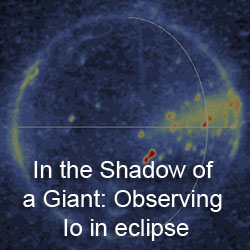
A word should be said about one of the mysteries regarding Galileo and New Horizons eclipse observations of Io: scattered around the sub-Jovian and anti-Jovian points on the satellite are a great number of glowing spots.  These spots appear similar to hot spots in size and intensity, but their concentration is much greater than the rest of the satellite.  Each of these spots can be correlated with a volcanic feature in Voyager images of this region.  Other infrared observations of the satellite suggest that thermal emission is not higher in these regions compared to the rest of Io, so the spots are probably not thermal emission from high-temperature lava.  As you can see in the image at left, the glows seem to be concentrated north of the equator near the sub-Jovian point (the white lines in the image are the equator [horizontal line] and the prime meridian [curved vertical line]), consistent with the tangent point of the Jovian magnetic field lines at the time of this observation.  From this one could surmise that these spots are the result of glowing gases rather than thermal emission.  But what would concentrate these gases into discreet spots that "look" like hot spots? One theory that I favor suggests that these spots are related to gases being slowly leaked from Io's interior at cooler volcanoes.  Not enough gas is released at these volcanoes to form plumes, but there is enough of sulfur dioxide that their auroral emissions are brighter than the surrounding regions.  They show up near the sub- and anti-Jovian points and not in other regions, not because there are more volcanoes there, but because Jupiter's magnetic field lines, and the electrons that are transported along them, connect to Io in these two regions.  This increased electron flux increases the brightness of the auroral emissions.

Future missions to Io will certainly use this technique to monitor changes in Io's volcanic activity and atmospheric emissions.  Narrow-band filters on future cameras would allow researchers to focus on specific line emissions from various chemical species such as atomic oxygen, sulfur, and sodium.  They would also allow for improved measurements of hot spot temperatures.  With increased bandwidth, more images using different filters can be taken during each eclipse, allowing for temporal variability of auroral and volcanic thermal emission to be monitored.  Finally, these measurements will allow researchers to determine the contribution outgassing from smaller volcanoes provides to Io's atmosphere.  Previously modeling focused on the contribution a few volcanic plumes provide, but not weaker outgassing from cooler, but more numerous, volcanoes.

References:
Cook, A. F.; et al. (1981). "Volcanic Origin of the Eruptive Plumes on Io". Science 211 (4489): 1,419–1,422.
McEwen, A. S.; et al. (1997). "High-temperature hot spots on Io as seen by the Galileo solid state imaging (SSI) experiment". Geophysical Research Letters 24 (20): 2443–2446.
McEwen, A. S.; et al. (1998). "High-Temperature Silicate Volcanism on Jupiter's Moon Io". Science 280 (5373): 87–90.
Geissler, P.; et al. (1999). "Galileo Imaging of Atmospheric Emissions from Io". Science 285 (5429): 870–874.
Geissler, P.; et al. (2001). "Morphology and time variability of Io's visible aurora". Journal of Geophysical Research 106 (A11): 26,137–26,146. 

Tuesday, August 3, 2010

Volcanic Moon of Jupiter Is Not Smelly and is Fun for the Whole Family

Back in mid-June, Space.com had a news article posted on their website titled, "Volcanic Moon of Jupiter Is Smelly and Bizarre."  The article was promoting the results of a paper by Arielle Moullet, Mark A. Gurwell, Emmanuel Lellouch, and Raphaël Moreno that presented results of Sub-Millimeter Array (SMA) surveys of Io's atmosphere. Their observations revealed the presence of the previously observed compounds in the atmosphere like sulfur dioxide (SO2) and sulfur monoxide (SO) and a compound observed for the first time in gaseous phase, sodium chloride (NaCl), which was predicted to exist based on the presence of sodium and chlorine in the Io Plasma Torus.  The SMA data also allowed the authors to map the distribution of these molecules, again including NaCl for the first time.  Finally, they analyzed the origin of each species, either sublimation from surface frost (the main source of SO2), photolysis from larger molecules (the dominant source of SO), or volcanic activity (the primary source for NaCl).  We discussed this paper on this blog back in March, and you can read that entry for more information about the results from this paper.

Back to the news article I mentioned at the top.  Space.com's reporting generally wasn't too bad.  It seemed to focus less on the results of the research than on the importance of it: the need to explain the source of the gases in Io's atmosphere given how small it is.  After all, our Moon is about the same size and has a much  thinner atmosphere composed mostly of sputtered regolith and outgassed radioactive decay products.  Understanding the connection between the atmosphere and Io's volcanic activity seems to be the key, along with how Io's atmosphere interacts with Jupiter's powerful magnetosphere, which acts as a sink for gases in the atmosphere.  The article also briefly reminds people about Io's active geology and possible future missions that may further explore this question of the source of Io's atmosphere.

Where the article goes off track is its description of Io's smell and derives mostly from the sentence, "She conceded the moon isn't a very pleasant place, though, because of the rotten-egg smell of the sulfur gases."  On the face of it, I could let it pass since it really feels like a throw-away comment.  However, many other sites re-reporting what Space.com wrote, particularly this gem from the Mother Nature Network titled, "Jupiter's moon smells like giant rotten eggs" or this one from the Christian Science Monitor called, "Scientists discover that Jupiter moon smells terrible".  These articles focused less on the science of the original paper (though both do provide an overview of the moon for readers who were unfamiliar), and more on that comment about how Io smells like rotten eggs, based on this discovery.

To this, I have (and had at the time I saw these stories come out) but one reaction:

Well, let me make it clear lest I am misunderstood.  For this purpose, I will employ the caps lock button on my keyboard, so look away if you think you might be offended by its use.  IO DOESN'T SMELL BAD.  IT DOESN'T SMELL LIKE ROTTEN EGGS.  Sorry about that.  It had to be done.  The known chemical components of Io's atmosphere smell no worse than burnt matches.  Sure, the smell of burnt matches may not smell nice say compared to a rose, German Chocolate Cake, or very good barbecue, but I think we can all agree that it is a far cry from rotten eggs or raw sewage.  The bad smell that people associate with sulfur actually comes from hydrogen sulfide, not from sulfur, which only has a faint odor.  Hydrogen sulfide is produced as a waste product by intestinal and other bacteria and through hydrolysis at volcanic centers on Earth.  Its presence in Io's atmosphere has only been hypothesized and it has not been definitively identified.  It certainly wasn't observed by Moullet et al.  Organic sulfides can also have a pungent odor, but those are much less likely to be present in Io's atmosphere.  The other component Moullet et al. observed in the atmosphere of Io was sodium chloride, which is just plain old table salt.

So again, the story here is the all-to-common failure of science reporting on the web, picking up on unimportant trivia (that in this case isn't true) or more often than not, no fact checking and instead just passing along verbatim either what other websites report or copying press releases.  In this case, it just passes along misinformation rather than reporting on the original paper that spawned Space.com's story, thus trivializing its results to merely state that "Scientists discover that Jupiter moon smells terrible".

Again, the reports of Io's bad smell are greatly exaggerated. The moon is still a great place to vacation!  ;-)

Link: Volcanic Moon of Jupiter Is Smelly and Bizarre [www.space.com]
Link: Jupiter's moon smells like giant rotten eggs [www.mnn.com]
Link: Scientists discover that Jupiter moon smells terrible [www.csmonitor.com]

Saturday, March 6, 2010

Paper: Mapping Io's Atmosphere with the Submillimeter Array

Another day, another Io atmosphere paper.  Today, we take a look at a paper by Arielle Moullet, Mark A. Gurwell, Emmanuel Lellouch, and Raphaël Moreno titled, "Simultaneous mapping of SO2, SO, NaCl in Io’s atmosphere with the Submillimeter Array." This paper was posted online Thursday in the Papers in Press section of the journal Icarus.  In press papers are articles which have gone through peer review, were revised, and have been approved for publication, but have not been published in the print journal yet.  This paper discusses results from sub-millimeter wavelength observations of Io's leading and trailing hemisphere.  Using these observations, the authors were able to map the distribution of three chemical species in Io's atmosphere, sulfur dioxide (SO2), sulfur monoxide (SO), and sodium chloride (NaCl).  The authors then used these maps and the intensity of the observed emission lines to model the sources for these atmospheric components.  For additional information beyond this summary, check out Moullet's presentation from the Harvard-Smithsonian Center for Astrophysics SMA Science Symposium 2009.

Io has a very thin atmosphere (1-10 nanobars at the surface) composed mostly of sulfur dioxide, along with its disassociation products, sulfur monoxide and atomic sulfur and oxygen.  Other gases observed in Io's atmosphere or thought to exist in Io's atmosphere include sodium chloride, potassium chloride (KCl), diatomic sulfur (S2), and sulfuryl chloride (Cl2SO2).  Io's atmosphere has significant density variations with time of day, being densest near the sub-solar point and thinnest on its night side, and with position on the surface.  The distribution of SO2 gas was mapped across Io's surface using Hubble ultraviolet images of Io at the hydrogen Lyman-α line by Feaga et al. 2009, finding Io's sulfur dioxide gas in the atmosphere to be densest within 40 degrees of latitude from the equator and on Io's anti-Jupiter hemisphere.  Adaptive optics observations at Keck in 2002 showed SO gas at several volcanic centers, which de Pater et al. 2007 suggested was related to volcanic activity.  One of major questions these observations are trying to answer include identifying the dominant source of Io's atmosphere, whether it is sublimation of surface frosts, as atmospheric sulfur dioxide is thought to be in vapor-pressure equilibrium with the surface, or direct volcanic outgassing.

In this new paper, Moullet et al. 2010, the authors used observations taken at the Submillimeter Array (SMA) atop Mauna Kea in Hawaii, a set of eight, 6-meter-wide radio antennas acting as a radio interferometer.  The system observes at millimeter and sub-millimeter wavelengths between 0.3 and 1.7 millimeters (or frequencies between 180 and 700 GHz), at between the infrared and microwave portions of the electromagnetic spectrum.  For these observations, Moullet et al. observed Io in June 2006 and July 2008 at 338 and 346 GHz, at emission bands for sulfur dioxide, sulfur monoxide, and sodium chloride.  These observations were disk-resolved, allowing the authors to examine the hemispherical distribution of each gas species, and in the case of SO2 and SO, the high spectral resolution and signal-to-noise ratio allowed for more detailed analysis of their total emission.

For SO2, Moullet et al.'s SMA data at 346.523 and 346.652 GHz is consistent with the results from Fegea et al.'s Lyman-α data and Spencer et al. 2005's infrared data, further indicating that the sulfur dioxide in Io's atmosphere is predominantly located at equatorial latitudes and Io's anti-Jovian hemisphere.  Both constraints on the distribution of SO2 are similar to the distribution of sulfur dioxide frost on Io's surface and volcanic plumes.  To see which source of SO2 dominates, volcanic outgassing or sublimation of surface frosts, the authors modeled the appearance of Io's 346.652 GHz SO2 line emission using a hydrostatic model of Io's sublimation atmosphere and another modeling emission purely from the volcanic plumes noted by Geissler et al. 2004.  Using an appropriate number of active plumes, the authors found that volcanism does not match the distribution and shape of SO2 gas seen in the SMA data (except for the slight northward offset in emission seen over the anti-Jovian hemisphere in 2006).  In addition, to match the amount of emission observed, an unrealistic number of active volcanic plumes (40-230 Prometheus-type, or 5-20 Pele-type plumes, on each hemisphere) would be required.  Even if all 16 plumes noted by Geissler et al. were active, they would still only account for 5-11% of the emission on the leading side, and 13-18% on the trailing side.  The hydrostatic models of the frost sublimation component of Io's SO2 atmosphere better match the distribution and emission flux seen in the SMA data. The derived SO2 column densities (an average of 2.3-4.6×1016 cm−2 for the leading hemisphere, and 0.7-1.1×1016 cm−2 for the trailing side), gas temperatures, and variations with Io's distance from the Sun provide further evidence that the main source for sulfur dioxide, the dominant component in the satellite's atmosphere, is vapor-pressure equilibrium sublimation of SO2 surface frosts.  A minor fraction of the SO2 also comes from volcanic gas plumes (though not all gas emissions for volcanoes form plumes).

Moullet et al. also mapped the distribution of sulfur monoxide and sodium chloride in Io's atmosphere for the first time.  Both gases were predominately found on Io's anti-Jupiter hemisphere, as SO2 was.  The signal-to-noise ratio for the SO data was sufficient for the authors to perform an analysis on the source of that gas, similar to the one they performed on sulfur dioxide. Two sources were considered: photolysis of SO2, when sulfur dioxide is broken up by solar ultraviolet photons into SO and O, and direct volcanic emission.  In the case of volcanic activity, they found that, using a reasonable level of plume activity, volcanism is the source of 2.5% of the SO observed in the SMA data, using a model that included four volcanic plumes.  Using more plumes, or Pele plumes, would result in models that was more extended spatially than the emission maps from the data acquired.  Even using a favorable, 16 plume model, volcanic plumes account for 13-40% of the total SO emission, assuming a 10% mixing fraction in the plumes.  This at least suggests though, that volcanism is a more significant source of sulfur monoxide than sulfur dioxide.  The dominant source, however, is photolysis from SO2, as the modeling performed by Moullet et al. suggests.  The authors note that the "relative contribution is not easy to assess in the absence of precise estimates on SO lifetime in the atmosphere."

The signal-to-noise ratios of the NaCl maps were much lower than those for the SO2 and SO data, but radiative transfer modeling of NaCl in Io's atmosphere shows that the data is consistent with a volcanic origin. This is particularly the case since NaCl has a short lifetime in Io's atmosphere due loss from condensation on dust particles and photolysis into atomic sodium and chloride.  The amount of NaCl emission observed is consistent with a lower-bound, mixing ratio in volcanic plumes of 0.6% on the trailing hemisphere, and 2.5% on the leading side, similar to thermochemical modeling done by Fegley and Zolotov 2000.  Moullet et al. could not rule out other sources for the NaCl emission, such as sputtering.

This paper seems to provide further evidence that most of the gases in Io's atmosphere result from the sublimation of sulfur dioxide surface frosts, with direct volcanic emission playing a minor role.  Other major atmospheric components such as sulfur, oxygen, and sulfur monoxide result from the photo-disassocation of sulfur dioxide into its elemental components by solar ultraviolet photons, though a larger percentage of the sulfur monoxide in the atmosphere may come from direct volcanic outgassing.  Finally, some atmospheric components not related to sulfur chemistry, such as sodium chloride, could be entirely explained by volcanic outgassing, though other sources such as sputtering are also possible, but weren't modeled by the authors as the distribution of surface deposits of minerals other than sulfur and sulfur dioxide are very poorly constrained.  According to their presentation from April 2009, the authors stated they planned to map the distribution of other species such as potassium chloride, silicon oxide, and disulfur monoxide in the summer of 2009 using the APEX antenna in Chile, and will submit a proposal to observe Io's atmosphere at much higher resolution using the ALMA telescopes when they are finished in 2012.

Link: Simultaneous mapping of SO2, SO, NaCl in Io’s atmosphere with the Submillimeter Array [dx.doi.org]
Link: Presentation - Mapping of SO2, SO and NaCl emission in Io's atmosphere [www.cfa.harvard.edu]

Friday, February 26, 2010

LPSC 2010: Simulating Io's Auroral Emission in Eclipse

Yesterday, we talked about a model of Io's atmosphere using the Direct Simulation Monte Carlo (DSMC) method.  Today we look at another Monte Carlo (MC) model of Io's atmosphere, this time focusing on simulating the emission of Io's atmosphere during an eclipse.  Like the research discussed yesterday, both the abstract for next week's Lunar and Planetary Science Conference (LPSC) and a new paper in press in Icarus are available.  The LPSC abstract is titled, "Io's UV-V Eclipse Emission: Implications for Pele-type Plumes," by Chris Moore, David Goldstein, Philip Varghese, and Laurence Trafton.  This research will be presented as a talk next Wednesday afternoon, March 3 in the Planetary Atmospheres session.  The Icarus paper in press is titled, "Monte Carlo Modeling of Io’s [OI] 6300 Ã… and [SII] 6716 Ã… Auroral Emission in Eclipse," by Chris Moore, K. Miki, David Goldstein, K. Stapelfeldt, Philip Varghese, Laurence Trafton, and R.W. Evans.  Both cover the topic of simulating Io's auroral emission when the satellites goes into eclipse, but under different regimes: the LPSC abstract discusses emissions in the mid-ultraviolet as the result of SO2 and S2, while the Icarus paper talks about emissions in the red portion of the visible spectrum from oxygen (from decomposed SO2).

Last year, this same group published a paper on the dynamics of Io's atmosphere during an eclipse, which occurs each Ionian day when the satellite passes into the shadow of Jupiter.  Each eclipse lasts around 2 hours and 20 minutes.  During this time, no direct sunlight reaches Io surface, though Europa-shine and refracted sunlight from Jupiter's atmosphere can faintly illuminate the surface.  The authors found that Io's atmosphere doesn't completely collapse during an eclipse, as a diffusion layer of non-condensable atmospheric species like oxygen and sulfur monoxide forms near the surface, preventing sulfur dioxide above it from condensing out on to the surface.  With their model from last year's paper in hand, the authors further examined it, seeing how their model results would appear at different emission bands of the species they included in their model atmosphere (SO2, O, SO, S, and O2).  They also examined the emission from S2 gas present in volcanic plumes like Surt and Pele, and the effects of volcanic activity on the other emission bands.

In their Icarus paper, Moore et al. focused on two emission bands, the prominent [OI] oxygen emission line at 630 nm and the much fainter [SII] band at 670 nm (both in the red portion of the visible spectrum).  Thus in the image above, the emission examined would be colored in red, so that covers much of the limb glow.  This limb glow shifts between the north and south polar region of Io, as seen by Galileo and Cassini.  Observations by Trauger et al. 1997 also revealed a high altitude bright spot in the [OI] line over the leading hemisphere, which is actually on the wake side of Io since the magnetosphere of Jupiter spins faster than Io revolves around Jupiter.  Moore's simulation of Io's atmosphere in eclipse was able to match the observed position of the bright wake spot, but not its intensity.  The model suggests that the position of the wake bright spot (which can be seen either above or below the equator) and the polar limb glows are related to the depletion of electrons from the Io-Jupiter flux tube, which effects the 630 nm emission by Io's position above or below the plasma torus, volcanic plumes (particularly large polar plumes), the density of the polar atmosphere, and Io's effect on Jovian magnetic field lines.  The authors also found that the [SII] emission is much weaker than the [OI] oxygen line, in part because of the lower S+ (remember, the ratio of oxygen to sulfur in Io's atmosphere is roughly 2 to 1).

The LPSC abstract examines emission bands by SO2 and S2 in the mid-ultraviolet to the visible (250-600 nm) as Io ingresses into an eclipse.  The authors found that the distribution of this emission across Io's sub-jovian hemisphere (the area covered by Trauger et al. 1997 Hubble observations) is strongly effected by volcanic plume activity.  These plumes act as shields for the atmosphere south of them from the electrons from the Jupiter-Io flux tube, reducing the energy of these electrons.  For example, if both the Surt and Acala plumes are active, the northern Surt plume shows up bright due to S2 emission above 300 nm, while Acala plume south of it appears fainter because molecules in its plume are not as excited by flux tube electrons.  The authors also examined the difference between the western and eastern halves of the sub-Jupiter side of Io at these wavelengths.  With the Surt and Pele plumes active, the emission from Io was much greater than if they were off.  The ratio between the eastern and western halves was greater than one when both are off because of emission from SO2, which as a greater density on the eastern half because before the eclipse, it had been in the afternoon (remember from the article yesterday that Io's sublimation atmosphere peaks in density where the frost temperature is greatest, around 2pm in the afternoon).  When both plumes are one, that ratio becomes less than one as the brightness of the S2 emission from the Surt plume dominates the brightness on the western side.  With significant differences such as these, the authors suggest that even barely disk-resolved spectra, particularly around 300 nm, can be useful for determining the activity of volcanic plumes on Io from Earth-based data.

These two papers explore Io's auroral emission at various wavelengths from the mid-ultraviolet to the visible using a simulation to explain the observations we have on hand.  They show that the auroral glow of Io's atmosphere is affected by volcanic plume activity, such that observations from Earth can be used to determine the presence or absence of different plumes, Io's position in the magnetosphere, and the density of Io's atmosphere.  These simulations also explore the various chemical species in Io's atmosphere and how even minor constituents like oxygen, formed from the disassociation of sulfur dioxide, can have a strong effect on its auroral, so vividly seen when Io is in eclipse.

Link: Io's UV-V Eclipse Emission: Implications for Pele-type Plumes [www.lpi.usra.edu]
Link: Monte Carlo Modeling of Io’s [OI] 6300 Ã… and [SII] 6716 Ã… Auroral Emission in Eclipse [dx.doi.org]

Thursday, February 25, 2010

LPSC 2010: Modeling Io's Atmosphere in Three Dimensions

Okay, it is about time I finished up my coverage of the abstracts covering Io science for next week's Lunar and Planetary Science Conference.  Today I am going to talk about "Modeling the Sublimation-Driven Atmosphere of Io with DSMC" by Andrew Walker, Sergey Gratiy, Deborah Levin, David Goldstein, Philip Varghese, Laurence Trafton, Chris Moore, and Benedicte Stewart.  A paper in press in Icarus was published last month by the group covering this topic, "A comprehensive numerical simulation of Io’s sublimation-driven atmosphere".  This post will act as a summary of both the LPSC abstract and the paper.  The LPSC paper will be presented as a talk next Wednesday afternoon, March 3 in the Planetary Atmospheres session.

In their model, Walker et al. used the Direct Simulation Monte Carlo (DSMC) method for simulated Io's rarefied atmosphere in three dimensions.  Previous modelers explored Io's atmosphere as a single dimension, looking at how column density and temperature changes over the course of a day in response to changes in surface temperature, or as a two dimensional model that looked at how these parameters changed across a single latitude, axi-symmetric with the sub-solar point.  With a three dimensional model, the authors were able to explore the effects on Io's atmosphere from volcanic plume activity at known volcanoes like Pele and Prometheus, plasma bombardment heating from above, planetary rotation, sub-solar temperature (115-120 K), the residence time of fine-grained sulfur dioxide frost on bare rock, and variations in frost temperature and areal coverage.  The DSMC method models individual sulfur dioxide molecules (usually representative of the total number of molecules), which is useful when the atmosphere has such low density that the mean free path of sulfur dioxide molecules exceed that the length over which many gas properties propagate.  Similar modeling was performed by Austin and Goldstein 2000, though this new model includes the inhomogeneous frost coverage mapped by Galileo NIMS. This also allows the authors to graph variations in the translational, vibrational, and rotational temperatures (related to the different emission bands of sulfur dioxide based on motions of the S-O bonds), density and column density (number of sulfur dioxide molecules per cubic centimeter or over a square centimeter of Io's surface, respectively), and flow rate (expressed in the article as mach number).

Since the authors primarily modeled the sublimation component of Io's atmosphere, the column density and many of the other properties of the lower atmosphere were related to the temperature and areal coverage of sulfur dioxide frost on the surface as this part of the atmosphere would be in vapor-pressure equilibrium with that frost.  Because of the difference between the position of the peak frost temperature and the sub-solar point, ~30° to the east or 2pm local time, the column density near the surface peaks to the east of the sub-solar point.  This lag in peak frost temperatures results from the thermal inertia of SO2 frost.  Changing the sub-solar peak temperature from 115 K to 120 K causes a five-fold increase in the peak atmospheric column density from 4.7×1016 cm–2 to 2.7×1017 cm–2.  This brackets the lower and upper bounds for the atmospheric column density measured by earlier observers of Io's atmosphere.  Compare this to the column density to the Earth's, which is ~3×1025 cm–2.

I should point out at this point that this group published a companion paper (Gratiy et al.) that actually showed up in the Icarus in press page first, and was discussed here last month.  This paper compared their model of Io's atmosphere to actual observations taken a ultraviolet, infrared, and millimeter wavelengths.  One note that Walker et al. does make is that the variation in column density with latitude doesn't seem to match the Hubble Lyman-α observations, which showed a sharp drop-off in atmospheric density poleward of ±45°.  They suggest that this could be because of differences in frost temperature from the assumed cos1/4(ψ) latitudinal variation.

In other results, the authors found that heating from the Io plasma torus inflates the upper atmosphere of Io and keeps the nightside atmosphere from completely freezing out.  Plasma from Jupiter's magnetosphere only penetrates down to an altitude of 1 km at the point of peak frost temperature, and the altitude decreases the further you get from that point, reach the surface at the poles and on the nightside.  This actually means that the low altitude translational temperature of the SO2 in the atmosphere is higher on the nightside (where plasma reaches all the way to the surface due the lower atmospheric density) and particularly along the terminator.  At the terminator, the higher density dayside atmosphere interacts with the low density nightside atmosphere, leading to supersonic gas flow just past the dusk terminator and near the poles.

Tomorrow we will take a look at another LPSC abstract and Icarus paper by this group on modeling Io's auroral emission.

Link: Modeling the Sublimation-Driven Atmosphere of Io with DSMC [www.lpi.usra.edu]
Link: A comprehensive numerical simulation of Io’s sublimation-driven atmosphere [dx.doi.org]

Wednesday, January 13, 2010

Paper: Verifying a new model of Io's atmosphere by simulating multi-spectral observations

In November, the paper "Multi-wavelength simulations of atmospheric radiation from Io with a 3-D spherical-shell backward Monte Carlo radiative transfer model" was published in press in the journal Icarus.  The authors for this paper are Sergey Gratiy, Andrew Walker, Deborah Levin, David Goldstein, Philip Varghese, Laurence Trafton, and Chris Moore.  This paper takes a look at a computer model of Io's atmosphere, consisting of a composite of sublimation and volcanic sources and published in Walker et al. (submitted to Icarus but not yet available online), and attempts to validate the model by comparing simulated observation derived from the model to real observations published over the last decade.  I have to admit that this paper covers a topic that is definitely out of my wheelhouse, so I may not cover the findings of this paper with as much depth as I have given to other papers recently, but I will do the best I can to provide a summary.

While I have not read the Walker et al. paper covering the details of this new model since it hasn't been accepted by Icarus and posted online, according to this paper, it is a 3-D global rarefied gas dynamics model that uses both volcanic plumes and sublimation of surface sulfur dioxide (SO2) frost as sources for the gas in Io's atmosphere.  The model takes into account changes to the column density of the atmosphere as a result to time-of-day changes to the surface temperature, distribution of SO2 surface frost, distribution of volcanic plumes (though they use persistent volcanic thermal hotspots as plume sites rather than confirmed plume locations or the locations of large surface changes), plasma heating from Jupiter's magnetosphere, and heat loss to space.  For this paper, the authors used a backward monte carlo method to simulate how their model atmosphere would appear in different types of observations.

In Gratiy et al. 2009, the authors compared their model results to three observations: disk-integrated, high-spectral resolution measurements in the mid-infrared near 19-µm published by Spencer et al. 2005; disk-resolved, far-ultraviolet observations in the hydrogen Lyman-α band published in Feldman et al. 2000; and disk-integrated, millimeter wavelength observations published in Io After Galileo in the Io's Atmosphere chapter by Lellouch et al.

First, the authors compared their model output to observations published in Spencer et al. 2005.  For that paper, Spencer observed 16 SO2 ν2 vibrational band absorption lines using the TEXES mid-infrared spectrometer at the NASA Infrared Telescope Facility.  This was disk-integrated spectra centered around 19 microns.  From this data, the authors found a significant longitudinal asymmetry in absorption band depth, a measure of the average column density over the hemisphere sampled, with a low band depth (1%) compared to the continuum level at 315°W (the hemisphere centered near Ra and Loki) and a much stronger bands (7%) at 180°W (the hemisphere centered near Colchis Regio).  This indicates that Io's atmosphere is denser over the anti-Jupiter hemisphere than over the hemisphere centered on Ra and Loki.  This distribution correlates to the distribution of surface frost, but it also correlates with the distribution of volcanic plumes, as Gratiy et al. notes.  The authors of this new paper found that a combined model with sublimation and volcanic sources with long residence times (5000 seconds) for condensed SO2 on bare rock.  They also note that their model and the data from Spencer et al. seem to support a thermal lag where the surface temperature and thus frost sublimation peaks 3.5 hours, or 30° of rotation, after local noon.  This is akin to the terrestrial experience of the air temperature being warmer in the mid- to late-afternoon, as opposed to right at noon when the sun is at its highest point in the sky.  However, if you look at the PPR day-side data from I31, shown at right from Rathbun et al. 2004, there maybe some question of whether that thermal lag is real.

The next dataset the authors compared their model to was the Lyman-α data disk-resolved observations published in Feldman et al. 2000 and Feaga et al. 2009 (the latter paper was discussed here last year).  This data was acquired using the Space Telescope Imaging Spectrograph (STIS) on Hubble between 1997 and 2001.At these far ultraviolet wavelengths, areas where Io's atmosphere are denser absorb sunlight, appear dark in Lyman-α images.  Sunlight is better able to reach the surface and reflect back into space in order to be seen by Hubble.  Thus, areas where Io's atmosphere is thinner appear brighter in Lyman-α images.  An example of one of these images is shown at top.  Gratiy et al. could not reproduce this data with their model, suggesting that they do not properly simulate the latitudinal variation in the column density of Io's atmosphere (thicker at the equator, thinner at the mid-latitudes and poles).  In particular, they had difficulty reconciling the observed sharp increase in Lyman-α brightness, and therefore the sharp decrease in atmospheric column density, 45° North or South of the equator, and with the utter lack of atmosphere beyond 60° North or South latitude.  This cutoff, the authors suggest, is more consistent with the distribution of surface changes and volcanic hotspots, as opposed to surface frost.  However, there don't seem to be variations in the Lyman-α images resulting from known volcanic plumes.  The lack of an east-west asymmetry on either side of the central meridian in Io's equatorial brightness in the far-ultraviolet data that would be expected from the Walker et al. model suggests that the surface thermal inertia is much lower than they used for that model.

In the final comparison, Gratiy et al. compared their model to disk-integrated millimeter-wave SO2 emission line profiles obtained at IRAM 30-meter telescope in Spain, published in Io After Galileo in the Io's Atmosphere chapter by Lellouch et al. and disk-resolved data in Moullet et al. 2008.  The authors determined that strong atmospheric winds explain the wider SO2 emission lines in the IRAM data compared to what would be expected from thermal Doppler effects alone.

To be honest, this was a difficult paper for me to get through, hence why it took a month and a half for me to get this summary up.  So, I apologize for not explaining the paper's conclusions as well as I could have.  Basically, the authors hope that by comparing their rarefied gas dynamics model of Io's atmosphere with real observations they can make some improvements to that model that also provide new information about Io, such as the presence and strength of atmospheric winds, the surface thermal inertia, and the relative contribution of frost sublimation and volcanic plumes to Io's atmosphere.

Link: Multi-wavelength simulations of atmospheric radiation from Io with a 3-D spherical-shell backward Monte Carlo radiative transfer model [dx.doi.org]

Friday, December 11, 2009

A Few New Io/Jupiter System Papers

Sorry for the hiatus there is posts over the last couple of months.  I've just been a bit busy with Cassini plus I wanted to take a bit of a break after posting so much in September and October.  I wanted to post a quick note letting you all know about three new Io/Jupiter System related papers currently in press in the journal Icarus.

The first is titled, "Geologic mapping of the Hi'iaka and Shamshu regions of Io" by Melissa Bunte, David Williams, Ronald Greeley, and Windy Jaeger.  This paper is the latest in a series that covers the geologic histories of some of the regions observed at high- and medium-resolution by Galileo during its flybys in the late 1990s and early 2000s.  Back in March, I covered the authors' LPSC abstract on this research so you can read up on that while I slowly get through this paper and post a summary over the weekend (hopefully, there is a major Titan flyby today whose data comes back Sunday morning).

The other Io paper is titled, "Multi-wavelength simulations of atmospheric radiation from Io with a 3-D spherical-shell backward Monte Carlo radiative transfer model" by Sergey Gratiy et al.  Yeah, that's going to take me a bit longer to get through.  Hopefully I can post something next week.

The final paper that caught my eye in Icarus is titled, "Global geological mapping of Ganymede" by G. Wesley Patterson et al.  This paper discusses the completed Ganymede global geologic map and presents research on the observed geologic units on that satellite.  Again, I've only flipped through the article, and maybe later this month I can write up something about it.

Sunday, September 20, 2009

Io Presentations at EPSC

While normally I remember to cover the big four conferences for planetary science each year (LPSC in March, AGU in May and December, and DPS in the fall), I often forget about the main European planetary science conference, the European Planetary Science Congress or EPSC.  Io science tends to be dominated by American institutions like the University of Arizona, the Jet Propulsion Laboratory, and Arizona State University, so a European conference would be expected to have less Io coverage than those held in the US.  However, this year, three talks and one poster were presented last week in Potsdam, Germany.  Let's take a look at the abstract for these four presentations:
  • The last talk in the Satellite Atmospheres session this past Thursday, September 17, was titled, "First detection of Io's atmosphere at 4.0 micron" and was presented by Emmanuel Lellouch et al. Lellouch and his colleagues observed Io in the near-infrared using the CRIRES spectrometer at the Very Large Telescope in Chile in July 2008.  These measurements allowed the authors to observe an absorption band of sulfur dioxide gas at 4.0 μm.  With the adaptive optics system at VLT, they were also able to spatial resolve variations in the absorption band, looking for differences in atmospheric column density between the polar region and the equator.  Lellouch et al. believe that these observation open up a new avenue for monitoring Io's dynamic atmosphere.
  • The Satellite Surfaces and Interiors oral session this past Wednesday, September 16 hosted two Io talks.  The first was titled, "Volcanism on Io: New Insights from Global Geologic Mapping" and was presented by David Williams et al.  This talk and abstract provide an update to the Io geologic mapping project, a subject Williams presented at this year's Lunar and Planetary Sciences Conference, which I discussed in greater depth earlier this year.  This geologic map displays the distribution of various morphologic and color units across Io's surface.  Using software such as ArcGIS™ will allow researchers to use the map to conduct various lines of research, including comparing the areas of various mountain units with their heights, looking at the areal extent of the various plains units, and seeing how ongoing volcanism change these areal extent of the different lava flow units.  The authors also plan to assess the distribution of different flow units to assess regional variations in the style of volcanism (sulfur versus silicate volcanism, for example) and compare these units to observed volcanic hotspots to look for correlations between eruption style and unit types.  The Io Geologic map was completed in February 2009 and has been submitted to the USGS for peer review.  A similar global geologic map of Ganymede was also presented at the conference, which has garnered some press coverage (but not Io's, bah I say, BAH!) .
  • The other Io talk at the Surfaces session was titled, "Continued Observations of Io's Volcanic Activity" and was presented by Imke de Pater et al.  In this abstract, de Pater briefly presents new results from observations of Io in the near-infrared using the adaptive optics system at Keck in Hawaii.  These results include new observations of volcanic hot spots on Io as well as the distribution of sulfur dioxide frost across Io's surface.  While the abstract left out specifics, the authors spent more time advocating for additional telescopic observations of Io.  Regular observation runs were conducted during the Galileo mission and the New Horizons flyby in 2007, but outside of that flyby, Io monitoring has been sparse the last few years.  Regular monitoring is important for understanding Io's heat flow and its active volcanism. de Pater et al. also advocate for the inclusion of narrow angle cameras on board Jupiter-bound missions, particularly EJSM, to provide for monitoring of Io and other satellites in the system.
  • Finally, Ashley Davies, Laszlo Keszthelyi, and Alfred McEwen presented a poster titled, "Determining Io Lava Eruption Temperature: Strategies for a New Mission to the Solar System's Most Dynamic Satellite."  These authors presented a similar poster at LPSC earlier this year, which was discussed here a bit more extensively.  This abstract discusses how the desire to measure the temperature of Ionian lava using near-infrared camera observations of lava fountains and skylights (holes in the roofs of lava tubes).  The authors explain that near-simultaneous, high-resolution color imaging during Io flybys by either a dedicated Io mission (such as the Io Volcano Observer) or by another Jupiter system mission (like EJSM) would be necessary for determining these lava temperatures without the issues from short-term variability (on the order of a few seconds) of lava fountains.  The authors also state that these observations would need to be preformed over Io's night-side to avoid contamination from sunlight.
With EPSC now passed and DPS abstracts online for that meeting in two weeks, we now have to wait for AGU abstract to be posted online.  The Fall AGU meeting is scheduled for December 14-18 and abstracts for this meeting are usually posted online in mid- to late-October.  At last year's fall meeting, five Io-related talks and posters were presented, so we will see what this year brings.

Link: European Planetary Science Congress [meetings.copernicus.org]

Friday, September 18, 2009

Io Talks at DPS 2009

The science program as well as the abstracts for this year's DPS meeting were posted online a few weeks ago. DPS 2009 will be taking place in Fajardo, Puerto Rico, and as such, I won't be going. Hopefully the organizers will be able to broadcast the meeting oral sessions like they did for last year's meeting, but I guess that will depend on the infrastructure at the El Conquistador Resort. The webcasts last year allowed me to post about each of the Io talks here on this blog.

The 2009 Meeting of the Division of Planetary Sciences will be held between October 4 and 9, 2009.

In this year's science program, there are four Io talks and one poster planned. All four Io talks will be held during the Galilean Satellites oral session on the afternoon of Friday, October 9. The Io-related poster will be in the Decadal Survey White Papers section during the poster session on the evening of Tuesday, October 6. Here is a brief summary of the talks and posters to be presented:
EDIT 09/19/2009 4:17 pm: Fixed links to abstracts...hopefully...  If you are having trouble with the links, just go to the two sessions with Io talks and posters and click the links their for the abstracts: Galilean satellites oral session and Decadal Survey White Papers poster session.

Link: DPS 2009 Meeting [dps09.naic.edu]

Thursday, September 17, 2009

Paper: Spectroscopy of Io Eclipse Reappearances

Last week, a new paper was published in press (the paper has been approved for publication, but hasn't found a slot in the dead-tree version of the journal yet) in the journal Icarus discussing spectroscopic observation of Io as it emerged from the shadow of Jupiter. The paper is titled "Eclipse reappearances of Io: Time-resolved spectroscopy" and was written by Dale Cruikshank, Josh Emery, Katherine Kornei, Giancarlo Bellucci, and Emiliano d'Aversa.

In this new paper, the authors discuss spectroscopic observation of Io acquired using NASA's Infrared Telescope Facility (IRTF) in Hawaii during five eclipse reappearances in April, May, and June 2004. These observations were intended as a follow-up to results from Cassini VIMS observations in Bellucci et al. 2004 taken during that spacecraft's Jupiter flyby during New Year's 2001 that showed a brightening of Io's surface in the near-infrared and a deepening of several strong sulfur dioxide absorption bands following Io's emergence from Jupiter's shadow. This result continues a 40-year-long mystery concerning the interaction between Io's atmosphere and its surface during and after an eclipse by Jupiter.

Unlike lunar eclipses, when the Earth passes between the Sun and our Moon and which happen about once a year, or every 13 orbits of the Moon around the Earth, eclipses of Io by Jupiter occur about once each Ionian day. This is due the large size of Jupiter compared to Earth and the much lower axial tilt of Jupiter and its main satellite system. Each Ionian lunar eclipse lasts about 2 hours and 22 minutes. During this time, the temperature of Io's surface cools due to the sudden lack of sunlight. As Io cools down as the eclipse progresses, atmospheric Sulfur dioxide (SO2) condenses onto the surface. Check out a post I wrote earlier this year on another paper for more details on this process.

Depending on the amount of SO2 that condenses onto the surface, the fresh frost should be visible shortly after Io emerges from behind Jupiter's shadow as a brightening of Io's surface compared to its appearance prior to being eclipsed, and it should quickly dim as the frost sublimates from the surface now that the Sun is able to heat it up. In addition, the strong SO2 absorption bands at 3.56 μm, 3.78 μm, 4.07 μm, and 4.37 μm would be deeper than they were prior to the eclipse and should become shallower during the first 60-90 minutes after each eclipse and particularly in the first 15 minutes as the fresh, fine-grained SO2 frost sublimates back into the atmosphere. Results from multiple studies using ground-based and spacecraft observations over the last 40 years, since Binder and Cruikshank 1964 revealed a brightening of Io of 10 percent following an eclipse by Jupiter, have been inconsistent with some showing such a brightening, and others showing none. As explained in this new paper, Nelson et al. 1993 found that post-eclipse brightenings are likely to be rare as a fresh SO2 frost layer several millimeters thick would be required to explaining the magnitude of the brightenings that were seen, and it would take longer than 15 minutes to sublimate that layer away. In addition, modeling of Io's atmosphere during an Io eclipse by Moore et al. 2009 suggests that SO2 condensation onto the surface would be curtailed to some degree by atmospheric heating by the Io plasma torus and by non-condensable species like Sulfur monoxide preventing SO2 in Io's upper atmosphere from condensing.

Cruikshank et al. examined their observations taken at IRTF and found no evidence of changes in Io's albedo or the area of three SO2 absorption bands at 3.56 μm, 3.78 μm, and 4.07 μm. What changes were observed were either the result of the rotation of Io during the 60-90 minutes of each observation run, were found in one absorption band but not in the other three, or were the result of observation noise or the thick airmass of Earth's atmosphere. Therefore, the authors were not able to confirm the VIMS results published by Bellucci et al. 2004. The authors suggested that the two conflicting results could be due to the background frost coverage in the area observed by the two groups of researchers. VIMS observed Io's trailing hemisphere which is thought to have the least abundant SO2 frost coverage while the Cruikshank et al. group observed the sub-Jupiter hemisphere, SO2 abundance is higher. The lower SO2 abundance would have made condensed SO2, even if in a very thin layer, more noticeable compared to the sub-Jupiter hemisphere.

In other results, Cruikshank et al. observed additional SO2 absorption bands between 2.11 and 2.24 μm, including a faint one at 2.198 μm that the authors thought they were first to see in Io's near-infrared spectrum. Another weak absorption band at 2.1255 μm was mapped by Laver and de Pater and the results of that study were published earlier this year and discussed on this blog. Cruikshank et al. also observed Io's emission spectrum while the satellite was still in the shadow of Jupiter during the observation run on June 22, 2004. They did not find convincing evidence for condensed SO2 in Io's atmosphere, which would be expected in Io's volcanic plumes. This negative result could be the result of the temporal variability of Io's plumes.

Finally, the table of contents for the October 2009 issue of Icarus has been published online. No Io-related papers in this issue, but there are a series of papers covering Jupiter's Oval BA, also known as Red Spot Jr.

Link: Eclipse reappearances of Io: Time-resolved spectroscopy (1.9-4.2 μm) [dx.doi.org]

Monday, June 8, 2009

Some Quick Notes

News has been pretty quiet lately, but here are some quick notes:
  • As has been pointed out to me by Michael New, the lead Discovery Program Scientist, and Alfred McEwen, the Io Volcano Observer PI, the Discovery program cost cap of $425 million does NOT include the launch vehicle, which will be provided by NASA and would not count against the cost cap for the next Discovery mission. This is good news as it actually represents an increase to the Discovery cost cap and should help more high-concept missions like IVO come more inline with that cost cap.
  • John Spencer is this week's guest blogger over at the Planetary Society Blog (the regular blogger, Emily Lakdawalla, is out on maternity leave). His first post covers recent ground-based observations of Io's atmosphere. These observations were conducted from the Infrared Telescope Facility on Mauna Kea in Hawaii. Spencer is examining the data coming back (acquired over the last four years) to determine if Io's atmosphere is supported by the satellite's volcanism or sublimation of sulfur dioxide frost on its surface. His research group is using the eccentricity of Jupiter's orbit (and thus Io's distance from the Sun) to look for changes in the pressure of Io's atmosphere over the course of a Jovian year. The difference in Io's distance from the Sun between 2005 and 2009 should amount to a 400% difference in atmospheric pressure in an atmosphere that is driven primarily by frost sublimation; a 50% difference has been observed. Spencer's preliminary conclusion is that the atmosphere is primarily driven by volcanic activity but during the warm season, when Io is closer to the sun, sublimation of SO2 outpaces condensation and the atmospheric density increases. Io will be even closer to the Sun next year, so Spencer hopes to see an more dramatic effect in potential observation then.
  • Mike Salway, an Australian amateur astronomer, acquired an incredible series of images showing an occultation of Io by Ganymede last month. Definitely something you all should check out!