Today at around 13:00 UTC, the Jupiter system will be in opposition, when the planet and its attendant moons are on the opposite side of the Earth's sky from the Sun. This means that the planet will be visible as a brilliant star in the sky all night long, rise in the east at sunset and setting in the west at sunrise. It also means that Earth is at its closest approach to Jupiter this year, with Jupiter only 591,560,000 kilometers (367,578,000 miles) away. From the perspective of any amateur astronomers out there, this makes it a great time to take a look at Jupiter as it is nearly 50 seconds of arc in diameter in the night sky (though let's kill any "Jupiter hoax" in the bud, Jupiter's apparent diameter is still 1/36 of the apparent diameter of the Moon). That is large enough to pick out Jupiter's cloud bands on even the most modest of telescopes. Despite its great distant, its large size also makes it bright enough to easily pick out in the sky.
In addition to being the closest Earth will be to Jupiter all year, this is also the closest Earth has been to the giant planet since 1963. That is because Jupiter is close to perihelion, its closest point in its orbit to the Sun. As you can see in the graphic above, Jupiter's orbit is slightly eccentric, and right now it is closer to the Sun (and the Earth) than it would be on the opposite side of its orbit (near apohelion), which is slightly off the graphic that is centered on the Sun. This makes this opposition a particularly good one to check out. Don't forget though that even if you are unable to check out Jupiter tonight, it will still be an excellent target to view for the next couple of months, though it will become more and more a planet to view in the evening.
Many planetary astronomers have been taking advantage of the current opposition to take some great images of the giant planet and its moons, like the one at left. I love the detail you can see in this image, taken on September 20 by astronomer Damian Peach. The southern equatorial belt is still faded and there is no indication that it will reappear anytime soon. A great place to check for more fresh images of Jupiter is the ALPO-Japan site, where astronomers from around the world post their latest and greatest shots. Another great site to check out is Cloudy Nights forum, which includes some great discussion of how these images are taken.
So please, definitely take this chance to look up at Jupiter!
Showing posts with label Jupiter. Show all posts
Wednesday, September 22, 2010
Thursday, September 9, 2010
Paper: Detection of a "Superbolide" on Jupiter
A paper was published today online in the Astrophysical Journal Letters on the June 3 fireball on Jupiter. The impact produced a bright flash that was seen all the way from Earth by two amateur astronomers: Christopher Go in Cebu, Philippines and Anthony Wesley in Murrumbateman, Australia. We discussed the impact at the time as not one but two detections of this impact were confirmed. This new paper is titled, "First Earth-based Detection of a Superbolide on Jupiter," by Ricardo Hueso, several co-authors include astronomers who observed the site using Hubble, Keck, and other large telescopes, and the two amateur astronomers who detected the impact. The paper discusses the circumstances of the observations of this impact, measurements of the energy released and consequently the size of the impactor, and observations by Hubble and other telescopes of the site in the days following the June 3, 2010 impact.
Prior to June 3, 2010, only a few extraterrestrial impacts or meteors had been directly observed. These included small flashes on the nightside of the Moon, a meteor streak across the Martian night sky by the rover Spirit, the faint flash that Voyager 1 saw in Jupiter's atmosphere, and the Shoemaker-Levy 9 impacts in 1994. Since June 3, two flashes have been seen in Jupiter's atmosphere, the impact on June 3 that is the subject of this paper and another on August 20 that was observed by several astronomers in Japan. These impacts produced a brief, bright 2-second flash in Jupiter's atmosphere. Subsequent observations failed to find the kind of visible scars that had resulted from the larger SL-9 impacts in 1994 and an asteroid impact in 2009. The discoveries this year by Wesley, Go, and the astronomers in Japan were aided by their use of webcam technology to record their observations of Jupiter. They sum multiple frames from the videos they record to produce spectacular color images of Jupiter and other planetary targets by reducing the signal-to-noise ratio of their data. These videos also allow for the detection of transient events like meteor fireballs that might otherwise go unnoticed or unconfirmed with additional observations.
In this new paper, Hueso et al. used the two videos taken by Wesley and Go to measure lightcurves of the June 3 fireball. By measuring how bright the bolide was compared to the brightness of the area before and after the impact, and by calibrating the photometric response of the filters and camera systems used, the authors were able to estimate the amount of energy released by the meteor. They estimated that the bolide released 1.0–4.0× 10¹⁵ Joules, or the equivalent of 0.25–1.0 megatons. This is about 5-50 times less energy than the June 30, 1908 Tunguska airburst, which flattened 2,150 square kilometers (830 sq mi) of forest in Siberia. Bolides with the energy of the June 3 event occur ever 6–15 years on Earth. Assuming an impact velocity of 60 kilometers (37 miles) per second and a density of 2000 kg per meter, Hueso estimated that the impactor had a mass of 500–2000 tons and was 8–13 meters (26–43 feet) across. This fits nicely within a gap in our knowledge of Jovian impactors, as the July 2009 asteroid had a mass that was 105 times larger while the meteor that caused the flash seen by Voyager 1 was 105 times smaller. According to the NASA press release, the August 20 impactor was on the same scale, though that event occurred a month after this paper was submitted.
Analysis of the bolide's optical flash reveals a number of characteristics that are similar to meteors here on Earth. The lightcurve of the event, which was visible for 1.5 seconds, is asymmetric as the event slowly brightened for one second, produced a bright central flash, then quickly faded. Analysis of both the blue filter data taken by Christopher Go and red filter data taken by Anthony Wesley also showed that the flash had three distinct peaks, again similar to bolides on Earth.
Anyway, the big result from this paper was the note that observations of Jovian bolides could help place constraints on the impactor (asteroids and comets) flux in the Jupiter system. Using similar systems as Go and Wesley, Jovian events five times less luminous than the June 3 impact should be detectable as well as events that involving slightly larger impactors on Saturn. Based on the impacts seen this year, it would appear that models predicting 30-100 collisions of this magnitude on Jupiter, like the dynamical model by Levison et al. 2000, maybe more accurate than those extrapolating from crater counts on the Galilean satellites. However, as always, more data is need. More than two data points will be needed to pin the impactor flux down.
For more details, definitely check out the original paper by Hueso et al. over on the European Southern Observatory website from their press release.
References:
R. Hueso, A. Wesley, C. Go, S. Perez-Hoyos, M. H. Wong, L. N. Fletcher, A. Sanchez-Lavega, M. B. E. Boslough, I. de Pater, G. S. Orton, A. A. Simon-Miller, S. G. Djorgovski, M. L. Edwards, H. B. Hammel, J. T. Clarke, K. S. Noll, and P. A. Yanamandra-Fisher (2010). First Earth-based Detection of a Superbolide on Jupiter The Astrophysical Journal Letters, 721 (2) : 10.1088/2041-8205/721/2/L129
Prior to June 3, 2010, only a few extraterrestrial impacts or meteors had been directly observed. These included small flashes on the nightside of the Moon, a meteor streak across the Martian night sky by the rover Spirit, the faint flash that Voyager 1 saw in Jupiter's atmosphere, and the Shoemaker-Levy 9 impacts in 1994. Since June 3, two flashes have been seen in Jupiter's atmosphere, the impact on June 3 that is the subject of this paper and another on August 20 that was observed by several astronomers in Japan. These impacts produced a brief, bright 2-second flash in Jupiter's atmosphere. Subsequent observations failed to find the kind of visible scars that had resulted from the larger SL-9 impacts in 1994 and an asteroid impact in 2009. The discoveries this year by Wesley, Go, and the astronomers in Japan were aided by their use of webcam technology to record their observations of Jupiter. They sum multiple frames from the videos they record to produce spectacular color images of Jupiter and other planetary targets by reducing the signal-to-noise ratio of their data. These videos also allow for the detection of transient events like meteor fireballs that might otherwise go unnoticed or unconfirmed with additional observations.
In this new paper, Hueso et al. used the two videos taken by Wesley and Go to measure lightcurves of the June 3 fireball. By measuring how bright the bolide was compared to the brightness of the area before and after the impact, and by calibrating the photometric response of the filters and camera systems used, the authors were able to estimate the amount of energy released by the meteor. They estimated that the bolide released 1.0–4.0× 10¹⁵ Joules, or the equivalent of 0.25–1.0 megatons. This is about 5-50 times less energy than the June 30, 1908 Tunguska airburst, which flattened 2,150 square kilometers (830 sq mi) of forest in Siberia. Bolides with the energy of the June 3 event occur ever 6–15 years on Earth. Assuming an impact velocity of 60 kilometers (37 miles) per second and a density of 2000 kg per meter, Hueso estimated that the impactor had a mass of 500–2000 tons and was 8–13 meters (26–43 feet) across. This fits nicely within a gap in our knowledge of Jovian impactors, as the July 2009 asteroid had a mass that was 105 times larger while the meteor that caused the flash seen by Voyager 1 was 105 times smaller. According to the NASA press release, the August 20 impactor was on the same scale, though that event occurred a month after this paper was submitted.
Analysis of the bolide's optical flash reveals a number of characteristics that are similar to meteors here on Earth. The lightcurve of the event, which was visible for 1.5 seconds, is asymmetric as the event slowly brightened for one second, produced a bright central flash, then quickly faded. Analysis of both the blue filter data taken by Christopher Go and red filter data taken by Anthony Wesley also showed that the flash had three distinct peaks, again similar to bolides on Earth.
Anyway, the big result from this paper was the note that observations of Jovian bolides could help place constraints on the impactor (asteroids and comets) flux in the Jupiter system. Using similar systems as Go and Wesley, Jovian events five times less luminous than the June 3 impact should be detectable as well as events that involving slightly larger impactors on Saturn. Based on the impacts seen this year, it would appear that models predicting 30-100 collisions of this magnitude on Jupiter, like the dynamical model by Levison et al. 2000, maybe more accurate than those extrapolating from crater counts on the Galilean satellites. However, as always, more data is need. More than two data points will be needed to pin the impactor flux down.
For more details, definitely check out the original paper by Hueso et al. over on the European Southern Observatory website from their press release.
References:
R. Hueso, A. Wesley, C. Go, S. Perez-Hoyos, M. H. Wong, L. N. Fletcher, A. Sanchez-Lavega, M. B. E. Boslough, I. de Pater, G. S. Orton, A. A. Simon-Miller, S. G. Djorgovski, M. L. Edwards, H. B. Hammel, J. T. Clarke, K. S. Noll, and P. A. Yanamandra-Fisher (2010). First Earth-based Detection of a Superbolide on Jupiter The Astrophysical Journal Letters, 721 (2) : 10.1088/2041-8205/721/2/L129
Thursday, September 2, 2010
Jupiter: Past and Present
This week, two of the best images of Jupiter that I've seen in a long time were published online. One is a blast from the past, as Björn Jónsson released a mosaic he has been working on based on Voyager 1 data. The other is simply the best image of Jupiter I have ever seen taken from by an astrophotographer.
First up is a 12-frame mosaic covering the Great Red Spot and surrounding cloud features. The original data was taken by the Voyager 1 spacecraft the day before its famous encounter with the Jupiter system, and Io in particular. This mosaic was created by Björn Jónsson, who also created another 12-frame mosaic from Voyager 1 data a couple of weeks ago, covering a larger area of Jupiter's southern hemisphere. His processing techniques bring out small-scale details in Jupiter's cloud features, accounts for Jupiter's rapid rotation, and preserves color contrasts without over-saturating the colors (that often plagued Voyager image processing that was performed at the time of the encounter). This gentler approach to the data set allows Jónsson to bring out features such as shadows cast by high, convective clouds on the main cloud decks below. While the Great Red Spot has certainly changed in the 31 years since these images were taken, these remain some of the best color images ever acquired of this giant storm, as Cassini was too far away to acquire high-resolution data, Galileo lacked the bandwidth, and New Horizons' high-resolution camera has only a single bandpass.
According to Jónsson, "the images I used were obtained on March 4,1979 at a distance of about 1.85 million km. The first image (C1635314.IMQ) was obtained at 07:08:36 and the last one (C1635400.IMQ) at 07:45:24. The resolution is roughly 18 km/pixel." He used orange and violet filter data combined with a synthetic green filter.
Bringing us back to the present, Anthony Wesley, who is still out at Exmouth in Western Australia, was able to take a spectacular image of Jupiter on August 30. The extraordinary quality of his data were the result of excellent viewing conditions. What makes this image so remarkable is not so much its resolution, but its contrast. For example, you can clearly make out a pattern of waves created by turbulence between the faded South Equatorial Belt and the South Tropical Zone to the west of the Great Red Spot. Because both bands are bright, a high level of contrast is needed to pick out this kind of detail. At the time this image was taken, the Great and Little Red Spots were reaching their closest approach, with only limited signs of interaction between the two orange storms. Features are also visible within the Great Red Spot, again feat made possible by the incredible image contrast. Not shown are two bright ovals in the North Equatorial Belt that merged on August 28. Luckily, amateur astronomers were able to catch this merger as it happened, showing them get closer over the last few weeks before spinning around each other and merging.
First up is a 12-frame mosaic covering the Great Red Spot and surrounding cloud features. The original data was taken by the Voyager 1 spacecraft the day before its famous encounter with the Jupiter system, and Io in particular. This mosaic was created by Björn Jónsson, who also created another 12-frame mosaic from Voyager 1 data a couple of weeks ago, covering a larger area of Jupiter's southern hemisphere. His processing techniques bring out small-scale details in Jupiter's cloud features, accounts for Jupiter's rapid rotation, and preserves color contrasts without over-saturating the colors (that often plagued Voyager image processing that was performed at the time of the encounter). This gentler approach to the data set allows Jónsson to bring out features such as shadows cast by high, convective clouds on the main cloud decks below. While the Great Red Spot has certainly changed in the 31 years since these images were taken, these remain some of the best color images ever acquired of this giant storm, as Cassini was too far away to acquire high-resolution data, Galileo lacked the bandwidth, and New Horizons' high-resolution camera has only a single bandpass.
According to Jónsson, "the images I used were obtained on March 4,1979 at a distance of about 1.85 million km. The first image (C1635314.IMQ) was obtained at 07:08:36 and the last one (C1635400.IMQ) at 07:45:24. The resolution is roughly 18 km/pixel." He used orange and violet filter data combined with a synthetic green filter.
Bringing us back to the present, Anthony Wesley, who is still out at Exmouth in Western Australia, was able to take a spectacular image of Jupiter on August 30. The extraordinary quality of his data were the result of excellent viewing conditions. What makes this image so remarkable is not so much its resolution, but its contrast. For example, you can clearly make out a pattern of waves created by turbulence between the faded South Equatorial Belt and the South Tropical Zone to the west of the Great Red Spot. Because both bands are bright, a high level of contrast is needed to pick out this kind of detail. At the time this image was taken, the Great and Little Red Spots were reaching their closest approach, with only limited signs of interaction between the two orange storms. Features are also visible within the Great Red Spot, again feat made possible by the incredible image contrast. Not shown are two bright ovals in the North Equatorial Belt that merged on August 28. Luckily, amateur astronomers were able to catch this merger as it happened, showing them get closer over the last few weeks before spinning around each other and merging.
Monday, August 23, 2010
Follow-up on Friday's Impact on Jupiter
As I reported yesterday, Japanese astronomer Masayuki Tachikawa recorded on video the impact of a small asteroid or comet on Jupiter's northern hemisphere on August 20 (early August 21 in Japan). The optical flash of the meteor streaking across the Jovian sky was also seen by two other Japanese astronomers, Kazuo Aoki and Masayuki Ichimaru. Both astronomers imaged Jupiter, again using webcams connected to their telescopes, during the impact event and recorded the optical flash of the fireball. Kazuo Aoki's recording allows a more precise estimate of the timing of flash to within a second of 18:21:56 UTC on August 20. Having more than observation of the event provides a confirmation of the observation and eliminates other potential sources of the flash, such as nearby artificial satellite.
Isshi Tabe has a webpage up where he is collecting the observations from various astronomers across the western Pacific of this impact event. More information on the methodology of these observations as well as links to images and videos can be found on his website.
Kelly Beatty reports over at the Sky and Telescope website that Imke de Pater and Heidi Hammel were also observing Jupiter using the 10-meter Keck II telescope in Hawaii. They did image the impact region during their two-day run, but in their initial look at the data, they didn't see anything new such as an impact scar. The impact occurred when the Sun was already up in Hawaii, so they most likely didn't observe the actual impact.
As I pointed out yesterday, this is the second fireball to be seen in Jupiter atmosphere this year, after only two previous impact event seen from Earth, in 1994 and 2009 (though the latter was only seen after the impact). This doesn't mean that impact events are somehow occurring more frequently. The discoveries this year are helped by the method many amateur astronomers use to record their observations and built up high-quality images. Because they tend to use smaller telescopes than most professionals, they are limited by the amount of light their telescopes can collect. This lowers the signal-to-noise of their observations. Increasing the exposure times is fine for faint targets, but for bright targets like Jupiter, that will just over-exposing the data, limiting their usefulness. Instead, they use USB cameras (webcams) to record video of their target of interest at 20-60 frames per second. Software is then used to stack the numerous frames they record to build up images with a much higher signal-to-noise ratio than each separate frame. This is akin to how we take images of Titan's surface, where we acquire 3 images of Titan's surface at 938 nanometers and then sum them on the ground. These webcam videos, taken by numerous amateur astronomers from around the world also have the side benefit of allowing them to detect transient events like meteor fireballs in Jupiter's atmosphere, which would have been difficult to detect otherwise. With so many amateur astronomers taking long videos of Jupiter, the likelihood that an impact event is detected is improved.
On that note, I want to repost something the head of the Jupiter section of the Association of Lunar and Planetary Observers, John Rogers, sent around today on the potential of this data set:
On Isshi Tabe's website, he also points out that Christopher Go found a reference to a Voyager 1 observation of a fireball. The paper is by A. Cook and T. Duxbury and is titled, "A Fireball in Jupiter's Atmosphere". It was found while the spacecraft was eclipsed by the Sun, shortly after the Io encounter on March 5, 1979. The Voyager narrow-angle-camera was using this opportunity to image Jupiter's night-side with limited contamination from sunlight to search for lightning and meteor fireballs. They were able to find one fireball, in Jupiter's high-northern latitudes, with an absolute magnitude of -12.5 and a path length of 75 km (image c1639630 from 03/05/1979 17:45:24 UTC). Cook and Duxbury mass of the impactor was 11 kg. Assuming an impact velocity of 64 km/sec., the flash occurred over a period of 1.17 seconds, which is on the same order as the meteors seen this year from Earth. From their observations, they suggest that the number density for objects larger than 3 kg is a factor of 6 less than the estimate obtained from terrestrial meteors. Additional modeling and observations from ground-based telescopes should help to pin down this estimate.
Link: Isshi Tabe - Fireball on Jupiter in 2010 20th August UT [yokohama.cool.ne.jp]
Link: Paper - A Fireball in Jupiter’s Atmosphere [dx.doi.org]
Isshi Tabe has a webpage up where he is collecting the observations from various astronomers across the western Pacific of this impact event. More information on the methodology of these observations as well as links to images and videos can be found on his website.
Kelly Beatty reports over at the Sky and Telescope website that Imke de Pater and Heidi Hammel were also observing Jupiter using the 10-meter Keck II telescope in Hawaii. They did image the impact region during their two-day run, but in their initial look at the data, they didn't see anything new such as an impact scar. The impact occurred when the Sun was already up in Hawaii, so they most likely didn't observe the actual impact.
As I pointed out yesterday, this is the second fireball to be seen in Jupiter atmosphere this year, after only two previous impact event seen from Earth, in 1994 and 2009 (though the latter was only seen after the impact). This doesn't mean that impact events are somehow occurring more frequently. The discoveries this year are helped by the method many amateur astronomers use to record their observations and built up high-quality images. Because they tend to use smaller telescopes than most professionals, they are limited by the amount of light their telescopes can collect. This lowers the signal-to-noise of their observations. Increasing the exposure times is fine for faint targets, but for bright targets like Jupiter, that will just over-exposing the data, limiting their usefulness. Instead, they use USB cameras (webcams) to record video of their target of interest at 20-60 frames per second. Software is then used to stack the numerous frames they record to build up images with a much higher signal-to-noise ratio than each separate frame. This is akin to how we take images of Titan's surface, where we acquire 3 images of Titan's surface at 938 nanometers and then sum them on the ground. These webcam videos, taken by numerous amateur astronomers from around the world also have the side benefit of allowing them to detect transient events like meteor fireballs in Jupiter's atmosphere, which would have been difficult to detect otherwise. With so many amateur astronomers taking long videos of Jupiter, the likelihood that an impact event is detected is improved.
On that note, I want to repost something the head of the Jupiter section of the Association of Lunar and Planetary Observers, John Rogers, sent around today on the potential of this data set:
It would really be worth determining the frequency of these events. Some ideas:With these measures in place, perhaps more impact events will be recorded and detected going forward. This information will scientists to estimate the impactor flux in the Jupiter system. With some modeling, this can further improve our age estimates for the surfaces of Io and Europa.
1) Regular observers: Please can you tell me: On a typical night, how many minutes of video do you record and look through?
2) From now on, could regular observers record the start and end times of video they view each night, and could anyone volunteer to collect this information? Perhaps regional associations (ALPO, ALPO-Japan, etc.) might be able to collect this info? I hope this would not be a burden for observers -- Obviously it is wonderful when you process and send the best of your images as soon as possible, and I certainly would not ask you to delay until you have completed the paperwork! A list of video times sent once a month would be fine. But it would be worthwhile, so the amateur observers' network could make an important measurement of the frequency of these events
3) Maybe someone could devise software for scanning the webcam videos and identifying these fireballs automatically??
On Isshi Tabe's website, he also points out that Christopher Go found a reference to a Voyager 1 observation of a fireball. The paper is by A. Cook and T. Duxbury and is titled, "A Fireball in Jupiter's Atmosphere". It was found while the spacecraft was eclipsed by the Sun, shortly after the Io encounter on March 5, 1979. The Voyager narrow-angle-camera was using this opportunity to image Jupiter's night-side with limited contamination from sunlight to search for lightning and meteor fireballs. They were able to find one fireball, in Jupiter's high-northern latitudes, with an absolute magnitude of -12.5 and a path length of 75 km (image c1639630 from 03/05/1979 17:45:24 UTC). Cook and Duxbury mass of the impactor was 11 kg. Assuming an impact velocity of 64 km/sec., the flash occurred over a period of 1.17 seconds, which is on the same order as the meteors seen this year from Earth. From their observations, they suggest that the number density for objects larger than 3 kg is a factor of 6 less than the estimate obtained from terrestrial meteors. Additional modeling and observations from ground-based telescopes should help to pin down this estimate.
Link: Isshi Tabe - Fireball on Jupiter in 2010 20th August UT [yokohama.cool.ne.jp]
Link: Paper - A Fireball in Jupiter’s Atmosphere [dx.doi.org]
Sunday, August 22, 2010
Meteor fireball spotted in Jupiter's Atmosphere - Again
Remember a time when Jupiter only had 16 satellites? Or when the only extra-solar planets know where a trio around a pulsar and a recently discovered handful? Or when the only known impacts on Jupiter seen by astronomers (or its after effects) were the Shoemaker-Levy 9 impacts in 1994? I do. Sometimes in science, once a discovery is made or observation recorded, it unleashes a torrent. First, one new moon is discovered out beyond Callisto (Themisto) in 1999, then another, then another at Saturn, and the next thing you know, both Jupiter and Saturn have 60+ known moons. Same for extra-solar planets, we've found so many, they are merely just part of a statistic for the Kepler team. Last July, amateur astronomers found an impact site on Jupiter, formed after an asteroid struck Jupiter's southern hemisphere. Then this year, on June 3, astronomers Anthony Wesley and Christopher Go spotted a meteor impact the planet's upper atmosphere, burning up before it could leave its own mark on the solar system's largest planet. Well, it has happened again.
On Friday, August 20 at 18:22 UTC (Saturday morning in Japan), Japanese astronomer Masayuki Tachikawa detected an optical flash, likely from a meteor striking Jupiter's upper atmosphere using a Philips Toucam Pro2 USB camera attached to his telescope. The impact is the first to be seen over Jupiter's northern hemisphere, occurring on the northern edge of the North Equatorial Belt (south is up in the image above) just to the east of the Great Red Spot's longitude. A detailed report on the discovery can be found over at the ALPO-Japan website (scroll down to the bottom for an English description of the observation). A video of the optical flash can be found on that site as well, though I found it best to save the file first before playing it. A French description (the first link I saw with this news, posted by Eric Soucy, tip o' the hat to him for this news) can be found at Ciel et Espace.
The ALPO-Japan website also has images from after the impact, taken yesterday. So far there doesn't appear to be any evidence for an impact scar, like the June 3 fireball.
Anyways, soon, observations of meteors in Jupiter's atmosphere will be just statistics used to determine the current impact flux in the Jupiter system...
UPDATE: Nick Previsich found a great English language link describing how this discovery was made from the Sky and Telescope's website.
Another Update: Two more excellent blog posts from Daniel Fischer and Emily Lakdawalla (who has a Youtube version of the optical flash video up) I would remiss to point out.
UPDATE 08/23 2:38 am: Thanks to Kelly Beatty and Emily Lakdawalla for pointing out some independent confirmation that this optical flash is in fact an impact on Jupiter.
Link: Optical flash on the surface of the Jupiter by M.Tachikaw [alpo-j.asahikawa-med.ac.jp]
Link: Another Flash on Jupiter? [www.skyandtelescope.com]
Link: Offenbar schon wieder ein Impaktblitz auf Jupiter von Amateur gefilmt [skyweek.wordpress.com]
Link: Yet another Jupiter impact!? August 20, seen from Japan [www.planetary.org]
On Friday, August 20 at 18:22 UTC (Saturday morning in Japan), Japanese astronomer Masayuki Tachikawa detected an optical flash, likely from a meteor striking Jupiter's upper atmosphere using a Philips Toucam Pro2 USB camera attached to his telescope. The impact is the first to be seen over Jupiter's northern hemisphere, occurring on the northern edge of the North Equatorial Belt (south is up in the image above) just to the east of the Great Red Spot's longitude. A detailed report on the discovery can be found over at the ALPO-Japan website (scroll down to the bottom for an English description of the observation). A video of the optical flash can be found on that site as well, though I found it best to save the file first before playing it. A French description (the first link I saw with this news, posted by Eric Soucy, tip o' the hat to him for this news) can be found at Ciel et Espace.
The ALPO-Japan website also has images from after the impact, taken yesterday. So far there doesn't appear to be any evidence for an impact scar, like the June 3 fireball.
Anyways, soon, observations of meteors in Jupiter's atmosphere will be just statistics used to determine the current impact flux in the Jupiter system...
UPDATE: Nick Previsich found a great English language link describing how this discovery was made from the Sky and Telescope's website.
Another Update: Two more excellent blog posts from Daniel Fischer and Emily Lakdawalla (who has a Youtube version of the optical flash video up) I would remiss to point out.
UPDATE 08/23 2:38 am: Thanks to Kelly Beatty and Emily Lakdawalla for pointing out some independent confirmation that this optical flash is in fact an impact on Jupiter.
Link: Optical flash on the surface of the Jupiter by M.Tachikaw [alpo-j.asahikawa-med.ac.jp]
Link: Another Flash on Jupiter? [www.skyandtelescope.com]
Link: Offenbar schon wieder ein Impaktblitz auf Jupiter von Amateur gefilmt [skyweek.wordpress.com]
Link: Yet another Jupiter impact!? August 20, seen from Japan [www.planetary.org]
Friday, August 20, 2010
The Remains of the Week
I just wanted to fire off a quick post with other Jupiter/Io-related news that is hitting the intertubes this week:
Link: ALPO-Japan's Jupiter Section [alpo-j.asahikawa-med.ac.jp]
- The Carnival of Space, hosted here last week, is hosted this week for the 167th Edition over at Space Tweeps, a group of Tweeters who post quick space news on Twitter. A couple of posts that caught my eye include one from Paul Schenk showing off some new videos he created using topography and color data from Cassini and another from the IAG Planetary Geomorphology Working Group discussing hematite-rich regions on Mars (like the area Opportunity is sprinting across this week).
- We are approaching next month's once-every-13-months alignment with Jupiter known as opposition. As we get closer to the opposition on September 22, many amateur planetary astronomers are pointing their scopes up at Jupiter to catch the best views of the planet on offer this year. One of my favorites showing Jupiter with Io is this one at right from Anthony Wesley, an astrophotographer out of Australia (who is best known for discovery not one but TWO impacts on Jupiter). It was taken on Wednesday from Exmouth, Western Australia. You can find more images of Jupiter by astronomers from around the world over at the ALPO-Japan and from the Cloudy Nights forum.
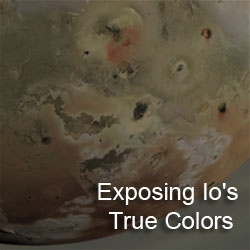
- I want to thank Emily Lakdawalla for re-publishing my post on Io's true-color processing. She even dug up a nice chart showing the spectral curves of the cones in your retinas :)
- Finally, Björn Jónsson created a nice, 12-frame color mosaic from Voyager 1 data of Jupiter. Very nice! I hope he posts more.
Link: ALPO-Japan's Jupiter Section [alpo-j.asahikawa-med.ac.jp]
Wednesday, June 16, 2010
No Debris Field from the June 3 Impact
A new set of images of Jupiter, taken a few days after the June 3 impact of a small asteroid or comet, was released on the website for the Hubble Space Telescope today. The research group, which includes Mike Wong, Heidi Hammel, and Amy Simon-Miller, focused on finding a small debris field that might have resulted from the impact, similar to the ones seen from last year's asteroid impact and the Shoemaker-Levy 9 impacts in July 1994.
To date, no such debris field has been spotted by amateur, ground-based telescopes, but it had been hoped that with Hubble's superior resolution, it might be able to spot a small, dark spot from the impact. Instead, as you can see above, even with Hubble's larger eyes, no impact scar is visible. This suggests that the impactor was too small to penetrate very deep into Jupiter's atmosphere, but instead burned up in the upper atmosphere, akin to meteor fireballs on Earth. Since these events are so brief, it is possible that similar Jovian meteors maybe fairly common, but because of their brief duration (< 3 seconds), they just hadn't been noticed before. Leigh Fletcher on his Twitter feed has noted that the Keck, Gemini, and IRTF observatories at Hawaii's Mauna Kea and VLT in Chile have also obtained views of the impact site, so maybe they will be able to spot a residual thermal hotspot from the site. He seems to suggest that no such scar has been seen though.
While it failed to detect an impact scar from the Jovian meteor, the Hubble data was able to provide images of the changes that have occurred in Jupiter's atmosphere over the last six months. The South Equatorial Belt (SEB), normally the reddish-brown southern complement to the similar North Equatorial Belt (NEB) which bracket the bright Equatorial Zone (EZ), brightened during the end of 2009. From ground-based scopes, this makes Jupiter appear as if it only has one dark belt, as opposed to the normal two. This also makes the Great Red Spot more visible since it is surrounded by mostly bright clouds. Hubble detected a high-altitude layer of ammonia clouds over the SEB, obscuring the darker clouds below. The Hubble image also points to the beginning of the end for these high clouds, as a series of dark spots along the southern margin of the SEB were also seen. Similar spots were seen near the end of earlier SEB brightenings.
Link: Hubble - Mysterious Flash on Jupiter Left No Debris Cloud [www.hubblesite.org]
To date, no such debris field has been spotted by amateur, ground-based telescopes, but it had been hoped that with Hubble's superior resolution, it might be able to spot a small, dark spot from the impact. Instead, as you can see above, even with Hubble's larger eyes, no impact scar is visible. This suggests that the impactor was too small to penetrate very deep into Jupiter's atmosphere, but instead burned up in the upper atmosphere, akin to meteor fireballs on Earth. Since these events are so brief, it is possible that similar Jovian meteors maybe fairly common, but because of their brief duration (< 3 seconds), they just hadn't been noticed before. Leigh Fletcher on his Twitter feed has noted that the Keck, Gemini, and IRTF observatories at Hawaii's Mauna Kea and VLT in Chile have also obtained views of the impact site, so maybe they will be able to spot a residual thermal hotspot from the site. He seems to suggest that no such scar has been seen though.
While it failed to detect an impact scar from the Jovian meteor, the Hubble data was able to provide images of the changes that have occurred in Jupiter's atmosphere over the last six months. The South Equatorial Belt (SEB), normally the reddish-brown southern complement to the similar North Equatorial Belt (NEB) which bracket the bright Equatorial Zone (EZ), brightened during the end of 2009. From ground-based scopes, this makes Jupiter appear as if it only has one dark belt, as opposed to the normal two. This also makes the Great Red Spot more visible since it is surrounded by mostly bright clouds. Hubble detected a high-altitude layer of ammonia clouds over the SEB, obscuring the darker clouds below. The Hubble image also points to the beginning of the end for these high clouds, as a series of dark spots along the southern margin of the SEB were also seen. Similar spots were seen near the end of earlier SEB brightenings.
Link: Hubble - Mysterious Flash on Jupiter Left No Debris Cloud [www.hubblesite.org]
Friday, June 4, 2010
Latest on Yesterday's Jupiter Impact
Yesterday at 20:31:29 UTC, astronomers Anthony Wesley and Christopher Go observed a bright flash within Jupiter's faded south equatorial belt. This bright flash is thought to be the fireball of an impacting meteor in Jupiter's upper atmosphere. Since the impact, both astronomers have posted videos and processed images online showing this flash. Wesley's images and video have been posted to his website. The link to his video is at the bottom of the page. Note that his video is an AVI container and you may have issues viewing it in Windows Media Player. It played just fine in VLC. Additional news from Wesley going forward maybe posted on the Ice in Space forum first. Christopher Go has posted processed images and video on his website.
The question now is whether this impact left a dark scar like the Shoemaker-Levy 9 impacts in 1994 and the July 2009 asteroid impact. Gary Spiers posted times when the impact site cross the central meridian as viewed from Earth on his blog. The first opportunity at 5:04 UTC was imaged in western and southern Europe by several observers. While the seeing wasn't as good as what those further south like Wesley and Go obtained the previous Jovian day, they don't seem to show any sign of an impact scar. A summary by John Rogers of the British Astronomical Association has been posted on ALPO-Japan with several "after" images from the UK, France, and Italy. The next opportunity at 15:00 UTC was observed by several observatories on Mauna Kea in Hawaii (Gemini, Keck, and IRTF), according to Leigh Fletcher (who was involved in the followup observations at Mauna Kea after last year's impact) on Twitter. No results have been posted yet, so hopefully their keener eyes will be able to spot a small impact scar.
Link: Anthony Wesley's 2010 Jupiter Impact Page [jupiter.samba.org]
Link: Christopher Go's Jupiter Imaging site [jupiter.cstoneind.com]
Link: New impact on Jupiter before & after by John H.Rogers [alpo-j.asahikawa-med.ac.jp]
The question now is whether this impact left a dark scar like the Shoemaker-Levy 9 impacts in 1994 and the July 2009 asteroid impact. Gary Spiers posted times when the impact site cross the central meridian as viewed from Earth on his blog. The first opportunity at 5:04 UTC was imaged in western and southern Europe by several observers. While the seeing wasn't as good as what those further south like Wesley and Go obtained the previous Jovian day, they don't seem to show any sign of an impact scar. A summary by John Rogers of the British Astronomical Association has been posted on ALPO-Japan with several "after" images from the UK, France, and Italy. The next opportunity at 15:00 UTC was observed by several observatories on Mauna Kea in Hawaii (Gemini, Keck, and IRTF), according to Leigh Fletcher (who was involved in the followup observations at Mauna Kea after last year's impact) on Twitter. No results have been posted yet, so hopefully their keener eyes will be able to spot a small impact scar.
Link: Anthony Wesley's 2010 Jupiter Impact Page [jupiter.samba.org]
Link: Christopher Go's Jupiter Imaging site [jupiter.cstoneind.com]
Link: New impact on Jupiter before & after by John H.Rogers [alpo-j.asahikawa-med.ac.jp]
Thursday, June 3, 2010
Meteor fireball spotted in Jupiter's Atmosphere
Less than a year after he first spotted an impact scar on Jupiter's south polar region, astronomer Anthony Wesley spotted a bright flash at 20:30 UTC today (about three hours ago from the time of this post) that lasted about 2 seconds in Jupiter's faded south equatorial belt. The brightness of the flash indicates that it was mostly likely caused by a small asteroid or comet striking Jupiter's upper atmosphere and burning up. Wesley indicates that don't seem to be any markings left by the impact, like those seen after the SL9 impacts in 1994 and last July's impact, though it occurred late in the day at the impact site, and we may not see anything until the area rotates into view three hours from now.
The original thread where Wesley posted this image is located at the Ice in Space web forum. He plans to post a video of the impact in the next few hours as well. I want to give a tip o' the hat to Emily Lakdawalla for alerting us to this observation on her blog. Coincidentally, she points out that the Hubble telescope team has released several images of the site of last year's impact, as the scar became sheared by the planets's winds.
Another place to check for up-to-date news on this is at the Unmannedspaceflight.com forum, where several regulars are already discussing the impact.
UPDATE 5:18 PM MST: A video by Christopher Go in the Philippines is now online. Didn't seem to last very long.
Link: Jupiter impact, June 3 2010 [www.iceinspace.com.au]
The original thread where Wesley posted this image is located at the Ice in Space web forum. He plans to post a video of the impact in the next few hours as well. I want to give a tip o' the hat to Emily Lakdawalla for alerting us to this observation on her blog. Coincidentally, she points out that the Hubble telescope team has released several images of the site of last year's impact, as the scar became sheared by the planets's winds.
Another place to check for up-to-date news on this is at the Unmannedspaceflight.com forum, where several regulars are already discussing the impact.
UPDATE 5:18 PM MST: A video by Christopher Go in the Philippines is now online. Didn't seem to last very long.
Link: Jupiter impact, June 3 2010 [www.iceinspace.com.au]
Friday, September 11, 2009
New Hubble Images of Jupiter
On Wednesday, NASA released a number of images acquired by the Hubble Space Telescope as part of its re-commissioning period following the Shuttle Repair and Service mission back in May. One of the images released is a full-disk color image of Jupiter taken four days after the impact of a ~0.3 kilometer (330-yard) wide comet or asteroid in the giant planet's south polar region. The temporary impact scar can be seen as dark splotch at bottom right. A portion of this image was released back in July as part of the global campaign to monitor the impact scar. In addition to the impact scar, this image also shows some beautiful atmospheric waves in Jupiter's northern hemisphere.Another great image released by the Hubble team shows the Butterfly Nebula as captured by the new Wide Field Camera 3. The image shows the glowing gas and dust cast off by the dying star at the center of the image (unseen because of the large amount of dust between the star and us). Very striking!
Link: Collision Leaves Giant Jupiter Bruised [www.hubblesite.org]
Monday, July 20, 2009
Jupiter Impact Confirmed by IRTF
The impact of a small asteroid or comet into Jupiter's atmosphere, first observed by astronomer Anthony Wesley (let's be honest, anyone who takes the kinds of pictures he does of Jupiter is not an amateur), has been confirmed in observations taken by NASA's Infrared Telescope Facility (IRTF) atop Mauna Kea on the island of Hawaii. The image shown at left reveals the impact to be glowing quite brightly in the near-IR, in a methane absorption band at 1.65 micronsBased on additional images taken by ground-based telescopes, the impactor came in from below Jupiter, striking the South polar region sometime between 07:00 and 14:11 UTC on Jupiter's nightside. Several dark spots in addition to the main impact site are visible with a faint, fan-like plume deposit to the west and north of the impact site. Similar plume deposits were seen at Shoemaker-Levy 9 impacts 15 years ago this week in 1994.
EDIT 07/20/2009 06:23 PM: New Scientist has an article with an image taken by Keck II. The IR data from Keck seems to suggest the possibility of multiple impactors.
EDIT 07/20/2009 11:33 PM: Looks like the image from Keck II in the New Scientist article is a bit of a double exposure, making it look like multiple impact sites.
In case you missed it, an hour ago I posted some of my thoughts on this, the 40th Anniversary of the Apollo 11 landing. Don't forget to post a comment there about when you think the first humans will land on Io (never is a possible answer, but not one I necessarily agree with).
Link: New NASA Images Indicate Object Hits Jupiter [jpl.nasa.gov]
Filed Under:
Astronomy,
Astrophotography,
Impacts,
Jupiter
Sunday, July 19, 2009
Impact observed on Jupiter
15 years ago, the world watched as broken-apart comet Shoemaker-Levy 9 impacted Jupiter's atmosphere in a series of event in July 1994. Well, a similar event seems to have occurred in the last day in Jupiter's south polar region. A new dark spot, similar in size and color to the Shoemaker-Levy 9 impacts was seen by ground-based observers on July 19.Hopefully more observations will be acquired over the next few days to help confirm this discovery, but it looks quite plausible to me :)
The image at left was captured by Anthony Wesley on 19th July 2009 at 1554UTC from Murrumbateman Australia. The south pole is up, north pole down. The impact site is near the central meridian about an eighth of the way down.
EDIT 07/19/2009 9:23 PM: Wesley's website has been slashdotted so he has mirrored the page to another server. So if you are having trouble accessing the link above, check out http://jupiter.samba.org/
Filed Under:
Astronomy,
Astrophotography,
Impacts,
Jupiter
Subscribe to:
Posts (Atom)