Showing posts with label Loki. Show all posts

Friday, June 4, 2010

Paper: Ground-based observations of the variability of Io's volcanoes

Today, a new paper was published "in press" (accepted and revised, but not yet in a paper issue) in the journal Icarus titled, "Ground-based observations of time-variability in multiple active volcanoes on Io" by Julie Rathbun and John Spencer.  In this paper, the two authors summarize the results they obtained by observing Io using NASA's Infrared Telescope Facility on more than 100 occasions between June 1997 and the end of 2005.  They focus on variations in the thermal output of three volcanoes: Loki, Kanehekili, and Janus, as well as output from smaller volcanic centers like Grian Patera.

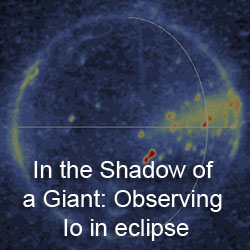
For their analysis, Rathbun and Spencer observed Io in the near-infrared at 2.26, 3.5, and 4.68 microns both in disk-resolved images while Io was in Jupiter's shadow and in sunlight.  An example of an image taken while Io was in sunlight is shown at left.  It was taken in November 1999 when the volcano Tvashtar Paterae erupted (seen much closer up by Galileo).  In both cases (in eclipse and in sunlight), the spatial resolution of the observation is generally too low to pick up any but the brightest hotspots.  The authors also measured the brightness at 3.5 microns of an eclipsed Io as it passed behind the dark limb of Jupiter.  By noting the times when dips in the occultation light curve occurred, caused by Jupiter occulting a volcanic hotspot, the authors were able to constrain the location and intensity of an erupting volcano.  Unfortunately, these would be one-dimensional fits of Jupiter's limb projected on the surface of Io.  This method is also limited to finding hotspots on Io's Jupiter-facing hemisphere.

Three of the most persistent hotspots on the sub-Jupiter hemisphere are Loki, Kanehekili, and Janus.  Rathbun and Spencer used their eight-year span of ground-based observations to chart variations in the amount of energy (in terms of Gigawatts) output by these volcanoes.  Loki, Io's most powerful volcano, experienced periodic increases in power output between 1990 and 2001.  In 2002, Rathbun and her colleagues suggested that this periodicity was due to a crust over a large lava lake foundering after becoming too thick, starting a wave of overturning crust that spreads counter-clockwise around the patera starting from the southwest corner of the volcano.  However, the authors note in this paper that this pattern ended after 2001 (around the time Rathbun published her paper describing the periodicity) as Loki's power output leveled out in 2001-2002 a bit below the average between the earlier active and inactive episodes, before weakening between 2005 and 2007.  Their extended history of Loki observations suggests that there have been no brightening events since 2001.  The authors concluded that the measured brightness of Loki at 3.5 microns, and the derived brightness at 2.26 and 4.68 microns (taken by subtracting the total power output of Io in eclipse when Loki is shown by the occultation data to be inactive from the power output of Io when Loki is active) is consistent with the author's thermal model of Loki.

Kanehekili and Janus are two volcanoes on Io's leading hemisphere located within Media Regio.  Ground-based observations by Rathbun and Spencer were unable to distinguish activity between these volcanoes are their proximity and Galileo observations of both of them as persistently-active volcanoes. The authors found that the 3.5 micron brightness of the region containing Janus and Kanehekili remained fairly consistent between 1996 and 1998 at a level similar to that of Loki in 2003 and 2004, before trending downward.  A significant increase was observed early in 2002, though the authors couldn't distinguish between an increase in activity at either volcano, or another volcano at that longitude.  I will point out that Marchis et al. 2005 observed a fairly bright hotspot at Janus in December 2001 using the Keck telescope, a few months prior to the Rathtbun and Spencer observations, and a very powerful eruption at Janus in January 2003.  Combined with the observations of variations in the brightness of Janus and Kanehekili at shorter wavelengths by Galileo SSI and NIMS noted by Rathbun and Spencer, this indicates that the high-temperature component of the eruptions at these two volcanoes can vary greatly, even if the lower-temperature one stays comparatively consistent.

Finally, the authors examined shorter-lived volcanic eruptions from other sources they found in their data.  These sources show significant variations in 3.5 micron brightness from near the background brightness to some of the brightest events seen in their decade of observing, such as an eruption of Grian Patera in June 1999.  The observed variations are consistent with non-persistent volcanic activity creating fresh, cooling lava that emits light in the near-infrared.  The authors noted weaker variations were observed in the mid-infrared by the PPR instrument on Galileo, which was sensitive to cooler, older lava flows.

Link: Ground-based observations of time-variability in multiple active volcanoes on Io [dx.doi.org]

Friday, January 29, 2010

LPSC 2010: Heat Flow from Dark Paterae Floors

Last Wednesday, the abstracts for this year's Lunar and Planetary Science Conference were posted online and since then I have been discussing a few of these abstracts here on this blog, including ones on the new global geologic map to the stability of patera margin slopes.  Today we are going to take a quick look at an abstract by Glenn Veeder, Ashley Davies, Dennis Matson, Torrence Johnson, Dave Williams, and Jani Radebaugh titled, "Io: The Dark Paterae Component of Heat Flow".  In this abstract, the authors discuss new thermal modeling work based Galileo NIMS, SSI, and PPR infrared data and the USGS global basemap.  This modeling was done to determine the contribution to Io's heat flow made by dark material on the floor of volcanic depressions known as paterae.

Io's total heat flow, ~9.5×10¹³ W, has been measured from disk-integrated, ground-based IRTF data along with incomplete global data from Voyager IRIS and Galileo PPR.  Galileo's SSI camera and NIMS near-infrared spectrometer acquired more complete global data (except over the polar regions), providing information on current or recently active volcanoes, but most of Io's heat flow is released at much longer infrared wavelengths from cooling lava flows, wavelengths IRTF, IRIS, and PPR were sensitive to.  To inventory how Io's internal heat is released, the authors created a thermal model to estimate the amount of total energy released by volcanoes that are either outside of the terrain covered by IRIS or PPR, or were too small for those instruments to detect.  In 2008 and 2009, this same group examined the contribution to Io's total heat flow from dark lava flows on the plains of Io (e.g. Amirani), both at LPSC in March 2008 and in a paper published in November 2009.

For this research, the authors mapped the distribution of dark paterae floor materials across Io's surface and measured their areas.  In total they found a total of 148,000 square kilometers, which is about 0.4% of Io's total surface area or a little less than the "dark patera floor" unit mapped by Williams et al.  The authors found that the distribution of dark patera floor material has a similar bimodal distribution in longitude (with peaks near 130° W and 315° W) as paterae in general.

Of the total mapped area, 30,500 km2 are composed of a combination of Io's two largest dark floored paterae, Loki Patera (shown above) and Dazhbog Patera.  The authors then took the areas of this dark patera floor material and using an effective temperature of that material, estimated their total power output.  The total average power output of these two volcanoes was modeled to be 9.6×10¹² W and 4.0×10¹² W, respectively.  In the case of Loki, this is 10% of Io's total heat flow.  Both modeled power outputs are close to the measurements made by PPR.  The other areas of dark paterae floor material account for six times that seen at Loki Patera, Io's most powerful volcano.

The abstract is part of research into how Io's internal heat is released, i.e. what heat sources make up Io's global heat flow.  Assuming the same effective temperature for all these materials as Loki, dark paterae would account for 70% of Io's total heat flow (compared to 5% for dark flow fields on the Ionian plains like Masubi or Amirani).  This makes dark paterae floor materials the most significant contributors to Io's heat flow. 

Link: Io: The Dark Paterae Component of Heat Flow [www.lpi.usra.edu]

Friday, September 18, 2009

Io Talks at DPS 2009

The science program as well as the abstracts for this year's DPS meeting were posted online a few weeks ago. DPS 2009 will be taking place in Fajardo, Puerto Rico, and as such, I won't be going. Hopefully the organizers will be able to broadcast the meeting oral sessions like they did for last year's meeting, but I guess that will depend on the infrastructure at the El Conquistador Resort. The webcasts last year allowed me to post about each of the Io talks here on this blog.

The 2009 Meeting of the Division of Planetary Sciences will be held between October 4 and 9, 2009.

In this year's science program, there are four Io talks and one poster planned. All four Io talks will be held during the Galilean Satellites oral session on the afternoon of Friday, October 9. The Io-related poster will be in the Decadal Survey White Papers section during the poster session on the evening of Tuesday, October 6. Here is a brief summary of the talks and posters to be presented:
EDIT 09/19/2009 4:17 pm: Fixed links to abstracts...hopefully...  If you are having trouble with the links, just go to the two sessions with Io talks and posters and click the links their for the abstracts: Galilean satellites oral session and Decadal Survey White Papers poster session.

Link: DPS 2009 Meeting [dps09.naic.edu]

Wednesday, October 15, 2008

Io DPS Talks

The Galilean Satellites session at the DPS meeting was held this morning in Ithaca, New York. The talks were also online as a webcast, allowing me to view (and all of you) to view the talks despite not being at the conference. The talks mostly focused on the icy satellites of Jupiter, particularly Europa and Ganymede, but two talks covered Io specifically. The first was given by Julie Rathbun (with co-author John Spencer) and was titled, "Loki, Io: Fitting a lava lake model to Eclipse Observations" (link takes you the abstract). The second was given by Nick Schneider (with coauthors C. Grava and C. Barbieri) and was titled, "Unusual Velocity Structures of Neutral Sodium Near Io's Wake."

Rathbun presented ground-based data of Io at multiple wavelengths in the near-infrared portion of the spectrum. This was done to see if the lava lake crust floundering model for Loki's eruption behavior was supported using multi-wavelength observations.

Ground-based observers have been monitoring activity at Loki Patera, the largest volcanic depression on Io, since 1988. This observation campaign has revealed that Loki goes through a cycle of activity, with periods of high-thermal emission (also called brightenings) and low emission. The Rathbun model suggests that this cycle is related to the style of activity at Loki. She (and her co-authors) propose that Loki Patera is a large lava lake, a depression filled with molten lava and covered by a thin crust of porous, solidified lava. Over time, this crust thickens to the point where the crust starts to collapse. This collapse occurs as a wave, moving from the southwest margin of the patera then counter-clockwise around the interior "island" to the northwest margin. A new thin crust forms behind this collapse wave, and is allowed to thicken until it is no longer bouyant over the molten lava below.

To test to see if this model is supported at multiple wavelengths, Rathbun examined disk-resolved Io images taken at NASA's Infrared Telescope Facility (IRTF) at 2.26 μm and 4.78 μm (similar to the image at right), to go along with the 3.5 μm observations used to develop their lava lake model. Using the model, which takes into account the average duration of a brightening event and the average peak 3.5 μm brightness during these events, they can predict the brightness of Loki at the other two wavelengths and the amount of power output in Gigawatts per micron per steradian. For the 3.5 μm observations, Rathbun and Spencer used occultation light curves, disk-integrated measurements of Io's brightness as it either leaves or enters Jupiter's shadow. Knowing the position of Io and the timing of these measurements, the authors can extract a position for any thermal emission source seen in the lightcurves.

For the disk-resolved images at the other two wavelengths, Rathbun and Spencer had to subtract the contribution from the other volcanoes on the sub-Jovian hemisphere to obtain an estimate for the brightness of Loki. Rathbun accomplished this by comparing global brightness measurements derived from the IRTF images between periods when Loki was active and when it was inactive. By subtracting the average global brightness between those two periods, she could get an estimate of Loki's average brightness during a brightening at 2.26 μm and 4.78 μm. The estimates had pretty large error bars, but the estimates seem to fit the predicted values from her lava lake model. This technique was also performed with IRTF observations at 3.5 μm, and they fit the occultation light curve measurements.

Rathbun and Spencer plan to compare the 2.26 μm estimates to a couple of lightcurve measurements at 2.2 μm accomplished during the Galileo mission. They also plan to look at the individual observations from the Galileo era when they had great temporal resolution.

The other talk, by Nick Schnieder, covered "Unusual Velocity Structures near Io's Wake." Io's atmosphere (and ultimately its volcanoes) supplies material for various structures in Jupiter's magnetosphere. Schneider used a spectrograph at the Telescopio Nationale Galileo in the Canary Islands to observe the various escape features for sodium in the banana-shaped neutral cloud that surrounds Io as Io went into and out of Jupiter's shadow. These include streams of fast moving sodium atoms from the neutral cloud and jets of sodium from Io's ionosphere. Schneider's observations revealed an additional escape mechanism. In this case, sodium jets away from Io toward Jupiter at only 15 km/sec. This suggests the sodium originates on the Jupiter-facing hemisphere and is perhaps limited to the leading hemisphere. How these jets are generated has not been determined. However, this new sodium features may provide a new way to study Io's volcanism, atmosphere, and plasma environment from Earth.

That finishes up the Io talks for DPS. Hopefully, AGU and next LPSC will provide more geology ;)

Tuesday, September 16, 2008

Io at DPS

The abstracts for next month's Division of Planetary Sciences Meeting are now online. Several talks and posters are about everyone's favorite moon. The abstracts for DPS (and the upcoming AGU meeting in December) are much shorter than those submitted for LPSC, which would be better described as mini-papers. So there is less to say about the abstracts themselves. A few abstracts do stand out:
  • Julie Rathbun and John Spencer have a talk scheduled for the morning of October 15 titled, "Io Eclipse Observations: Determining the History of Loki’s Flux at Multiple Wavelengths." The abstract just summarizes Loki's importance to Io's total heat flux and Rathbun and Spencer's theory for Loki's observed activity. The talk will cover their work on separating Loki's contribution to the observed heat flux from the other volcanoes on the sub-Jovian hemisphere. They will then discuss Loki's extracted brightness at three wavelengths in the near-infrared.
  • Erinna Chen et al. will present a poster covering her group's summer school Team X project, a New Frontiers-class Io mission concept. The mission, which they call Argus, would use a high-inclination orbit around Jupiter and would flyby Io at least 40 times. The mission would use Advanced Stirling Radioisotope Generators (ASRG) as a power source, pushing the mission to after Discovery 2013. The payload included in the study would consist of a narrow-angle camera, a thermal imager, an NIR spectrometer, a UV spectrometer, and an INMS-like instrument, similar to the IVO Discovery mission concept, but with more advanced instrumentation and 4-10 times the number of Io flybys, so presumably the increased cost between the Discovery mission concept and this New Frontiers mission would be taken up in increased payload size and radiation shielding.
While I will not be at the conference, I am a co-author on three abstracts: "Evidence for Past Lake-Level Change in Titan's Ontario Lacus" by Jason Barnes et al., "Tiger Stripes and Cassini ISS High-Resolution Imaging of Enceladus" by Paul Helfenstein et al., and "Cassini Imaging Observations of Titan’s High-Latitude Lakes" by Elizabeth Turtle et al. Of these, I spent the most time working on the last one, and includes the coolest discovery we have made at Titan from Cassini images:
Differences between the two ISS observations may be due to changes on the surface as a result of precipitation from a large cloud system observed in Fall 2004 (Schaller et al., 2006), although diffuse clouds or atmospheric scattering could also play a role.
The meeting will occur between October 10-15 in Ithaca, New York on the Cornell University campus.

Link: Division of Planetary Sciences Meeting 2008 [dps08.astro.cornell.edu]

Sunday, March 9, 2008

LPSC 2008: Io Eclipse Observations

Julie Rathbun and John Spencer have a poster a this week's Lunar and Planetary Sciences Conference entitled, "Io Eclipse Observations: Does Loki Dominate Io's Infrared Flux?"

Rathbun has published a few papers over the last few years on the episodic brightening experienced at Loki and what these brightenings might tell us about the Loki's eruption style. The conclusion she reached in her 2006 paper "Loki, Io: New ground-based observations and a model describing the change from periodic overturn" is that Loki Patera is a periodically overturning lava lake. According to the model presented in that paper, the surface of the Loki lava lake founders when it has cooled and thickened to the point that is negatively buoyant compared to the lava below. The time between this episodic overturning of the lava lake crust varies depending on the amount of vesicles (basically gas bubbles) within the lava crust. Essentially, the more vesicles within the lava crust, the less dense it becomes, and thus the longer it takes since the last brightening before the crust overturns again. As I mentioned in a previous blog post, Rathbun's overturning lava lake model isn't the only one published to explain Loki's behavior.

This attention focused on Loki is the result of its apparent dominance of Io's thermal flux. Rathbun and Spencer examine data taken by NASA's Infrared Telescope Facility atop Mauna Kea in Hawaii to see if Loki does in fact dominate Io's thermal flux when it is observed in eclipse. When researchers observe Io at this facility, they observe it when Io is in eclipse so they can separate flux from reflected sunlight and thermal flux from the satellite's volcanoes. If they observe Io during an occultation just as it is going behind Jupiter, or just egresses from behind Jupiter (depending on when it is in eclipse), they can measure the moon's thermal flux as it more or less of the satellite is hidden behind Jupiter. This method can help pinpoint the location of hotspots on Io's surface. Measurements were also taken of Io's full-disk while the satellite was in eclipse. Such measurements were performed at more wavelengths but their low resolution makes it difficult to pinpoint the location of individual hotspots.

Using a model Rathbun et al. developed in 2006, the authors predict Loki's brightness at 2.2 and 4.8 micron based on the volcano's brightness at 3.5 microns and the duration of the eruption episode. They determined that the 2.2 microns brightness is a close match, but they assumed that the entire thermal flux from Io at 2.2 microns came from Loki. The authors indicate that they will look at the occultation data to determine the percentage of the flux from other volcanic eruptions in order to see just how much Loki dominates Io's thermal flux.

Link: Io Eclipse Observations: Does Loki Dominate Io's Infrared Flux? [www.lpi.usra.edu]

Monday, February 25, 2008

Lava lakes on Io: New perspectives from modeling

Tracy Gregg and Rosaly Lopes have a new paper in the March issue of Icarus titled, "Lava lakes on Io: New perspectives from modeling." The paper provides a possible model for the volcanism observed at Loki Patera (shown at left from images taken by Galileo's SSI and NIMS instruments). Previous models by Davies et al. and Rathbun et al. suggested that the episodic activity was the result of lava flows spreading out from a fissure and an overturning lava lake, respectively. The lava lake hypothesis has gained particular currency among the Iophile community over the last few years, particularly its ability to explain the distribution of thermal sources as seen by NIMS.

Gregg and Lopes, in their paper, point out a few problems with both models. In the first, wherein lava flows spread out from a fissure, the lack of overflowing lava despite repeated eruption episodes over the last 20 years is a concern. In the second, the difference in scale between terrestrial lava lakes (most are on the order of 100 meters across) and Loki (approximately 200 km across) is an issue. The authors point out several other issues, including the scale of magma reservoir needed and the thermally patchy nature of the patera floor.

The authors instead propose the following model for Loki Patera: 1) Magma is fed into a thin (10s-100s meters thick) chamber from a tidally heated source deep beneath Loki; 2) When this chamber is filled, magma travels up a conduit a few km long (assuming relatively low surface porosity) and into a fissure along the southwestern margin of the patera; 3) The lava then flows out from the fissure into pre-existing lava tubes or covered-over lava channels, travelling out from the fissure across the rest of the patera; 4) The lava ends up being intruded into the country rock of the patera floor (rather than flowing along the surface as lava flows) or fills lava ponds along the patera margin; 5) The eruption episode ends when the magma chamber is emptied and the lava in the fissure trench drains back down. The authors suggest that the eruption style at Loki is roughly analogous to eruptions along the East Pacific Rise.

This model is consistent with observations obtained of Loki. The thermal wave seen by ground-based observers and NIMS would be produced by heat conducted up from the lava tubes to the patera floor. The hotspot along the southeastern margin of the patera represents the location of the fissure. The other hotspots along the patera margin and along the margin of the "island" on the floor of Loki likely represent lava ponds where lava has collected at a topographic obstacle. The corresponding darkening wave at visible wavelengths seen along the patera floor by Voyager 1 and 2, rather than being the result of lava flowing across the surface or new crust in an overturning lava lake, is the result of volatiles being driven off a surface that is heated from below by lava flowing through lava tubes.

This is certainly a very interesting model for Loki as it explains the lower temperature measured by NIMS and PPR compared to eruptions at other volcanoes on Io and the lack of lava overflowing the patera margin. I think the lava lake model works best for smaller volcanoes like Pele and the southeastern portion of Gish Bar Patera, where the difference in size between terrestrial and Ionian lava lakes wouldn't be so great. It would be interesting to see how well this model might work for other inter-patera flows, like the main floor of Gish Bar or Emakong Patera.

Link: Lava lakes on Io: New perspectives from modeling [dx.doi.org]