Showing posts with label Cassini. Show all posts

Tuesday, February 23, 2010

Budgets, Carnivals, and Cryovolcanoes, Oh My!

Here are some short little news items that are hitting the interplanetary interwebs today:
  • Ian Musgrave's Astroblog is this week's host for the Carnival of Space, #142 of its name.  The Carnival of Space is a collection of links to the best space blog posts from the week that was.  In this edition, learn about the launch of the Solar Dynamics Observatory, the (then) ongoing STS-130 shuttle mission to install the Cupola at the International Space Station, and why the oxidation of iron creates a positive spectral slope in the visible (aka, "Why is rust red?").
  • Today, the Cassini Imaging and the Composite Infrared Spectrometer (CIRS) teams released a series of images from the November 21 encounter with Enceladus, a cryovolcanically active moon of Saturn.  This set of images includes some awesome mosaics, including one showing a series of water-rich jets erupting from fractures within the moon's south polar region and another combined with CIRS data to show thermal emission from one of these fractures, Baghdad Sulcus.  Also don't forget to check out two mosaics of Enceladus' leading hemisphere, an area not seen at high-resolution previously, and an 3D anaglyph (don't forget your red-blue 3D glasses) of a portion of Baghdad Sulcus.
  • Yesterday, NASA released further details on its proposed budget for the next fiscal year, FY2011, including the breakdown for Planetary Science.  Overall, the next year will see budget increases for the Planetary program with out-years showing shallower increases, that according to Van Kane, would barely cover inflation, possibly decreasing the budget's purchasing power. The Mars program and precursor missions (mostly Lunar) will see major increases, with more modest increases over the five projected years for the Outer Planets Program (Cassini, EJSM, and ROSES, a research grant program).  Until FY2013, the budget is inline with the project needs of the Europa/Jupiter System Mission for its Phase Pre-A and A when studies will be conducted to mitigate the radiation risk further, instruments selected using an Announcement of Opportunity, and the preliminary concept design finalized.  Starting with Phase B in FY2014, the budget does start to deviate from what is required for JEO, staying in the $150 million range when it should closer to $300 million (or $425 million if one includes reserves) in FY2014 and $400 million (or $600 million if one includes reserves) in FY2015.  While a bit discouraging, keep in mind that budget projections for years so far out are...very sketchy.  I don't trust them any farther than I can throw them; who knows who could be in the White House at that point.
Link: Carnival of Space #142 [astroblogger.blogspot.com]
Link: Enceladus Rev121: Forest of Jets [ciclops.org]
Link: FY11 NASA Budget Proposal Details [futureplanets.blogspot.com]

Tuesday, November 10, 2009

A Few Quick Notes

I am going to try to writeup that Io Chemistry post up tonight or tomorrow morning, but in the meantime, here are a few quick notes.  First, the Carnival of Space #128 is now up at the AART Scope Blog.  Check it out to see what has been going on in the world of astronomy and space science this past week.  Second, ugordan over at Unmannedspaceflight.com has posted a few newly processed images from the Cassini flyby of Jupiter.  Some nice false color of the Pele and Tvashtar plumes.

Tuesday, February 10, 2009

LPSC 2009: Volcano Temperature Estimates from Cassini Data

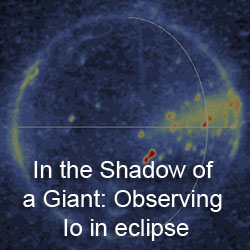
Continuing our series on the Io abstracts for this year's Lunar and Planetary Science Conference, we now take a look at "Ionian Volcanoes Reveal Their Temperatures" by Daniel Allen and Jani Radebaugh. The authors took a look at Cassini's eclipse images of Io from that spacecraft's December 2000 encounter with Jupiter and measured the color temperature of several of the hotspots that were visible.

In late December 2000, the Cassini spacecraft conducted a distant flyby of Jupiter on its way to Saturn. While the data acquired by Cassini had much lower spatial resolution than most of the images acquired by Galileo, the greater data volume provided by Cassini's working high-gain antenna allowed Cassini to acquire images with higher temporal resolution. The abstract mentions that more than 500 images were acquired during three Io eclipses with a resolution of 61 km/pixel. These images revealed a number of features visible in higher spatial resolution Galileo data, including atmospheric emissions such as the bright equatorial aurorae and a fainter halo surrounding Io. They also revealed several hotspots, the most prominent of which is Pele. Radebaugh et al. (2004) used the ratio of the pixel values from clear and near-infrared (IR4; 975 nm) filter data to determine the color temperature of Pele, measured at 1500 ± 80 K, consistent with other datasets from Galileo.

Allen and Radebaugh have now gone back and performed similar analysis on three other volcanoes in the Cassini ISS data: Loki, Wayland, and Pillan. All three are much fainter than Pele and this decreases the signal-to-noise ratio of the resulting measurements and the error bars, compared to the earlier Pele measurements. The authors averaged the pixel values of a 5x5 box around each hotspots in both IR4 and CLR filter data, subtracted the background DN level, and then calculated the CLR/IR4 ratio. Using a blackbody response curve, the authors could then correlate their ratio calculations with color temperature in kelvins. They found temperatures of 1384 ± 238 K for Pillan, 1249 ± 148 K for Wayland, and 1409 ± 225 K for Loki. That latter temperature is actually higher than most previous temperature measurements at Loki.

The authors also tried to look at the trend in the CLR/IR4 ratio with emission angle for each volcano. Emission angle is an angle measure of the distance from the sub-spacecraft point with 0° at nadir and 90° at the limb. If a volcano has a significant vertical component, such as from a lava fountain, the color temperature should increase as the more foreshortened view of an surface flows should decrease the low temperature component and the more straight on view of the lava fountain should help to increase the amount of high-temperature lava seen by the detector. If a hotspot has no vertical component, then the color temperature should decrease as the more foreshortened view of surface flows prevents Cassini from sensing warmer lava visible through cracks in the lava crust. The plot shown in the abstract for Pillan is pretty noisy due to the low signal-to-noise ratio, but it seems to suggest that color temperature decreases as emission angle increases, indicating that there is no significant vertical component.

The authors again present this as a work-in-progress (then again, what LPSC poster isn't). They hope to continue their work comparing color temperature to emission angle with the idea of better constraining eruption styles at the fainter hotspots seen by Cassini.

Link: Ionian Volcanoes Reveal Their Temperatures [www.lpi.usra.edu]

Wednesday, March 12, 2008

Little Bits 'O the Day - March 12, 2008

A few random items for today: