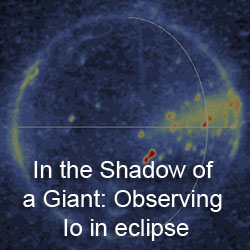
On Friday, I posted a note about Franck Marchis' observations of Io using the Keck Telescope's adaptive optics system on June 28, 2010. These observations allow us to sneak a peek at the ongoing volcanic activity on Io's anti-Jovian hemisphere. Their images revealed hot lava at several volcanoes like Pillan Patera (the most intense hotspot seen on that date), Isum Patera, Marduk, Prometheus, and Volund (not Zamama as previously suspected). These hotspots were seen in both 3.8 μm and 4.7 μm wavelength images, in the near infrared. Hotspots were seen in only the 4.7 μm wavelength image, indicative of more cooled lava, at Rata Patera, Culann Patera, near Kurdalagon Patera, Tupan Patera, near a patera at 42.5 South Latitude, 172.5 West Longitude, and at a patera located at 6 degrees South, 190 degrees West. All but the last of these hotspots was seen before by either Galileo or New Horizons as active volcanoes. None of these hotspots were seen in the 2.1 μm image, suggesting that none of these volcanoes were vigorously active on June 28. The 2.1 μm instead showed Io's surface in reflected sunlight. Silicate materials show up as dark in the 2.1 μm image, while sulfurous materials show up as bright.
Now as Franck pointed out, this isn't the most exciting set of results. Save one new hotspot, all the others were seen as active before and none are currently in an outburst phase. But regardless, it is important to observe Io more often to understand what is typical in terms of volcanic activity on the satellite. How often do outbursts occur? You are not going to know that if some observing days reveal none. Exciting, okay, maybe not, but VERY useful.
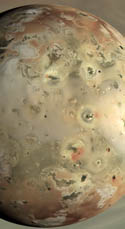
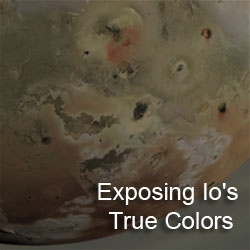
Anyways, I was a bit curious about the one exception to this "boring" fest, the new hotspot at 6 degrees South, 190 degrees West. The patera this hotspot seems to be associated with is 60 kilometers by 45 kilometers in size. The image at left shows various views taken by Galileo during its mission between November 1996 and October 1999. As you can see, no changes were observed at this volcano during the Galileo mission, nor did the volcano look any different in New Horizons images taken in February 2007. While the 2.1 μm image from Keck has a very low resolution (150 km or so), there does seem to be dark spot associated with this volcano that would indicate the emplacement of dark lava, whereas before, the floor of the patera was covered with sulfurous materials.
Very intriguing stuff that at least one volcano on Io seems to have reawakened.
Link: Keck AO Observations: Io Volcanism - “Mornes plaines” [www.cosmicdiary.org]
Showing posts with label Keck. Show all posts
Sunday, July 18, 2010
Friday, July 16, 2010
New Io Data! Hallelujah, praise Jebus!
Believe it or not, but public information on recent volcanic activity on Io has been pretty limited. In fact the last report on Io's volcanic activity that is available to discuss here came during the New Horizons encounter back in late February 2007, more than three years ago. Thankfully, that information drought has finally, mercifully come to an end! Franck Marchis posted on his blog at Cosmic Diary results and images he and one of his undergraduate assistants, Keaton Burns, of Io on June 28.
Using the adaptive optics system on the W.M. Keck II telescope on the Big Island of Hawai'i, Marchis was able to image Io at several near-infrared wavelengths during a break between searching various asteroids for satellites (a project Marchis has previously been quite successful with). On his blog, Marchis posted a set of images taken at 2.1 μm (Kp), 3.8 μm (Lp) and 4.7 μm (Ms) of Io's anti-Jovian hemisphere. The 2.1 μm image shows mostly reflected sunlight, but the other two reveal thermal emission from Io's volcanoes. More volcanoes are visible in the 4.7 μm image because cooler (read older) lava can be detected at longer wavelengths. Both the 3.8 μm and the 4.7 μm images revealed emission at the usual suspects like Marduk, Prometheus, and Zamama, with the most intense hotspot located at Pillan. Looking at the image myself, you can also see additional, fainter hotspots can be seen at Rata, Culann, and Isum, as well as a new hotspot near a volcano at 6 degrees South, 190 degrees West.
I need to head out the door right now, so I will definitely have more when I get back.
Link: Keck AO Observations: Io Volcanism - “Mornes plaines” [www.cosmicdiary.org]
Using the adaptive optics system on the W.M. Keck II telescope on the Big Island of Hawai'i, Marchis was able to image Io at several near-infrared wavelengths during a break between searching various asteroids for satellites (a project Marchis has previously been quite successful with). On his blog, Marchis posted a set of images taken at 2.1 μm (Kp), 3.8 μm (Lp) and 4.7 μm (Ms) of Io's anti-Jovian hemisphere. The 2.1 μm image shows mostly reflected sunlight, but the other two reveal thermal emission from Io's volcanoes. More volcanoes are visible in the 4.7 μm image because cooler (read older) lava can be detected at longer wavelengths. Both the 3.8 μm and the 4.7 μm images revealed emission at the usual suspects like Marduk, Prometheus, and Zamama, with the most intense hotspot located at Pillan. Looking at the image myself, you can also see additional, fainter hotspots can be seen at Rata, Culann, and Isum, as well as a new hotspot near a volcano at 6 degrees South, 190 degrees West.
I need to head out the door right now, so I will definitely have more when I get back.
Link: Keck AO Observations: Io Volcanism - “Mornes plaines” [www.cosmicdiary.org]
Filed Under:
Adaptive Optics,
Franck Marchis,
Keck,
Volcanism
Subscribe to:
Posts (Atom)