Showing posts with label China. Show all posts

Thursday, May 14, 2015

Baidu's Brain & AI's Rise

Although it's incremental, the improving quality of AI is becoming more and more obvious. This Technology Review article is about Chinese search giant Baidu's new super computer, built specifically for massively parallel "deep learning" techniques, advanced neural network methods which are applied to image recognition. On a standard training/recognition benchmark, it improved only slightly on Google's recent accuracy record (4.58% error rate vs. 4.92%, in March). But the average human performance on the data set is 5.1%, which was first bested by Microsoft (4.94%) in February! This is not factoring large numbers or playing chess, it is pattern recognition, the hallmark of human intelligence. 

We are definitely on a slippery slope here.  It's not just SF, though the SF writers remain well ahead of the technology when it comes to extreme extrapolation and scary scenarios. But even in reality, the accelerating rate of change and the number of different entities in the world working on this stuff suggest we may be in for a wild ride over the next few years. Will there be unintended consequences? Probably. 

For a good overview of what AI means and where it seems to be going, I heartily recommend two recent articles by Tim Urban, author of the wonderful website Wait But Why. "The AI Revolution: The Road to Superintelligence" and "The AI Revolution: Our Immortality or Extinction" are well researched, well explained, and frankly a wee bit scary, even to someone who has followed AI development in fact and fiction for decades. These articles caught the attention of Elon Musk, the billionaire founder of SpaceX and Tesla, an optimistic futurist if there ever was one. Musk believes that ASI (artificial superintelligence) represents an existential risk to humanity beyond even nuclear and biological weapons. 

As a nice side effect of Tim and Elon's shared interest in ASI, Tim is now doing a new series of Wait But Why articles on Elon Musk's ideas, technologies, and companies. Tim has become one of my favorite writers, and Wait But Why one of my top 5 web destinations. Great stuff on a wide range of subjects. If I ever wanted to try to turn my little wooden-headed Pinocchio blog into a "real boy," it would probably be a clone of Wait But Why. 


Sunday, March 04, 2012

Brand New Tune: "Maybe Not"


I just got back from a business trip in China. Nothing much to report besides a very busy schedule, but since I had some 40 hours of time on airplanes, I managed to work on some songwriting, thanks to music apps on my iPod Touch. The one I'm using most these days is Apple's GarageBand (GB). I wrote about this app last month, but since then, I have really figured out how to use it effectively. The interface design is absolutely brilliant (OK, it's Apple, I know). It really is the ideal interactive sketchpad for creating new music (at least music that is based mainly on keyboards, guitars, drums, and vocals, though you can also record any acoustic or electric instrument you like - unless you're on an airplane). The "smart" instruments are able to generate various instrumental riffs and patterns based on the chords you play. You can also play manually though the tiny keyboard and guitar simulations are tough to use on the iPod Touch's small screen (still resisting buying an iPad). Semi-automatic is also possible (e.g., a palette of chords is presented with buttons that are easier to play than the conventional keyboard but still offer some expression and inversion features).

On the way home yesterday (13 hour flight from Shanghai to Toronto), I wrote a new song and made a rough demo, pretty much complete except for vocals which I did today. This song is called "Maybe Not," and the lyrics are pretty strange. But I mostly like it, and even though the demo has some quite rough edges, I uploaded a version to SoundCloud just now, for comparison with the studio version (TBD later this week I hope). A work in progress and a sample of my songwriting process and what is possible on a mobile device these days (with a powerful app like GarageBand).

At the start I inserted 4 bars of the bare bass riff that inspired the whole song. This was an "autoplay" option that GB offered when I chose upright bass, 3/4 time, 92 bpm, and a G minor to D minor chord change. I just started scatting to this as a loop and the song was born. I used "smart drums" and "smart bass" (automatically following the chords, key, tempo, etc. I defined) and played the electric piano chords manually from the "smart keyboard" chord palette.  I'm thinking the bridge may not work. The transition (to a G major chord) is too abrupt but Roger can help me fix that, or I will rewrite it. The last verse probably should get its own lyrics too (and a proper ending). I will post a studio version when it's done, maybe later this week.

Friday, March 20, 2009

Multidimensional China

I spent this past week traveling in China with two Chinese-speaking colleagues, visiting customers and prospects with our distributors in Shenzhen, Guangzhou, Shanghai, and Suzhou. Since presentations and demos in Chinese are understood much better than English, I haven't had much to do in most meetings other than some opening and closing remarks. I've used that extra time to discretely check email on my Blackberry, or to read a book on my iPod Touch.

This allowed me to finish James Fallows' wonderful Postcards from Tomorrow Square: Reports from China. Fallows has been a favorite writer of mine for years. I've read many of his articles in The Atlantic as well as several of his books. Fallows and his wife lived in Shanghai and Beijing from 2006 to 2008 and also traveled widely around China. This book collects the essays he wrote for The Atlantic during that period.

It was cool to be in Shenzhen or Guangzhou while reading his observations about the rapid development of the city of Shenzhen and the hyperactive manufacturing region that surrounds it. Fallows reports on people in many situations, from an Irish expat deal maker who connects overseas companies with Shenzhen-area manufacturers to billionaire business owners to the workers who live in the company dorms and work 12 hour shifts. He actually visits the places he writes about, whether it's a factory or a tiny, impoverished village in far western China.

The picture that emerges is extremely multidimensional, as you should expect from a huge country with over 1.3 billion people. Yes, China is centrally controlled, but it is also extremely open in many ways. Yes, it often seems that making money for yourself is the "religion" of China, but there are also people working to help the poorest people in remote western areas. Yes, China's growth is adding CO2 and other pollutants to the environment at a feverish rate, but environmental issues are being taken seriously and they are making real progress (though maybe not fast enough to avert various disasters).

This book has really improved my understanding of China's complexities, and it added greatly to the discussions I've had with my Chinese companions this week. I'm sure I'll get some additional perspectives next week in Taiwan.

Monday, March 16, 2009

Shenzhen, China

Just thirty years ago, Shenzhen was a basically a fishing town near Hong Kong. Then it was designated a special economic zone by the Chinese government. Factory complexes and office buildings sprouted like weeds and now they have 10 million people. But since it's a recently planned city, it feels different from any Chinese city I've every visited - streets are wide and seem less chaotic because there are virtually no bicycles and hardly any scooters (I've mostly been driven on just a few main streets).

So it's all new, and while it's mostly typical looking office, factory, and apartment buildings, they do have some pretty amazing architecture here and there. The Shenzhen City Hall shown here is especially striking. The nearby library and concert hall are also quite beautiful.

Saturday, September 27, 2008

China Walks the Walk

There is news beyond the the US financial crisis and presidential race. China's third manned spaceflight is underway with three "taikonauts" in Earth orbit since Thursday. The main goal of the Shenzhou 7 mission was a space walk, and that happened today when mission commander Zhai Zhigang spent 15 minutes outside the cabin, waving a Chinese flag.

I read a BBC news item that said this was the first EVA by someone other than an American or Russian, but I know that's not right. I'm sure that several European (ESA) astronauts flying on US shuttle/ISS missions have conducted EVA's. Perhaps they meant under the control of a nation other than the US or Russia. In any case, it's a pretty important step in the development of the Chinese space program.

Friday, April 20, 2007

China and the Moon


I’ve read a number of articles in recent days about how the space race in Asia is heating up. Japan will launch its Moon-orbiting SELENE probe in August. India has an active space program. South Korea is building a rocket launch site. And China’s program is the most extensive of all in Asia, including human spaceflight (two orbital missions so far, with the next one planned for 2008). China seems to view its space program as a serious matter of national power, prestige, and technological leadership.

According to this report from a recent visitor to China (thanks to Brian Dunbar for the tip), China is very serious indeed about the Moon – according to SciGuy's guest blogger, they plan to get Chinese astronauts there within 10 years, and to “not make the mistake” that the U.S. did, i.e., they will establish a permanent Moon base. If that should actually come to pass, it will certainly be well ahead of NASA's plans for the Moon, and while the immediate economic value of a Moon base may be questioned, its message of technological and territorial leadership would certainly be clear.

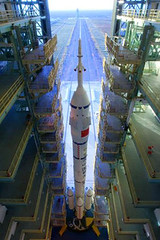
The picture of the Chinese LM-2F "Long March" booster above is from the Flickr pages of Kodiakspace, a fellow Orbiter user who has collected a number of photos and other images from Chinese space missions and plans, in addition to images of his Orbiter add-ons and adventures.

Monday, April 02, 2007

China Moon Rover for 2012

Interesting item via KurzweilAI.net and AP: China is developing a moon rover for a 2012 landing (I dug up the photo from a Chinese news site). It looks a lot like the NASA Mars rovers - a proven design! And although it has MER-like solar panels, primary power is said to be nuclear (presumably nuclear-thermal, like the power sources used on NASA's outer solar system probes). This would allow the rover to stay toasty warm and even to keep driving during the chilly two-week lunar night.

Friday, January 19, 2007

Space Gets Nasty

Can't we all just get along? A quick look around the world shows that the answer is "not anytime soon." The recent Chinese test of an antisatellite (ASAT) weapon suggests that we won't all be getting along in space either. Of course the U.S. and Russia are known to have ASAT technology, though neither has tested anything in space since the mid-nineteen eighties. The Chinese launched what was believed to be a kinetic energy weapon (i.e., a projectile that kills the satellite by flying into it at high speed) to destroy one of their own older weather satellites, resulting in a cloud of space debris estimated at 800 objects.

What a mess. And that goes for the whole "war in space" thing too. It would be nice if space could be all about peaceful international cooperation. It should be all about peaceful international cooperation - that would be best for everyone. But space is also a valuable resource and a strategic high ground, and international powers are bound to jockey for position there, as President Bush made clear last fall when he signed the new National Space Policy that declared that "freedom of action in space is as important to the United States as air power and sea power." Actions speak louder than words, so I guess it's natural for the Chinese to want to assert their position too. Not good, but natural. I hope it leads to serious discussions about ways to limit weapons in space, but I'm not too optimistic.

Friday, August 18, 2006

Something So Right


They got a wall in China, it's a thousand miles long
To keep out the foreigners they made it strong...
Paul Simon, "Something So Right"

I'm sure every songwriter can name at least a few songs they wish they had written, and along with everything by the Beatles, a top one of mine is Paul Simon's 1973 song "Something So Right." It's a finely crafted love song that happens to mention the Great Wall of China. I visited a part of the Great Wall near Beijing today, and despite the hazy gray sky, it was amazing to see and experience a small part of this wonder of the world. I climbed a section of it, about an hour up and down steep flights of many, many stone steps of irregular height, sweating profusely and whistling that song to myself.

Thursday, August 17, 2006

Vertigo

Private pilot (sadly grounded for quite a while now). Frequent flyer (United 1K). Space flight advocate and fan. Afraid of open heights.

Afraid of open heights?!? Well, not exactly afraid, but looking down the atrium of the Shanghai Hyatt from the 85th floor to the lobby on the 56th did give me a sort of dizzy feeling, even though the railing was quite solid and chest high (so not really an "open height" in any literal sense). It's an amazing sight, as is the night view from the 86th floor restaurant. Shanghai is one visually stunning city.

Now I'm in Beijing and will visit the Great Wall tomorrow. Let's get a space connection in here, one I vaguely recall discussing somewhere before, maybe in this blog. Is the Great Wall the only man-made object visible with the naked eye from space as is sometimes claimed? Depends on where you are in space. From LEO (that's low earth orbit, Shuttle altitude), many man-made objects such as highways, ships, railroads, etc. can be seen depending on conditions, often including the Great Wall. From the Moon? This was claimed somewhere too, but beyond a few thousand kilometers, no man-made features are visible on Earth, and from the Moon, just patches of white, blue, brown, yellow, and sometimes green.

Monday, August 14, 2006

The Bund In Motion

This was taken with a borrowed digital camera which I did not really know how to use. It shows Shanghai's famous Bund from my hotel window, across the Huangpu River. My friend uploaded and sent me the picture with the overly kind suggestion that it has "some artistic effect." Yeah, that's it, artistic, not just shaking the camera! Here's what it's really supposed to look like (not by me, just the first one I found on Flickr).

Flickr probably has all the photos I need of everything in the world, but I still think I should get myself one of those ultra-thin digital cameras so I can just keep it in my computer bag (I tend to leave the one we have at home unless it's specifically a vacation or something). I sometimes see some cool things on business trips, like the whole Shanghai skyline. Here is another Flickr user's shot of the Shanghai skyline including the giant Oriental Pearl TV Tower which is across the street from my hotel, the same one where the Flickr user stayed (he notes this in his caption, but the TV tower and hotel are on the left, not the right).

Sunday, August 13, 2006

Speed: 431 km/hour, Altitude: 10 mm

I took the world's first commercial maglev (magnetic levitation) train from Shanghai Pudong Airport to Shanghai this afternoon. The 30 km trip took eight minutes and reached a top speed of 431 km/hour, or about 268 mph. Pretty zippy. This is a lot faster than the operational speed of Japan's Shinkansens, which I've ridden many times (about 270-300 km/h or 168-186 mph, depending on the line and model). The Shanghai Maglev has been in commercial operation since 2004 and has reached 501 km/hour (310 mph) in test runs. When you combine this with its amazing and often weird high-rise architecture, you can really believe that Shanghai is the City of the Future. They are talking about a maglev line from Shanghai to Beijing to make that a 3 hour trip (currently a 2 hour flight or a very long train trip).

I wanted to provide a link to a general article on maglev technology, but when I tried to do this, I realized there is one thing the City of the Future doesn't have today: access to Wikipedia (I can't get to any Wikipedia pages, and I assume the IP addresses for this are blocked in China, from what I've read about internet policies here). Too much "controversial" content I guess. But this link gives the basic maglev info.