Showing posts with label people. Show all posts

Saturday, July 09, 2022

England Aviation Vacation, Part 2


After I got back to North Weald Airfield from my “Castles & Coasts” flight down to Dover, my taxi friend Ali drove me back to Epping Station and I caught a train for Cambridge, stopping for the night at Duxford, the site of another Imperial War Museum at Duxford Airfield, the biggest air museum in Europe.

My Tiger Moth lesson flight was set for 3 PM, but I entered the IWM at 11 AM on a beautiful, clear morning so I could explore the hangars and ramps brimming with historic airplanes.  In the Air & Space hangar I found many favorite jets including the Vulcan bomber, the swing-wing Panavia Tornado, and the Concorde, which I walked through.

In and around the other hangars I found Spitfires, Hurricanes, a PBY Catalina, and a WWII twin-engine RAF Mosquito made mostly of wood, among many others! I walked into a hangar where workers were rearranging aircraft for the upcoming airshow. I wasn’t supposed to be in there, but I spotted an RAF Eurofighter Typhoon before they kicked me out.

In addition to all the amazing ground exhibits, several of the flight performers for the weekend Duxford Airshow were rehearsing their acts low over the runways. Practically a private airshow!

There was a great Battle of Britain exhibit with Spits and Hurri’s and a crashed Messerschmitt Bf-109 in addition to a recreation of the control rooms where they directed those epic aerial battles in 1940 using telephone and radar reports, with a big map table where they pushed around markers to track friendly and enemy aircraft positions.

I loved the American hangar where dozens of huge airplanes were parked and hung from the ceiling, starting with the big iron – B-52, B-29, B-24, and B-17 as well as all the major fighters from P-51 to F-15 and even the Mach 3 SR-71 Blackbird.  

Before my Tiger Moth lesson, I had also signed up for a 15 minute flight around the airfield in the Dragon Rapide, a small passenger biplane from the late 1930’s. This was great because I got to take some good aerial shots of Duxford which wasn’t possible in the Tiger Moth (no personal cameras). It was also very cool to taxi out next to a Hurricane fighter!

Finally it was time for the 40 minute Tiger Moth lesson I had booked months before. I had to empty my pockets for the open cockpit flight (and to remove any competition for the in flight video they would later sell me). I donned a leather helmet, headset, and goggles as well as a fleece-lined leather jacket. I was strapped into the front seat, and after a radio check, we took off on the grass and headed southwest.

Clear of the airport area, the pilot soon gave me the controls for the cruise and a few turns. The stick forces were amazingly light (the pilot was likely trimming for me), so “fly with two fingers” worked quite well. Instruments were minimal, and the forward view was obscured by the nose, so I used the left and right lower corners of the windscreen as reference points to keep the wings level with the horizon. Visibility was otherwise excellent, and I enjoyed the beautiful Cambridgeshire countryside from 1500-2000 feet. We flew over several towns including Royston, as well as the radio telescopes of the Millard Radio Astronomy Observatory, just 5 miles SW of central Cambridge.

After landing, exhausted from hours of walking around huge Duxford Airfield, I took a taxi into Cambridge and checked myself into my apartment hotel for the remainder of my stay. It was a great little flat although I wished I picked one a little closer to central Cambridge. I spent Friday morning exploring the excellent  Fitzwilliam Museum, although I mainly visited the art galleries, including a special David Hockney exhibit.

I didn’t have time for the many galleries of Egyptian, Greek, and other antiquities because I was keen to get to the pub for lunch and a pint of DNA. Specifically, a pint of DNA Ale at the Eagle Pub, famous as the place where James Watson and Francis Crick (above left) popped by from their nearby lab in February 1953 to announce that they had discovered “the secret of life,” otherwise known as the double-helix structure of the DNA molecule. They were regulars so they shared the news at the pub prior to actual publication.

After lunch I signed up for a “guided punt” on the Cam River. This classic Cambridge experience takes you for a couple of hours up and down the Cam, gliding serenely along the “backs of the colleges” of Cambridge. The weather remained perfect, and our punter guide was quite informative and funny as he related history and gossip from ancient up to modern times.

By Friday evening, walking had become very hard, and I soon found the reason – two enormous blisters on my big toes. Although I did my best to treat them, it was clear that another 5–8-mile day at the airshow the next day was not going to be feasible. I texted my regrets to the friend I’d planned to meet there and spent Saturday relaxing and looking at pictures. It was cloudy and raining, but fortunately I had a kitchen and had bought some food and beer, so survival was not at stake.

By Sunday and Monday my first aid and foot padding strategies allowed me to venture out with the help of buses and taxis to minimize my steps. I went out to eat and explored two small but historic museums. The Sedgwick Museum is one of the oldest in Cambridge with a focus on paleontology and geology. The museum also had an excellent exhibit on the life and scientific accomplishments of Charles Darwin. Always a Darwin fan, I really enjoyed this exhibit and all of the fossils and displays at the Sedgwick.

Finally, I spent an enjoyable couple of hours at the nearby Whipple Science History Museum which was dominated by my old specialty, optics. There were hundreds of telescopes and microscopes from various periods, as well as a fascinating collection of globes.  

I recently read a brief biography, The Reluctant Mr. Darwin by David Quammen. In it, the author describes the various reasons that it took over 20 years from the voyage of the Beagle (1831-1836) to the publication of The Origin of Species (1859). A big chunk of that time was devoted to detailed studies of barnacles. Why? At the time, little was known about barnacles, and Darwin thought he might spend a year or so identifying and organizing barnacle species. This might aid his understanding of variation in characteristics between closely related species, as well as contribute to zoology. It turned out to be more complex than he imagined, taking eight years and four books to complete to his satisfaction. Barnacles are small so a microscope was his constant companion, and that very microscope is on display in the History of Science Museum (above).

My flight for Boston was Tuesday evening, June 21, and I planned to take a National Express bus from Cambridge directly to Heathrow. But I had forgotten about a planned rail strike that day, and when I went to book my ride, the only available seats were on the 5 AM bus, since rail travelers were using every available option to get to London. Oh well, I can kill ten hours at an airport. 

But there was a further adventure in store when the bus failed to show. So I shared a two-hour taxi ride with three other Heathrow-bound travelers who were congenial and funny. It was a wonderful vacation, right down to the last near-disaster.


Wednesday, January 26, 2022

Exploring Switzerland with MiGMan

I've been virtually exploring many cool areas in Africa and Europe with the help of a new series of VFR flight plans for Microsoft Flight Simulator, MiGMan's World Tour. They include a large number of locations with richly illustrated guides to help you decide where to fly next. The flights are fairly short (depending on the aircraft you choose) with an emphasis on the scenic and the unusual in the huge, detailed world of MSFS.


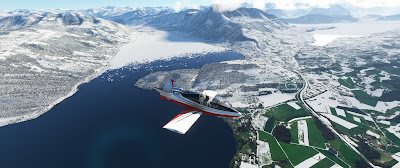
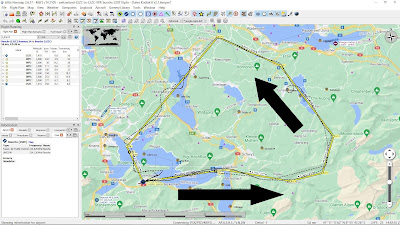
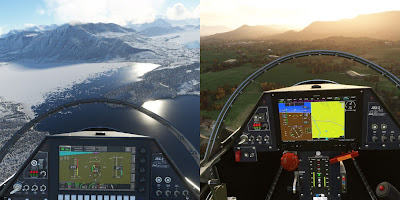
I made a new video (music by me) from a series of screen captures done on two flights around Lake Lucerne, Switzerland, both based on the same flight plan from MIGMAN'S FLIGHT SIM MUSEUM - EUROPE VISUAL VOL. 4. I first flew the plan in the "wrong" order, crossing icy Lake Lucerne to the east at fairly high altitude, and with Live Weather - lots of snow and frozen lakes in January. Then I flew it again in the published way point order, this time at low level, with "cloudy horizon" weather and with the date set to late fall. So different! Here's another version, full video flown and narrated by MiGMan. 

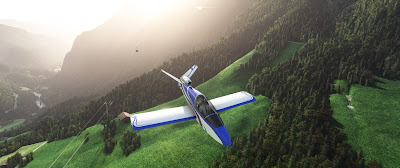
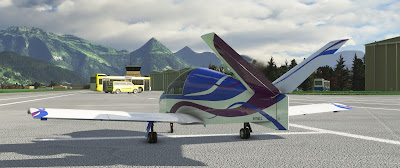
I was using Bijan's Four Seasons addon to add variety to the vegetation, as well as addons for powerlines and lifts (ski lifts and cable cars are everywhere in Switzerland). You can see those (and avoid them) when flying down low. I was in VR which makes it easy to judge your position when flying low in valleys and around obstacles. I chose a new aircraft I just bought, YSIM's SubSonex JSX-2 “personal jet” which is really fun in VR. A cozy little jet. I might build one! 

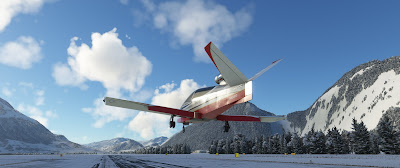
MiGMan’s World Tour series has many great flight routes throughout Europe and Africa, so there’s no special need to fly the same one twice. But as you can see from these screenshots and especially in the video, changing the weather, the altitude, and the direction brings out different aspects of the beauty of Switzerland’s mountains, valleys, lakes, and towns. I also enjoy getting familiar with the terrain as I explore an area from different perspectives. So the “replay value” of these flight plans is excellent.

Of course Switzerland is amazing and these flights show that well. But there are hundreds of less famous but still beautiful places all around Europe and Africa, and this series has surprised me many times with unexpected wonders. If you love geography as I do, Microsoft Flight Simulator is the biggest and best playground ever, especially if you also like airplanes (as I apparently do). 

Microsoft points out that you can fly anywhere in the world, but as with real-world travel, it’s helpful to have an experienced guide who can lead you to incredible places you might never think to visit otherwise.


Sunday, June 03, 2018

Center Of It All


I have a new album! Center Of It All is available for download on CD Baby, and actual CD's will also be available there within a couple of weeks. It is also available on Apple Music, Amazon Music, Spotify, YouTube and other download and streaming sites.

I'm really pleased with how the album came out. I've been working on this project on and off for six years, since my last album Look At You in 2012. This is the fourth album produced by my friend Roger Lavallee, and as usual, Roger also came up with great arrangements, played most of the guitars, programmed the drums, and accomplished what still blows my mind every time I hear it -- he made it sound like a record! I also want to thank my friend Craig Collins for designing the cover graphics. He did a beautiful job of integrating my interests in music and space and in visualizing the idea of the "center of it all." Thanks also to my two co-writers (Rob Simbeck on "Center Of It All" and "Saving the World" and my brother Doug Irving on "Foggy Morning London Town").

Here are the album notes I wrote for the album page on CD Baby:

Writing and recording songs can give you a rich fantasy life. Like when you watch an episode of "The Americans" (great show) and out pops the song "Rough Days." Or when you imagine being so down and out that you wish someone would airlift you away and voila, "Angels Are Hiding." Think you're tired? Try flapping your wings 1500 times a minute like the characters in "Hummingbird." How about a pep talk from a quasi-Rastafarian? That's "Hey O Way O." An early morning stroll down Abbey Road? "Foggy Morning London Town." A helicopter getaway? "When Charlie Went AWOL." There's a song just called "Who?" What's that all about? Or who?

It's not all crazy talk. There's some of the usual sensitive guy "what's it all about" stuff too, like "In the Name of Love," "No Second Chances," and even "Saving the World." "Center Of It All" was inspired by memories of my Mom who passed away just recently - she really was the center of it all for me and my family.

There's a lot of rock, a ton of harmonies, a bit of folk and country, and just a dash of jazz. An album 6 years in the making with twelve very different and dare I say rather good songs (yes, I dare say). And I must ALSO say that if you like cool guitar solos, my producer, friend, and Local Guitar God Roger Lavallee has really outdone himself on this project. Smoking.

It's a good album. You'll like it. Trust me. Why would I lie?

Friday, January 27, 2017

Nothing Is Unbelievable Now

The word “unbelievable” is obsolete now that Trump is president. Any horrible thing you can imagine someone in government doing or saying is believable now. Trump's appointments and actions seem calculated to hurt the most people possible, especially if they are brown, female, or immigrants. Some of this is ideological but most of it seems more like mean-spirited bullying, a Trump specialty. It doesn't seem that these actions actually HELP anyone, not even Trump's misguided yet hopeful supporters, but he's fulfilling his wild campaign promises, so his fans are like, “hell yeah!” Many of Trump's actions will end up hurting his supporters much more than they will educated know-it-all liberals like me.

But to see this requires accepting facts and sometimes complicated reasoning. Take for example building a wall with Mexico and (maybe) imposing 20% import tariffs on goods from Mexico to “force them to pay for it.” This will raise prices on many goods for Americans (including vegetables and fruits) and probably cost jobs in industries that rely on imported parts. We could have a trade war. Americans will pay for the wall through higher prices and job losses. It will also damage the Mexican economy which will likely increase illegal immigration regardless of any wall.

As was the case during the campaign, there's such a flurry of batshit-crazy "alternative facts" coming out of Trump and his cronies that it's hard to keep it all in focus. And it's only been one week! This is all bad, but it's just the tip of the iceberg because he is also saying and doing scary things in the international arena, like saying again that we "should have kept the oil" in Iraq, and maybe we will get another chance. Statements like this are lighting up social media in the Arab world and putting at even greater risk the thousands of military personnel we still have in place helping our Iraqi allies to fight ISIS. And as Trump has been so fond of saying about others, there is clearly "something going on" with Russia to explain why he has criticized everyone from the US intelligence community to John Lewis to Meryl Streep -- but never Vladimir Putin.

Here are a few other examples just from today's NY Times.

Gail Collins suggests that Trump actually has no strong views on abortion and women's rights (or perhaps on anything but himself) but that he's just following Pence's toxic anti-woman agenda on this. He's a puppet for both Putin and Pence.

http://www.nytimes.com/2017/01/26/opinion/mike-pence-pulls-president-trumps-strings.html

Nicholas Kristoff points out that the stupid lies about inauguration crowd sizes and nonexistent electoral fraud are acting as a smokescreen for real damage caused by early actions like the abortion “gag rule” that blocks US foreign aid to any care-providing organization that even discusses abortion. This goes farther than gag rules from earlier presidents in that it will apply to all health services, including for example efforts to combat the Zika virus. Direct US funding of abortions is already banned, but this expanded policy will kill poor women in places like Africa and lead to more abortions. But Pence and Trump won't see or care.

http://www.nytimes.com/2017/01/26/opinion/president-trumps-war-on-women-begins.html

Charles Blow focuses on Trump's use of lies and criticism of the press to try to control all narratives, supplying “alternate facts” when the truth is too inconvenient, as it usually is. In addition to this, the Trump team is blocking US government agencies that deal with science from using social media and removing references to climate change from government websites. Charles Blow writes in part:

[Trump] is in fact having a running war with the truth itself.

Donald Trump is a proven liar. He lies often and effortlessly. He lies about the profound and the trivial. He lies to avoid guilt and invite glory. He lies when his pride is injured and when his pomposity is challenged.

Indeed, one of the greatest threats Trump poses is that he corrupts and corrodes the absoluteness of truth, facts and science.

http://www.nytimes.com/2017/01/26/opinion/a-lie-by-any-other-name.html

Welcome to 1984.

The cartoon by Nomi Kane is from The Nib, a great political cartoon site:

https://thenib.com/an-embarrassment-of-leaks

Tuesday, January 24, 2017

Fermi Paradox Explained?


I’ve often thought that the whole “where are they?” question about SETI (i.e., the Fermi Paradox) is bogus, both because the universe is just so BIG, and because we still understand so little about it, even though we have learned in recent years that planets and even “Earth-like” planets seem to be quite common throughout the Galaxy. As smart as some of us may be, it seems likely that we are still as clueless about major chunks of physics as scientists in the 1800’s were about quantum mechanics and the scale of the universe. If there are wormholes or quantum foam or gravitational technologies we won't develop for another 200 years, there could be aliens popping in and out all the time, and we wouldn't even know what to look for. It would be like an airliner passing 37,000 feet above some remote tribe of people who have never encountered other humans or modern technology, as unlikely as that may be today.

Such advanced beings might find radio wave communication to be as quaint as rubbing sticks together as an energy technology. I’ve also read articles suggesting that we ourselves are probably approaching the end of our “radio age” due to fiber optics and other technologies. Though we still send out a lot of radio waves, they tend to be more directional (like radar, microwaves, etc.) or short range (cell phone towers, Wifi, Bluetooth, etc.). Maybe technical civilizations only use radio waves for a few years and any continued or specialized use eventually becomes very efficient with very little leakage to space.

Somehow I wandered over to Centauri Dreams, a blog that periodically blows my mind with advanced space exploration ideas. I found an article “CitizenSETI” about a couple of guys (Roger Guay and Scott Guerin) who decided to work out this Fermi thing. A key part is the lifetime of an IC (intelligent civilization), which really means the DETECTABLE lifetime. If that is very short (e.g., humans have been broadcasting for about 110 years and listening for only about 60 years), and if such civilizations are widely separated in time and space, you will have a big “synchronicity” problem – finding times and places where someone is broadcasting AND someone in range is listening.

Roger Guay created a simulation with LiveCode, a modernized version of my old, beloved HyperCard for the Mac (screen shot above). In his Advanced Civilization Detection (ACD) program, he can set various assumptions about the spacing, lifetime, and other factors and run this simulation at high speed. Under most reasonable assumptions it creates a sort of “firefly” effect with detectable IC’s flashing in and out of existence and only rarely being seen by other IC’s. If these assumptions and simulations are reasonable, IC’s could be plentiful and it might still take hundreds of years of observation to catch one of these “fireflies” before it flickers out.

I've been interested in this subject since I read Intelligent Life inthe Universe by Carl Sagan and Iosif Shlovsky back in 1974. This was a pretty early work on exobiology (or perhaps astrobiology), a field that still lacks data but provides an interesting framework for thinking about everything we know about ourselves. My guess is that unicellular life has probably evolved in many places but that the leaps to multicellular, intelligent, and technological stages are much rarer, though certainly possible (current sample size is N=1 if you give humanity the benefit of the doubt as an IC).

Based on this simulation work, we are not likely to expand that sample size anytime soon. Here is Roger Guay’s final paragraph on Centauri Dreams:

Conclusions? The ACD simulation dramatically demonstrates that there is indeed a synchronicity problem that automatically arises when ICs attempt to detect one another. And for reasonable (based on Earth’s specifications) Drake equation parameter selections, detection potentials are shown to be typically hundreds of years apart. In other words, we can expect to search for a few hundred years before finding another IC in our section of the galaxy. When you consider Occam’s razor, is not this synchronicity problem the most logical resolution to the Fermi Paradox?


Of course this is hardly the last word on the subject of the Fermi Paradox. In fact, while reading the blog posts that triggered this one, I discovered a recently updated book that goes into much greater depth, If the Universe IsTeeming with Aliens … WHERE IS EVERYBODY?: Seventy-Five Solutions to the Fermi Paradox and the Problem of Extraterrestrial Life (2015) by Stephen Webb. I've read the Kindle sample and I may have to buy it despite my insane backlog of books already waiting to be read. Author Stephen Webb also has an interesting blog

Wednesday, January 11, 2017

Obama Farewell


I watched President Obama’s farewell speech last night with my wife. It was an incredibly hopeful and moving speech, and the part near the end when he spoke to and about his family and his VP and friend Joe Biden was hard to see without crying. The presidency is huge, an unimaginably high-pressure job in which you are pulled in a million different directions and challenged every day to keep thousands of balls in the air. Obama did it with grace and often made it look easy, which it was not. I truly believe he is one of the most decent human beings ever to hold this office and that when he had to comfort the families of children murdered in Newtown or order military operations or drone strikes that took lives, often including innocent lives, that this responsibility truly weighed on him. I don’t want to contrast him with what is following him in just over a week. There’s no comparison. But at least we had this great and decent man as our president for eight years.

This is not to say he was perfect in office – he would be the first to say he was far from perfect. He made mistakes, some of them very costly, but very few people are in the position to judge the trade offs a president is forced to make to keep our country mostly safe and mostly free most of the time. And I far prefer the coolness of Obama to the impetuousness of… certain others.

For those of us who believe in facts, who believe in the Constitution, who believe in science, who believe that all people deserve a chance, who believe that America is a great country but not the most important one in the world – wow, he was our president. For those who hate him for whatever reason, whether it’s because they didn’t prosper while much of the country was getting better after the near-disasters of the Bush years, or just because they choose to believe that this country is somehow intended to be Christian and White, I feel sorry for them. They missed out on something great.

His speech suggested that we need to keep working for what is right even in the face of the evil that has wormed its way into Washington and will be in charge for at least four years (assuming we make it that long). He says he’s optimistic, and I want to believe him, I want to try, but it’s very hard, even for a natural rational optimist like me. I’m giving money. Can I do more than that? Can I be an activist? Can I stomach the noise of politics more than a few months every four years? I don’t know. I'm glad I volunteered for the small amount of campaign work and donated the money I did in 2008 and 2012 (and 2016), but now I can barely stand to watch MSNBC for more than a few minutes. My wife watches it a lot and she’s anxious about the coming time. I get that, wanting to be informed but scared to death of what you see happening. I'm fortunate that I am able put it aside and focus on other things – sometimes anyway.

I don’t know what to do. Reach out to the other side? Try to cross that shaky bridge? I'm not sure I can, and that in itself is a bad sign. I need to think more about it once the dust has settled a bit. But I know I will miss having a president who is smart and who I can trust to lead our country for the benefit of its people. That is a huge and scary loss.

Saturday, July 30, 2016

100 Days


One of the most encouraging things I looked at in the NY Times this morning was the interactive "Who Will Be President?" feature, part of their numbers-oriented Upshot section. It says that based on current polling, as of yesterday, Hillary Clinton has about a 69% chance of winning the presidency. With Donald Trump continuing to double down on his crazy statements and his traitorous flirting with Putin, I have to believe that Clinton's odds will improve over the next 100 days. There will be debates (that will certainly be bizarre) and probably more surprises from Russian hackers, but I'm hopeful that Hillary's team is ready for all of this and that the Dems' convention bounce will exceed the one Trump got from the RNC. I think the DNC did a masterful job of making the case for optimism about the country and for the qualifications of Mrs. Clinton.

Of course there are always ways to look on the dark side. I also read an essay in The Atlantic summarizing the typical Trump supporter's view of "what is really going on" and why they believe he will win. It seems to hinge on voter turnout and male support. Supporters believe there are many people, especially men, who normally wouldn't even vote but who secretly support Trump and who will turn out in droves to vote for him. They believe this latent "surge" of disgruntled people is invisible in polls. Why? I'm not sure. Maybe these closet Trump supporters are embarrassed and lie to pollsters but will choose him in the privacy of the voting booth? Some of these Trumpsters even believe that many black and Latino males will go for Trump because they would feel emasculated by a woman president -- the machismo vote?

This reminds me of similar ideas in 2008 and 2012 about President Obama. It was called the Bradley Effect. It posed the idea of what you might call "embarrassed racists," people who would tell pollsters they supported Obama but who would actually refuse to vote for a black man for president. Subsequent analysis found that this did not occur -- the polls were pretty reliable. But could it be different with secret Trump supporters? I hope not.

In any case, I am excited that Hillary Clinton is the nominee and I plan to do whatever I can to support her against the very real threat of Trumpism. I can see more donations and some New Hampshire front doors in my future -- at least in the next 100 days. 

Wednesday, May 11, 2016

Sunspots


I love to write, though you might never guess this from my recent blog activity. While this is my first blog post of 2016, I used to blog a lot more -- some 1500 entries since I started this blog in 2005. Most of my writing these days is in a journal I keep on my iPhone and iPad using an app called Day One. I like keeping a journal, but recently I started to think about getting out of my comfort zone and doing something a little different with writing. Looking around, I found a wonderful organization called the Seven Bridges Writers' Collaborative in Lancaster, Massachusetts, just 20 minutes from me. There was an opening in one of their weekly creative writing groups, and I joined the spring session in late March. It's a small, informal group led by Winona Winkler Wendth, an experienced, insightful, and supportive writing teacher. I've enjoyed the writing exercises and the lively discussions each week with the group. And it has successfully gotten me out of my comfort zone, writing things I would never have thought to write, sometimes well, sometimes not so well.

Here is a new one that is very different for me. The prompt was simple -- write 300-500 words starting with "I counted. There were 27." It gave me some trouble for a day or so until I started thinking about the recent transit of Mercury, and about sunspots.

Sunspots

I counted. There were 27. Shining the sun on a paper plate with your telescope works great. I’ve never seen the sun like that. Is 27 a lot of sunspots?

Not really. Sometimes it can be over a hundred. It goes in cycles over something like eleven years. Twenty-seven is actually a pretty low number.

What do they mean?

What do you mean, what do they mean?

Sunspots. If you can’t see them without a special trick like this, why are they even there?

Well, they don’t mean anything. They’re just something that happens because of the way the sun works. Astronomers have figured out that sunspots are cooler areas on the sun, though they are still hotter than anything on Earth, and often they are as big as Earth. They only look small because the sun is so far away.

But how can they not mean anything? Isn’t there a reason for them?

There’s a difference between a reason and a meaning. Scientists can study the sun and figure out why events like sunspots and eclipses happen from information they can see and measure. In the past, people didn’t know as much about how the world works. They might see sunspots or eclipses as special signs, warnings about something bad. Some people still think this way, figuring that anything so strange and different from normal must mean something.

But isn’t that right? Grandma says everything happens for a reason.

Let’s think about what she means. Is she talking about science when she says that?

I don’t think so. She usually says it when someone gets sick or dies or something and people are sad.

Right. If everything were random and unpredictable, that could be pretty scary. But some things in the world happen pretty regularly, like day and night, right?

Sure.

And other things are not quite so regular, but we know something about them. We have weather forecasts, and we expect it to rain sometimes, and we know most summer days will be warmer than most winter days. If it rains and your baseball game is canceled, you might not be happy, but you don’t think it rained because someone didn’t want you to play your game, do you?

Of course not.

Rain happens for reasons you can study and learn about. But those reasons don’t have anything to do with what people want. And the rain doesn’t mean anything by itself, though you can find meaning in it. To some people rain means joy because it helps their flowers grow. Some may write poems and songs about the meanings they find in the world. Other people may be scientists and find joy and meaning in understanding the reasons for rain or sunspots or brain cells. People are the most complicated part of this complicated universe. Everyone studies people, but psychologists, writers, and some others do it in special ways.

Can we get ice cream now, Dad?

Yup.

Tuesday, October 27, 2015

Insane Convictions


For the first time this year, Donald Trump is starting to fall behind in polls of likely Republican primary voters, especially in Iowa but also in one major national poll (New York Times today). This would be good news were it not for the fact that it is Dr. Ben Carson who is catching up with The Donald. Trump's conviction is that he is simply the greatest. He's self-serving and egomaniacal and willing to say or do anything to get attention. He is also extremely rich and quite smart in his obnoxious way. Sometimes I think he is playing all of us, that this is all a big game of some sort, although he probably really does think he could be a good president.

Carson, on the other hand, may be certifiably insane. Here's a guy who had to have been brilliant at one time to achieve what he did as an innovative pediatric neurosurgeon. But he's also a Seventh-day Adventist who seems to be completely dominated by his religious beliefs. It's almost funny that he has talked about his fear of a Muslim president who might try to institute sharia law in the United States. This from a guy who clearly wants to impose his own Christian beliefs on our entire country, starting with no abortions for any reason, although in a recent interview, he seemed unable to connect this with the obvious GOP agenda step of reversing Roe vs. Wade. It seemed like he didn't really know what that was. He has strong, insane convictions, but very large gaps in his knowledge of how our country works. And of reality in general. He looks and sounds like he's on Thorazine or some other antipsychotic drug.

It's a testament to the power of religion to make you believe in strange things that he does not believe in evolution. Here's a man trained as a neurosurgeon who helped develop a surgical procedure to separate conjoined twins joined at the brain. I have to believe that some of the procedures that were developed for this and other surgical innovations were tested and practiced on animals such as dogs, monkeys, and maybe even chimps because of their anatomical similarities to humans. He must have noticed those resemblances and is perhaps even familiar with how bacteria become resistant to antibiotics (through evolution). And that all life on Earth uses the same DNA system that we do, and that the genomes of great apes are nearly identical to ours. I suppose Ben believes that God created all of the similarities just because he felt like it, even though humans were somehow independently created from all the other animals.

Ben also believes that homosexuality is a choice (and not unlike bestiality), that Obamacare is like Hitler, that abortion is like slavery, that people who are shot by mass killers simply failed to defend themselves, and on and on. This Salon article is a nice review of seven of his most insane statements:
  1. Gayness must be a choice, because prisoners who are raped come out gay.
  2. Obamacare is worse than slavery. We live in a Gestapo age.
  3. The Big Bang is a "fairy tale" and the notion of evolution was encouraged by the devil.
  4. There's no war on women; there may be a war on women's insides. [ WTF? -Ed. ]
  5. Nope, I don't see any global warming.
  6. Nope, I don't see any racism.
  7. Planned Parenthood is a plot to kill black babies.
Considering that Carson claims to have been a Democrat in 1992, it's tempting to believe that his current conservative views have been cherry-picked to appeal to right wing Republican voters, although he might truly believe in some or all of them. In this Yahoo Politics article, he even describes how he only learned in 2013 the right way for a Republican to talk about guns. It seems he actually believes that assault weapons should be restricted in urban areas, but of course a Republican can't say anything like this, you always have to start with "the Second Amendment is sacred, no restrictions on guns!"

So what is this dude's appeal? He's personally non-threatening, soft-spoken, ultra religious, and occasionally articulate-sounding. I can see how this sells among evangelicals in a place like Iowa if you don't look too closely at his ideas and beliefs. But I would hope that once the details of his views become better known, that mainstream Republican voters will quickly recognize what an insane and dangerous thing we have here in Ben Carson. We should not be considering handing the keys to the US nuclear arsenal to such an inexperienced and loopy guy, let alone a man who believes that the "End of Times" may soon be upon us.


Tuesday, September 15, 2015

Infinite Jest


Infinite Jest is a 1,079 page novel by the late David Foster Wallace (DFW). I haven't read it, but as I was updating some iPad apps and playing briefly with a synthesizer app called Magellan, the phrase popped into my head. The 1996 book is somewhat in the news because of a new movie "The End of the Tour," based on an interview with DFW by a Rolling Stone reporter played by Jesse Eisenberg. It sounds pretty dull but I guess it all depends. According to an article on how to fake having read Infinite Jest (because come on, who reads a 1000 page book?):
The Title: “Infinite jest” has three meanings in the context of the novel. It’s a Hamlet quote, the name of a fictional movie that’s impossible to stop watching, and a reference to our own culture of constant entertainment. [emphasis added]
I guess that's why "infinite jest" popped into my head. I was realizing that Magellan is possibly the most amazing musical instrument ever, and if I had had this one thing before the era of i-devices and the Internet, I might have spent weeks or months exploring and creating music with it. The sounds are beautiful and the flexibility is mind boggling.

But I've had this app for probably 2 years, and except for brief periods like this when I launch and play with it a while due to an app update, I hardly notice it. I have 143 apps on this iPad including at least 20 synthesizers (probably more since GarageBand has several synths built in). Every one of those synths is similarly worthy of hours or weeks of exploration and music creation. Yet I hardly notice them and have not written or recorded even a song fragment in months.

I can't blame my lack of creative output on "too many choices" but this does play a part. My journal does too. I'm not dying but sometimes it feels like I'm amusing myself to death with apps, Facebook, Flickr, Amazon Instant Video, Apple Music, and all the other trivial stuff vying for my attention.

In my personal hierarchy of worthy pursuits (outside of family and work), creating something is #1, especially if it's a completed song or recording (journal or blog writing gets partial credit). Learning something, usually by reading a book, is probably #2, and I still do spend a lot of my free time on that. But I wish I could figure out how to get past the fractal fragmentation of the culture of infinite jest. Usually a self-defined "special project" like making a new album does the trick, but I've defined several of these projects in the last year, and they too have succumbed to fragmentation. Maybe I need to lock myself in a room with nothing but a guitar. Would I have my iPhone too? It's a slippery slope.

Wednesday, July 22, 2015

Summer of (Ugh) Trump

My interest in politics right now is pretty low, and the 2016 presidential election still seems a long way off. So I don't often think much about it, and I rarely blog about politics (heck, I rarely blog at all these days -- though I write a lot in my journal). But the 16 ring circus that is the fight for the Republican nomination is pretty hard to avoid, especially when my wife watches MSNBC and I occasionally sit in. Rachel Madow and other MSNBC commentators have been having a field day with the motley crew of Republican contenders. But since Donald Trump announced his run for the presidency in June, he has made their jobs even easier and has dominated every news cycle with his ever more ridiculous shoot-from-the-hip pronouncements.

He started with Mexicans and immigration, claiming that most illegal immigrants are rapists and drug dealers. He says that when he is president, he will build an impenetrable wall along the border with Mexico, and force Mexico to pay for it. Then the other day in an interview on stage, he ad-libbed some remarks about Senator John McCain and how he isn't really a war hero, followed by, "OK, maybe he is, but only because he was captured. And I like people who weren't captured." I'm definitely no fan of John McCain, but anybody who does not respect the service and sacrifice of a naval aviator who spent five years in a Vietnamese prison is insane and despicable. Though of course we already knew that Trump was insane and despicable. Yesterday he went on the rampage against some of the other Republicans who have insulted him in the press, especially Senator Lindsey Graham of South Carolina. Speaking to an audience in South Carolina, Trump insulted Graham as a loser and a wimp and actually gave out Graham's private cell phone number to the crowd.

Trump's form of campaigning is basically improvised insult comedy -- Don Rickles with more money and a creative hair stylist. It's only a matter of time before everyone, no matter how conservative, realizes what a toxic waste dump he is. It's hard to understand how he can achieve 16% in any poll of anybody, Republican or not (some suggestions here). Someone pointed out on a show last night that four years ago, Sarah Palin (not even running), Rick Perry, and Michelle Bachmann were leading in Republican polls at this point (summer 2011, ahead of the 2012 election season). Romney and Santorum were far behind. In spring 2011, Trump himself was actually leading in the polls. I don't recall when he bowed out of the 2012 race that Mitt Romney ultimately won for the GOP nomination. So his strength in the polls at this time really means nothing, except that under the crazy rules set by FOXNews, national poll position will determine which 10 of now 16 Republicans will get to participate in the first GOP debate on August 6. So Trump will be on stage that night, making the Republican debate even more bizarre than it would be with only "serious" candidates.

As comedian Andy Borowitz has written, Trump is the first openly asshole presidential candidate, and there apparently are a lot of assholes in the country who are rooting for him. He is not a serious presidential candidate, and he certainly knows this himself (I read somewhere that he's only spending 50% of his time on his presidential run because of his business commitments). But Trump is an entertainer who thrives on any sort of publicity, and that is what he is getting now by the ton. The good news is that it disrupts the GOP. The bad news is that he makes somebody like Jeb Bush almost look like a reasonable person. Almost. 

Monday, May 25, 2015

SevenEves: Bye Bye Moon


When I got super interested in space flight technology and orbital mechanics back in 2005, I played with the Orbiter space flight simulator for a few months and wrote a 181 page tutorial book for it called Go Play In Space. When Neal Stephenson got interested in space technology and orbital mechanics, he researched it for 9 years and wrote 880 pages to create a novel called SevenEves. The only common thread I can claim is that Neal and I both did our homework on the physics of space flight. But Neal did his homework on much more than this, and tied it all together into a fantastic story. Two major stories, actually -- one an extremely detailed, near-future "disaster movie" (the first two thirds of the book), the other an imaginative and ultimately exciting speculation on the lives of the survivors' descendants, 5000 years in the future. How many survivors were there? The book's title gives a clue that's at least partially correct (it's also a palindrome).

I really enjoy most of Neal Stephenson's writing, and when I learned that his next book would be based in space, I pre-ordered it immediately. When it was released last Monday, it jumped the queue of all the books I was reading or planning to read. I saw a couple of early reviews, including a fairly negative one focused on Stephenson's relative lack of character development and other novelish niceties, in favor of nerdish discussions of all technical sorts. To me, this is a feature, not a bug. I loved the wide-ranging and carefully researched details, and I thought the characters were mostly well drawn. The storytelling and pace are good, although I did feel that it bogged down in the first third of part 3 (the 5000 years from now part). In fairness, there's a lot of explaining to do when you introduce a complex future civilization and many new characters, and after all that setup, the last 300 pages are quite thrilling. Good save, Neal!

The book starts with the moon exploding for no apparent reason. It initially breaks into seven major pieces, but a popular public outreach astrophysicist nicknamed "Doob" (clearly modeled on Neil Degrasse Tyson) and his grad students figure out that it will soon break further into trillions of pieces, many of which will reenter Earth's atmosphere, destroying the atmosphere and everything in it. In 25 months (plus or minus 2 months). Scientists in many other countries independently reach the same conclusion.

Two years is not much time to get ready for the end of the world, so most of the 7 billion people and virtually all other living things will die.  And unfortunately, the incoming swarm of debris dubbed "hard rain" is estimated to continue for some 5000 years. So immediate repopulation of Earth's surface will not be possible. People will have to learn to live deep underground or in space, indefinitely -- somehow. The first 600 pages are mainly focused on a gigantic space lifeboat effort, although it's clear that only a relative handful of people (a few thousand at most) can make it to space in that short time, even with all of Earth's resources, industry, and minds focused on this.

Of course this immediately answers the question, what is the International Space Station good for? Why, to serve as the centerpiece of a swarm of hastily constructed and launched habitat spacecraft that will be used to save this small number of humans in hopes of some sort of future. It's fortunate that in this near future world, the ISS has been expanded to include an experimental rotating habitat and a captured asteroid for experimentation with mining using a fleet of small robots. That at least gives the planetless survivors a fighting chance. But to say there are challenges is a vast understatement. There are many close calls and heroic efforts that turn out to be essential -- like a hastily organized mission led by an Elon Musk-like space entrepreneur to retrieve a chunk of a comet.  This huge mass of water is needed for radiation shielding and to make rocket fuel. You can do that (extract hydrogen and oxygen) if you have enough electric power, like a nuclear power plant repurposed from a submarine. Since part 3 takes place 5000 years in the future, you know that somehow humanity makes it, but it is by the very thinnest of margins.

Is this book realistic? You have to just accept the premise that the Moon just blows up for some reason. The "agent" responsible for this is never really explained, but it doesn't really matter. Everything else within parts one and two ("now") is constrained by realistic physics and plausible current or near-future technology. Orbital mechanics is a major constraint and is handled very well. The problems of radiation, microgravity, growing food in space, living in crowded spaces, and many other issues are handled realistically. Space debris is a constant problem, especially once the "hard rain" starts throwing parts of the former moon in all directions. Space construction requires the help of thousands of small robots, but these are not especially smart robots -- plausible extrapolations of things I have read about in MIT Technology Review. All in all, I consider parts 1 and 2 to be some of the best "hard SF" that I've ever read.

Part 3 is more problematic for me, though ultimately enjoyable. The future space construction technology is massive, though still believable by extrapolation of robotic capabilities. But the tight connection between the personalities of the few survivors and the characteristics of the resulting race-driven civilization in 5000 years often did not ring true to me. There are a lot of interesting and plausible ideas, but also a lot that I thought was very silly, seemingly just made up, "because I said so." These are extrapolations of genetic and social engineering over 5000 years. I don't think you can say anything definitive about this based on anything we know, even if you accept genetic manipulation of the human genome as a required and well-understood tool.

Of course it is all just made up by the author. But it is in part 3 that I have to say to myself, "that's why they call it science fiction." It's still more than fantasy or magic, though I wouldn't call it hard SF. But overall, it's a really good book, and most of those 880 pages flew by over the last six days (actually 14,403 Kindle "locations," read mostly on my iPad).

It's a long book, full of interesting ideas and good writing. I learned a lot, as I always do from Stephenson's books. It is ultimately a hopeful book -- humans are resourceful and manage to barely survive, and eventually go on to build a new and very different civilization and to start to repopulate the Earth (with genetically engineered plants and animals, synthesized from a comprehensive DNA database that was saved from "Old Earth," since no actual animals and very few plants were brought to space -- the Old Earth mission planners did manage to preserve much of Earth's knowledge, genetic and otherwise). But as different as their new civilizations are, aggression and racial stereotypes remain -- even though the races are completely new. Even if we were capable of building a future "paradise," even a small handful of people will fail to agree that it is paradise -- some will want something else. Humans are difficult creatures. It will always be so.

The images here are my own screen captures from the Orbiter space flight simulator, loosely inspired by early events in the book. Some of them are from a project I did in 2006 called "Mars for Less," a partial simulation of a human Mars mission using existing launch vehicles and orbital assembly. We used some of the techniques discussed in SevenEves, such tethering two spacecraft together and rotating them to generate artificial gravity. There are better artists' conceptions of some of the objects in the book here. There's a companion website for the book here, including the author's book tour schedule. He's in Cambridge, MA next Friday, so I'm going to hear him speak about the book. I hope to learn a little about how you go from a palindrome and some concerns about space debris to an 880 page book.

Thursday, May 14, 2015

Baidu's Brain & AI's Rise

Although it's incremental, the improving quality of AI is becoming more and more obvious. This Technology Review article is about Chinese search giant Baidu's new super computer, built specifically for massively parallel "deep learning" techniques, advanced neural network methods which are applied to image recognition. On a standard training/recognition benchmark, it improved only slightly on Google's recent accuracy record (4.58% error rate vs. 4.92%, in March). But the average human performance on the data set is 5.1%, which was first bested by Microsoft (4.94%) in February! This is not factoring large numbers or playing chess, it is pattern recognition, the hallmark of human intelligence. 

We are definitely on a slippery slope here.  It's not just SF, though the SF writers remain well ahead of the technology when it comes to extreme extrapolation and scary scenarios. But even in reality, the accelerating rate of change and the number of different entities in the world working on this stuff suggest we may be in for a wild ride over the next few years. Will there be unintended consequences? Probably. 

For a good overview of what AI means and where it seems to be going, I heartily recommend two recent articles by Tim Urban, author of the wonderful website Wait But Why. "The AI Revolution: The Road to Superintelligence" and "The AI Revolution: Our Immortality or Extinction" are well researched, well explained, and frankly a wee bit scary, even to someone who has followed AI development in fact and fiction for decades. These articles caught the attention of Elon Musk, the billionaire founder of SpaceX and Tesla, an optimistic futurist if there ever was one. Musk believes that ASI (artificial superintelligence) represents an existential risk to humanity beyond even nuclear and biological weapons. 

As a nice side effect of Tim and Elon's shared interest in ASI, Tim is now doing a new series of Wait But Why articles on Elon Musk's ideas, technologies, and companies. Tim has become one of my favorite writers, and Wait But Why one of my top 5 web destinations. Great stuff on a wide range of subjects. If I ever wanted to try to turn my little wooden-headed Pinocchio blog into a "real boy," it would probably be a clone of Wait But Why. 


Sunday, October 19, 2014

Macca & Me

An odd thought occurred to me yesterday: is Paul McCartney happier than I am? So I was thinking about this, starting with a few comparisons.

Some obvious differences include age (he's around 11 years older), plus he is British, famous, very wealthy (net worth ~$1.2 billion), and a fabulously successful musician, composer, and entertainer. I am none of these things. For all his success, Paul has suffered some tragedies in his life, starting with the death of his mother (Mary) when he was just 14. He lost his wife and soulmate Linda to cancer and his musical brother John Lennon to murder. I have experienced divorce (Paul has as well), but luckily no untimely deaths so far of anyone close to me other than my father (sadly he was only 62, but I was around 35 and was not severely affected).

What do we have in common? Musical sensibility perhaps, with strong value placed on creativity. Although Paul is clearly more talented, prolific, and successful in every aspect of music, we are both singer-songwriters with eclectic tastes. For me music is only a hobby, and I have experienced little recognition beyond family and friends (which is not to be sneezed at!). But it seems we have each experienced the joy of creating something from nothing, writing songs and turning them into complex recordings, and performing live for dozens (me) or millions (Paul) of people.

Unlike Paul, I continue to work a "real job" and to pay somewhat careful attention to money. I'm confident I will be ok when it's time for retirement, but I do have to prepare for and manage that, while I'm guessing Paul has few concerns in this area, should he ever choose to retire. I suppose he still has money worries of some sort. The rich reportedly always do. Multiple homes, employees, tax problems, frivolous lawsuits, not owning all the rights to some of your biggest songs, etc.

But what about happiness? How can I know if Paul is happy? Hell, I'm not even sure if I'm happy! But I think I'm mostly happy. Satisfied anyway. I'm reasonably healthy, have a good marriage, great kids (and a lovely granddaughter), some friends, a reasonably satisfying job, a decent home, and time and money enough to pursue music and other hobbies and occasional non-business travel. Though far from rich, we're financially OK. So happy enough I guess. Most days.

What about Paul? He certainly seems happy, but of course he's been a professional celebrity for over 50 years, so who knows? Seeming happy is part of what celebrities do, whether they are genuinely happy or not. From what I have read, he shared a great life with Linda and suffered when he lost her. But he bounced back musically (Run Devil Run was released in late 1999, a year and a half after Linda died) and was in a relationship not long after. Unfortunately Heather Mills turned out not to be his new soulmate, and there was a divorce that cost him some probably unnoticeable millions of pounds and likely some pain and suffering. Now he seems to be happy with his lovely current wife Nancy Shevell. And at 71, he continues to create new music and to actively participate in the world music scene. I'm sure that must give him some satisfaction.

So I don't know. I'm guessing that Sir Paul (another small difference, knighthood) and I are both reasonably happy people. He's probably happy with his fame and fortune and I'm happy if I can see my granddaughter and write and record a new song every once in a while. Even if only 12 people ever hear it.

In the picture above, the one of me is from 1973 (left, age 20). Paul seems to have his Sgt. Pepper mustache, so I am guessing 1967 (age 25). 


Monday, April 07, 2014

Salieri and Me

One of the things that has always annoyed me about myself is my lack of fluency in most of the things I do. By fluency, I mean the seemingly effortless way that many Europeans switch among 3-5 languages (while I struggle to follow a simple conversation in French or Japanese), or the way Paul Simon writes a song, or Eric Clapton plays guitar.  Back when I was still flying, I spent some time (in 2011!) with an instructor working on a tail-wheel rating that I never quite finished. Although I managed to do things safely, I was frustrated that I could never come close to the smoothness and consistency with which my instructor handled the airplane.

Closer to my professional life, I discovered in college that my brain’s “math engine” didn’t work very well beyond matrix algebra and calculus. I was the only science or engineering major I knew whose verbal SAT scores were higher than the math scores. I always felt that my “real” science major friends could “think in math,” while I somehow had to emulate the math in my verbal brain, a trick that didn’t work very well for abstract subjects like quantum mechanics. When I did software development early in my career, it was similar. Basic algorithm development, coding, and debugging were all OK – but despite my physics and optics background, I just could not get my head around complex optical analysis algorithms (or invent new ones, as I was expected to do). Is this why I eventually ended up in marketing and sales (albeit for some highly technical software products for optical science and engineering)?

While this is only a partial list, right away you might spot a problem: too many interests. If you dabble in a lot of different things, how can you expect to be an expert in any of them? That is a good point, but my interests are my interests, and I have trouble just dropping something I love (though I have pretty much done this with flying, a demanding hobby where dabbling is dangerous). Other conclusions might follow. Things that seem effortless seldom really are. You have probably heard about the 10,000 hour rule. I’m not sure it’s exactly a rule, but the idea is that you need to do something for 10,000 hours or more before you can expect to be really fluent or expert in it. My most recent flight instructor probably has 10,000 hours of flight time (I have about 125). Paul Simon has probably written 1000 or more songs – I have written maybe 200. I almost never practice playing the guitar (when I try, I usually end up writing a song fragment instead – or if I’m lucky, maybe a complete song). Although I can still recall chord progressions and lyrics for songs I learned in my teens or twenties, I can hardly remember new songs I learned or practiced a couple of months ago (including my own songs!).  Fortunately I am quite good at making and playing from lyric/chord sheets!

I love Mozart’s music, and I’m a big fan of the movie Amadeus, even though it is only loosely based on Mozart’s life, with many aspects exaggerated for dramatic effect. One of these is Salieri’s extreme jealousy of  Mozart’s musical talent, even to the point of working to sabotage Mozart’s career. The evidence suggests otherwise, but it makes for a good story, and for some good lines for Salieri. In the movie and in real life, Salieri did very well as the court composer for Emperor Joseph II. But in the movie, he compares his own musical gifts to those of Mozart, and comes up short: “All I wanted was to sing to God. He gave me that longing... and then made me mute. Why? Tell me that. If He didn't want me to praise him with music, why implant the desire? Like a lust in my body! And then deny me the talent?”

Forget Mozart, I can hardly compare myself musically to Salieri, a professional who wrote more than 40 popular operas and who enjoyed status, fame and fortune until his death in 1825 at the ripe (for the time) old age of 75.  But I sometimes share his frustration in seeing what is possible in a Mozart, Paul Simon, or Eric Clapton, even though I have not begun to put in the time or effort (not to mention the prerequisite talent) to create or achieve at such a sublime level. There’s a character in The Hotel New Hampshire by John Irving (no relation) who says, “You've got to get obsessed and stay obsessed.”  I don’t think I have really done even that – if I had, surely I would be working on songwriting, Japanese, higher math, guitar, something, every single day. But many days I just go to work, or if I’m home, I hang out, I read a book, watch a movie, or play around with apps on my iPad. And check Facebook five or six times. Or 10. Of course I do have the serial obsession thing going on – when I do lock onto a well-defined project (like getting my pilot’s license or recording an album), I manage to focus on that pretty tenaciously for weeks or months at a time (which is not always a good thing).

But aside from English (speaking, reading, and maybe writing), I have achieved fluency in one important skill: rationalization! After beating myself up (rather gently) for a few paragraphs, I can turn around and think things like “lifelong learning is fun” or “creativity is its own reward” (as argued in this lovely letter from Kurt Vonnegut), and congratulate myself for at least trying to speak foreign languages, create music, understand general relativity, or fly airplanes (despite my relatively poor sense of direction and lousy parallel parking skills).

Finally, I cannot end this blog post without acknowledging that to a high level of approximation, I’m whining here. Anyone who has had a chance to write, play, and record music with amazing friends and musicians, learn to fly with dedicated and talented flight instructors, and travel enough to have found French and Japanese worth studying – shouldn’t be complaining!  But hey, it's a blog.