Showing posts with label private space. Show all posts

Tuesday, August 07, 2018

My Inner Space Child


Not very deep inside me is a still-space-obsessed Inner Child who thinks space flight is the coolest thing ever. As a kid in the sixties, I was super-excited to follow the Mercury and Gemini and Apollo missions as they happened, and I covered the walls of my bedroom with the space posters NASA would send me by the ton whenever I wrote to ask. Space was real then. Apollo 8 orbited the moon in 1968, and in that same White Album year, 2001: A Space Odyssey convinced me that space ships full of people would be tooling around the solar system before I was even 50 years old. I wanted to go!

Of course it didn’t quite pan out that way. The moon landings ended in 1972 and I never got to be a test pilot and an astronaut which was my plan since I was ten. We did have a cool space shuttle for a while, and astronauts on the International Space Station (ISS) still circle the globe every 90 minutes. We’ve also sent a bunch of amazing robots to tool around the solar system on our behalf. This isn’t as exciting as the 2001 movie, but I like all of that stuff too.

Even though my obsession is usually turned down to a low simmer, every once in a while something will trigger my Inner Space Child and I will get super-excited again. Sometimes it’s a book, often by Kim Stanley Robinson. Sometimes it’s a movie like The Martian in 2015. But most often it’s something Elon Musk says or does. NASA is still doing lots of important work but it seems that SpaceX gets all the glory. That’s probably because of Elon Musk’s hyperactive Inner Child, and because Elon (yes, I call him Elon) has huge ambition, a huge fortune, and a huge ego, so he can say, “wouldn’t be cool if we could build a rocket that’s bigger than a football field that could fly dozens of people to Mars” and the SpaceX engineers will all say “I’m on it.” And they are. That’s the already-in-work “BFR” which stands for “Big Falcon Rocket” (sure it does). I’ve also seen it called BFS for Big Falcon Ship, and if it really happens as planned, it will certainly be the first true space SHIP, huge and fully re-usable. Elon says that “short test flights” will begin in 2019. That probably means 2020 or 2021, but still. They are seriously building a space ship to colonize Mars (it will do lots of other stuff too).

This week I got excited when I learned about a new SpaceX add-on for the Orbiter 2016 space flight simulator. Orbiter is a free space-flight simulator that runs on a PC. It has accurate physics and beautiful graphics and it is a Space Nerd Inner Child’s dream come true. I spent about a year obsessed with it when I first discovered it in 2005. I even wrote a book about it, Go Play In Space, which teaches you how to do just that.  I still fire up Orbiter on my PC every now and then, usually when I hear about some new features or some cool new add-on developed by someone in the Orbiter community.

The new add-on is a model of the SpaceX Crew Dragon spacecraft that is set to start carrying astronauts for NASA in 2019 (an “add-on” is a user-developed set of 3D models and computer code that work within Orbiter to simulate a specific spacecraft). This one was the latest work of “BrianJ,” a talented add-on creator who has also made an add-on of the SpaceX Falcon 9 rocket needed to carry the Crew Dragon or other payloads into virtual orbit. In late 2017 another prolific add-on maker (“francisdrake”) created a model of the SpaceX BFR.

To capture the picture above, I created a scenario in Orbiter 2016 with the Crew Dragon docked to the “top” of the BFR in low Mars orbit (BFR's "wings" are actually solar panel arrays that deploy like Japanese fans). For scale, the SpaceX Crew Dragon with its “trunk” is about 27 feet or 8 meters long, taller than a two-story house. So you can see that the BFR is indeed a Big something Rocket. Search for "BFR size comparison" and you will find many illustrations of its incredible size. Also check out this speculative but suggestive cutaway diagram of the interior of the BFR's second stage (the part that will go to Mars). 

But Orbiter add-ons are more than just pictures or even 3D models. They are working models of the spacecraft, so they can be launched, flown to orbit (or to Mars), maneuvered, entered in the atmosphere, and landed. The Falcon 9 first stage and the BFR are “tail sitters” so they land with rockets blazing. I haven’t tried this yet with the BFR, but I have flown BrianJ’s Falcon 9 and Falcon Heavy a few times (the built-in autopilot makes this rather easy). If you’d like to see it without bothering to install Orbiter, you can watch a video like this one. It's really amazing to see the first stage boosters turn around and fly themselves back to their landing pads. 

Is it weird to be so obsessed, still space-crazy after all these years? Maybe. But I prefer to think that I’m nurturing a sense of wonder that never quite left me. Or something like that. 


This picture shows BrianJ's SpaceX Crew Dragon orbiting the moon in Orbiter 2016.

Tuesday, April 24, 2018

What If Space Really Sucks?


I read an interesting essay on The Space Review by Dwayne Day, titled “Mars ain’t the kind of place to raise your kids,” quoting Bernie Taupin in Elton John's song “Rocketman.” That 2017 essay was inspired by the SF TV series The Expanse, which is now in its third season (I bought the first season and watched a couple of episodes on Amazon Video -- I liked it but never returned to it since it’s not my wife’s thing and I have so many other time sinks). He doesn’t talk too much about The Expanse except to describe it as “gritty” and to say that it depicts a settled solar system a few hundred years in the future, and guess what? There’s politics and war and crime and inequality and oppression of asteroid colonists by Earth and Mars people, and resentment of Earth by Martians who are struggling to make their planet livable, and not just a place defined by its independence of Earth. There are many other problems too, e.g., agriculture collapses on Ganymede because the engineered environment is not as robust as natural environments of Earth. This is something that Kim Stanley Robinson addresses in his colony-starship novel Aurora  which I read and wrote about back in 2015 and found really fascinating (as I do most of KSR's books).


I guess the bottom line is that people are people, and that moving to Mars or a space colony or anywhere is no magic bullet. If there are multiple people anywhere, there will be conflicting needs, priorities, goals, etc. that will need to be managed. Even if you build a seemingly robust, prosperous, and somewhat fair and democratic society like the United States, it won’t be prosperous and fair to all its people, and a scam artist like Donald Trump can come along and try to ruin it for everyone except himself and a few of his wealthy supporters and Russian friends. That’s our now. I don’t think Trump will ultimately succeed in ruining the American Experiment, but he might (or he might drag us into wars that will screw up everything for everyone).

To me, space is not a religion or a utopia or even a next frontier that is needed to inspire humanity to be better. I think it is a source of materials, energy, and yes, space for future populations to exploit, in ways that at least have the potential (in the very long run) to relieve pressure on Earth-bound ecosystems and societies. And for now at least, exploiting those resources will not displace or destroy anyone else as the Europeans did when they invaded the “New World.” I think the profit motive will play a key part in having a reason and the means to get more people in space, even if it’s not the only reason, with Elon Musk and SpaceX serving as Exhibit A for this approach. Having a long-run backup plan for humanity doesn’t seem crazy to me – as long as it isn’t coupled with the idea that we can just abandon this planet. Earth is really perfect for us, because we co-evolved with it. So as KSR and many others suggest, we have to make this planet work. That doesn’t preclude also using asteroids, the Moon, and other planets for their living space and resources. But we shouldn't expect them to be perfect societies or utopias. They will be imperfect, human creations, just like everything else humans have created (with the exception of Mozart's music). 

But I also think that AI is going to have a very big part to play in space and in every aspect of life going forward, which may be bad news for old fashioned flesh-and-blood humans like us. If engineered “mind children” are the ones that reach the planets first... well, I don’t know what I think about it. For sure they won’t need life support, just energy sources. And maybe they won’t need meat machines like their parents to slow them down. I hope they still like us and remember to send us a postcard now and then.


Monday, May 25, 2015

SevenEves: Bye Bye Moon


When I got super interested in space flight technology and orbital mechanics back in 2005, I played with the Orbiter space flight simulator for a few months and wrote a 181 page tutorial book for it called Go Play In Space. When Neal Stephenson got interested in space technology and orbital mechanics, he researched it for 9 years and wrote 880 pages to create a novel called SevenEves. The only common thread I can claim is that Neal and I both did our homework on the physics of space flight. But Neal did his homework on much more than this, and tied it all together into a fantastic story. Two major stories, actually -- one an extremely detailed, near-future "disaster movie" (the first two thirds of the book), the other an imaginative and ultimately exciting speculation on the lives of the survivors' descendants, 5000 years in the future. How many survivors were there? The book's title gives a clue that's at least partially correct (it's also a palindrome).

I really enjoy most of Neal Stephenson's writing, and when I learned that his next book would be based in space, I pre-ordered it immediately. When it was released last Monday, it jumped the queue of all the books I was reading or planning to read. I saw a couple of early reviews, including a fairly negative one focused on Stephenson's relative lack of character development and other novelish niceties, in favor of nerdish discussions of all technical sorts. To me, this is a feature, not a bug. I loved the wide-ranging and carefully researched details, and I thought the characters were mostly well drawn. The storytelling and pace are good, although I did feel that it bogged down in the first third of part 3 (the 5000 years from now part). In fairness, there's a lot of explaining to do when you introduce a complex future civilization and many new characters, and after all that setup, the last 300 pages are quite thrilling. Good save, Neal!

The book starts with the moon exploding for no apparent reason. It initially breaks into seven major pieces, but a popular public outreach astrophysicist nicknamed "Doob" (clearly modeled on Neil Degrasse Tyson) and his grad students figure out that it will soon break further into trillions of pieces, many of which will reenter Earth's atmosphere, destroying the atmosphere and everything in it. In 25 months (plus or minus 2 months). Scientists in many other countries independently reach the same conclusion.

Two years is not much time to get ready for the end of the world, so most of the 7 billion people and virtually all other living things will die.  And unfortunately, the incoming swarm of debris dubbed "hard rain" is estimated to continue for some 5000 years. So immediate repopulation of Earth's surface will not be possible. People will have to learn to live deep underground or in space, indefinitely -- somehow. The first 600 pages are mainly focused on a gigantic space lifeboat effort, although it's clear that only a relative handful of people (a few thousand at most) can make it to space in that short time, even with all of Earth's resources, industry, and minds focused on this.

Of course this immediately answers the question, what is the International Space Station good for? Why, to serve as the centerpiece of a swarm of hastily constructed and launched habitat spacecraft that will be used to save this small number of humans in hopes of some sort of future. It's fortunate that in this near future world, the ISS has been expanded to include an experimental rotating habitat and a captured asteroid for experimentation with mining using a fleet of small robots. That at least gives the planetless survivors a fighting chance. But to say there are challenges is a vast understatement. There are many close calls and heroic efforts that turn out to be essential -- like a hastily organized mission led by an Elon Musk-like space entrepreneur to retrieve a chunk of a comet.  This huge mass of water is needed for radiation shielding and to make rocket fuel. You can do that (extract hydrogen and oxygen) if you have enough electric power, like a nuclear power plant repurposed from a submarine. Since part 3 takes place 5000 years in the future, you know that somehow humanity makes it, but it is by the very thinnest of margins.

Is this book realistic? You have to just accept the premise that the Moon just blows up for some reason. The "agent" responsible for this is never really explained, but it doesn't really matter. Everything else within parts one and two ("now") is constrained by realistic physics and plausible current or near-future technology. Orbital mechanics is a major constraint and is handled very well. The problems of radiation, microgravity, growing food in space, living in crowded spaces, and many other issues are handled realistically. Space debris is a constant problem, especially once the "hard rain" starts throwing parts of the former moon in all directions. Space construction requires the help of thousands of small robots, but these are not especially smart robots -- plausible extrapolations of things I have read about in MIT Technology Review. All in all, I consider parts 1 and 2 to be some of the best "hard SF" that I've ever read.

Part 3 is more problematic for me, though ultimately enjoyable. The future space construction technology is massive, though still believable by extrapolation of robotic capabilities. But the tight connection between the personalities of the few survivors and the characteristics of the resulting race-driven civilization in 5000 years often did not ring true to me. There are a lot of interesting and plausible ideas, but also a lot that I thought was very silly, seemingly just made up, "because I said so." These are extrapolations of genetic and social engineering over 5000 years. I don't think you can say anything definitive about this based on anything we know, even if you accept genetic manipulation of the human genome as a required and well-understood tool.

Of course it is all just made up by the author. But it is in part 3 that I have to say to myself, "that's why they call it science fiction." It's still more than fantasy or magic, though I wouldn't call it hard SF. But overall, it's a really good book, and most of those 880 pages flew by over the last six days (actually 14,403 Kindle "locations," read mostly on my iPad).

It's a long book, full of interesting ideas and good writing. I learned a lot, as I always do from Stephenson's books. It is ultimately a hopeful book -- humans are resourceful and manage to barely survive, and eventually go on to build a new and very different civilization and to start to repopulate the Earth (with genetically engineered plants and animals, synthesized from a comprehensive DNA database that was saved from "Old Earth," since no actual animals and very few plants were brought to space -- the Old Earth mission planners did manage to preserve much of Earth's knowledge, genetic and otherwise). But as different as their new civilizations are, aggression and racial stereotypes remain -- even though the races are completely new. Even if we were capable of building a future "paradise," even a small handful of people will fail to agree that it is paradise -- some will want something else. Humans are difficult creatures. It will always be so.

The images here are my own screen captures from the Orbiter space flight simulator, loosely inspired by early events in the book. Some of them are from a project I did in 2006 called "Mars for Less," a partial simulation of a human Mars mission using existing launch vehicles and orbital assembly. We used some of the techniques discussed in SevenEves, such tethering two spacecraft together and rotating them to generate artificial gravity. There are better artists' conceptions of some of the objects in the book here. There's a companion website for the book here, including the author's book tour schedule. He's in Cambridge, MA next Friday, so I'm going to hear him speak about the book. I hope to learn a little about how you go from a palindrome and some concerns about space debris to an 880 page book.

Sunday, August 25, 2013

Space Settlements


A few weeks ago I saw the movie Elysium, mainly because I was intrigued by trailers showing a huge Earth-orbiting space settlement, very much like those proposed in the 1976 book The High Frontier by Gerard K. O'Neil. I had that book back in the day (actually I may still have it). Back then they were called space colonies or habitats. The movie was both entertaining and irritating. The imagined technologies and the visuals were very cool, including Elysium itselfa rotating torus-type space habitat that is supposed to be large enough to house 500,000 of the super-rich in 2154 (the much-less-than-one-percent), when the Earth's surface has become just too ugly to stand (or something). There's a lot of shooting and other typical action movie stuff, and a plot based on the huge disparity between the haves (living in luxury in space) and the have-nots (living in squalor in Los Angeles, apparently). Matt Damon is the sort-of hero in a wildly implausible story. I wanted to see more of the Elysium habitat, but that was not the point of this movie. I'm not really sure what was, other than that grossly unequal wealth distribution might have unintended consequences. True, but hard to believe this could be the result.


I hope that someday we do develop space settlements that are not gated communities for the super rich. Who will they be for, and why will we need them? I pretty much agree with the National Space Society (NSS) that humanity should strive to have places to live beyond the Earth for a variety of reasons. To provide a backup in case of extreme disaster on this planet, a way to preserve human and other life. To give access to additional resources. For economic growth that could arise from new frontiers and technologies. Because we can do it. And because it's really cool! I'm also a member of the Mars Society, and I think that eventually we will be able to colonize Mars (starting as early as 2023 if the Mars One project succeeds). But Mars is very far away, and if we can learn to capture near-Earth objects and use their materials to robotically build things in space, large space settlements might be practical, and they can be built in near-Earth orbit (like Elysium), or at other places in the Earth-Moon system, and eventually in other places in the solar system. 

So I would say, plan for all possibilities. There's an essay by Rick Tumlinson in the current issue of the NSS magazine ad Astra called "All of the Above." In it he says, "the opening of space to human development is the most important activity of the human species" (in the long run, this is certainly true). He suggests that there is no "one true path" to achieve this, but that there are three key components:
  1. Regular, reliable, and low-cost access to and from space.
  2. Utilization of the resources of space, wherever they are, for whatever purpose we need (i.e., "live off the land")
  3. Governments that understand and support the idea of an open and expanding frontier in space, by, of, and for the people.
I agree with these points, though I'm sure not all the governments who will be active in space in the coming decades will sign up for #3. 


The same issue of Ad Astra has a space habitat on the cover. It's not Elysium, but the movie may have affected the timing since the article discussed was written in 2007. "Kalpana One" is not a torus, but a cylinder, and it's much smaller than Elysium, in consideration of the amount of mass needed to construct it, as well as radiation shielding and various safety factors. It is sized such that a 2 rpm rotation rate produces one G of rotational pseudo-gravity (low radiation and Earth equivalent G are essential, especially for growth and development of children). It might house 3000 people. It's really cool that so much analysis has gone into this. You can read the article here.

I've read a lot of science fiction on subjects like this. In terms of what things could be like if we open up and settle the solar system, I especially like Kim Stanley Robinson's 2312. Is the NSS agenda really just unlabeled science fiction? I don't think so. I think that technology is accelerating at such a rate that we really need to be planning for things like space settlements and Mars colonies. They aren't going to happen next year. But with the usual caveats (e.g., assuming we don't plunge ourselves into nuclear war or world-wide depression), some of these things could happen in the lifetime of my children. Or at least my grandchildren. 

Saturday, July 06, 2013

Europa Report - Good Movie

I just bought Apple TV and connected it to our HDTV. Coolest thing ever. With my heavy stake in Apple i-devices, iTunes music, and even a few movies and TV series bought over the years, it's the perfect thing. I can stream music from iCloud through my living room stereo, share content from the iPad or iPhone on the big screen, view rented movies at full (1080p) HD, and much more. Great little $99 device with no additional subscription required. Much nicer web interface than the Panasonic BluRay player we have used up to now (and still may use for Amazon movies since Apple TV doesn't support those).


But I digress. The very first movie I rented through Apple TV was Europa Report, and I really liked it. It's an unusual situation that this first-run film is available on iTunes ahead of its theatrical release on August 2, but that works for me, especially with Apple TV.

Europa Report is mostly "hard SF," my preferred SF genre. The science and the technical treatment of human space flight on a long interplanetary mission are mostly realistic and quite well done, on par with 2001: A Space Odyssey. It's a planned 3-year mission to explore the surface and sub-surface of Jupiter's icy moon Europa. The space-station like spacecraft is fairly large and has a rotating component to provide artificial G in the crew quarters. The six person crew (4 men, 2 women) works well together, though they experience tension, boredom, isolation, and other mundane effects of a long mission in a cramped environment (the movie is only 90 minutes, but the production manages to convey the length of the mission pretty well). They also experience a number of crises, which also mostly seem realistic, triggered by events such as a solar storm, equipment failures, and accidents.

I won't give away any key plot details, but as the picture above suggests, they do reach Europa, their crewed lander reaches the surface, and they are able to drill through some 2.7 km of ice with a probe that sends back video and data from a sub-ice ocean. I will let you see the movie to find out what they learn and what happens. It's pretty dramatic and exciting.


I do have a few minor complaints. Why does a lander intended only for non-atmospheric use have deployable landing gear? Why would they not follow better safety and backup procedures on EVA's? I won't say more lest I reveal plot details, but some of the dramatic events seemed preventable to me if certain common sense procedures had been followed. Of course it's a movie, so dramatic events are needed. And these are minor complaints - on the whole, this movie required much less suspension of disbelief than 90% of the space movies I have seen. There is serious consideration given to zero-G, radiation, crew psychology, communication delays, spacecraft operations, and much more, all in the context of a good story with real-seeming characters. Multi-year spaceflight seems much more of a tough job than an adventure in this movie, though the adventure part is definitely there (sort of like the old saying about war - long periods of sheer boredom interspersed with moments of stark terror).

I would give the movie 4.5 out of 5 stars if I were one to give stars to movies (and BTW, there are no "stars" in this movie - the actors are all unknowns to me, but they do a fine job).

Monday, April 29, 2013

SpaceShipTwo Supersonic!


SpaceShipTwo is Virgin Galactic's suborbital passenger vehicle, currently in testing for commercial joy rides starting in the near future. Today SS2 achieved powered and supersonic flight (Mach 1.22) for the first time, with just a 16 second burn of its scary-awesome rocket engine.

I wanna go! Unfortunately Virgin won't accept my United award miles.

Photo credit: Virgin Galactic

Tuesday, February 12, 2013

Mars in 2023?

Mars Direct at Vallis Dao

Considering that this started out as something of a "space blog," it's odd that I haven't actually written about space in quite a while. Of course my tag line gives me a pretty wide charter: "Space flight, simulators, astronomy, books, flying, music, science, education: whatever the obsession of the moment might happen to be." And for the last couple of years, I've been occupied with other things, such as music and travel (not to mention work). So it goes.

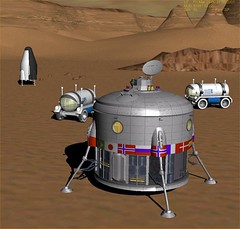
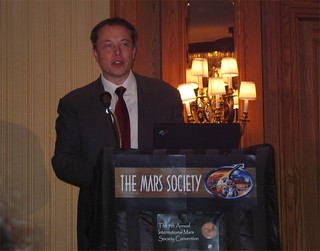
But I really am still quite interested in space, even if I'm not writing books about space flight simulators (simulated Mars Direct mission in Orbiter shown in picture above) and attending space conferences as I did a couple of times back in 2006 and 2007. Two weeks ago, I made a special effort to go see the space shuttle Endeavour at its new museum home in Los Angeles. And I continue to follow developments in private space with great interest, including the accomplishments of SpaceX and its founder, Elon Musk, whom I heard speak at the Mars Society conference in Washington in 2006:

Elon Musk at MSC 2006

Today I was reading the tenth anniversary edition of The Space Review, a weekly roundup of space related articles published by Jeff Foust (congratulations Jeff!). One of the articles is "Can Elon Musk retire on Mars in 2023?" This is something I had heard about back in 2010 but mostly had forgotten. Musk told a newspaper interview that he planned to retire to Mars (not for a while I suppose, as he is only 41). Really? Could that be possible? I mean, I know Elon has had long-term goals for Mars and for human expansion into the solar system. But how soon could there be something on Mars that one might retire to? 

Maybe sooner than we might think if Mars-One has its way. I had not heard too much about this Netherlands-based private organization, but they've got some big plans, including the start of Mars colonist selection in 2013. Whoa, that is now! It's pretty wild and I don't know whether their "Mars colonization as a global reality TV show" could really work for funding. But they are thinking big by thinking small, as in, don't assume any major technological breakthroughs. Plan to use what we know how to make and do now, including rocket boosters from SpaceX, and various technology developed and used for the International Space Station. They claim it is indeed possible.


If they stay on schedule, they will launch a Mars communication satellite and a first pre-supply mission in 2016 (above), and land the first four colonists on Mars in 2023 (one major simplification of their humans-on-Mars program is that all trips are one-way, not round trip - if you go, you plan to stay). Four more colonists will land every two years in the initial plan, though other short-term colonization proponents believe that a viable colony will need to (and could) grow faster than this. By the time Elon reaches a still youngish retirement age of say 60 (in 2031), perhaps there could be a few dozen to a few hundred colonists he could join in a small Martian town.

I certainly believe that it's a good idea to expand humanity into the solar system, in part to provide a genetic backup of sorts in case of some unexpected disaster on Earth. And I would really be excited to see a private humans-on-Mars program starting as early as 2023 - just ten years away! I may be getting ready for retirement around then myself - but unlike Elon, I don't plan to join a Martian retirement village. I will enjoy watching from afar (I hope there's a virtual reality feed I can subscribe to), but I'm rather attached to Earth and many of the people who share it with me. I think I will just stay here and re-read some of Kim Stanley Robinson's novels like Red Mars and 2312

Saturday, July 21, 2012

SpaceX Dragon to ISS: Highlights


Cool video from SpaceX with highlights of the recent successful flight of their Dragon spacecraft (unmanned cargo version) to the International Space Station. This happened in late May when I was in Europe, so I didn't follow the mission at the time, but it's a great milestone for private space.

Monday, March 19, 2012

Elon Musk on 60 Minutes

There was a great segment on 60 Minutes last night on Elon Musk and SpaceX. I share his belief in the importance of humankind becoming a space-faring, multi-planet civilization, but Musk has taken this vision and run with it. Big time. The introduction to the interview says:
In the history of space flight - only four entities have launched a space capsule into orbit and successfully brought it back to the Earth: the United States, Russia, China and Elon Musk.
It's impressive and inspiring to me. I wish I were a 30-something engineer again. I would move back to Los Angeles and get a job with SpaceX!

The text version of the interview is here. The video of the whole show (including commercial breaks) is here (there was also a fascinating story on the neurological condition of face blindness). This appears to be just the SpaceX video segment. I don't know how long CBS keeps these 60 Minutes videos on-line.

Wednesday, December 14, 2011

Stratolaunch: Too Cool


And here I was thinking Burt Rutan had retired.

I just heard about this and watched the simulation video. The concept is to scale Burt's "White Knight" carrier/launch aircraft to super-jumbo size (six 747 engines) to provide a runway-launched "first stage" (Scaled Composites) for a large orbital booster (SpaceX) for cargo or people (using the SpaceX Dragon spacecraft). Stratolaunch is a Paul Allen project with commercial operation projected for 2016. Of course nothing is flying yet, but private space looks to have a few tricks up its sleeve for the coming years.


Monday, May 30, 2011

Skylon in Orbiter

So Wikipedia tells me that the Reaction Engines Skylon proposal has been around for a very long time - how did I miss it? I guess the idea has heated up mostly since 2009 with the emergence of some funding. The new UK Space Egency/ESA report gives it another boost. It will still need a lot of funding, but Reaction Engines claims that it "will be able to repay its development costs, meet its servicing and operating costs and make profits for its operators whilst being an order of magnitude cheaper to customers than current space transportation systems." Here's hoping that all pans out (and that there's sufficient launch business to support this project as well as SpaceX and other private space ventures - so much depends on the costs-to-orbit they achieve). It would be really great to see a true space plane taking off from a runway, flying to orbit, and returning to the same runway - just like in the movies (and even without a pilot).

This article clearly explains some of the hybrid engine challenges. The Wikipedia article explains some of the smart thinking that has gone into keeping Skylon cool and safe for reentry (cool enough to allow an integral ceramic skin to do most of the work, although active cooling will probably be needed for the wings).It will still land as a glider like the space shuttle - no plans to retain fuel and re-start the air-breathing engines for landing.

I may have missed Skylon (until this very recent blog post), but members of the Orbiter community didn't and there is already a cool add-on version as well as some additional work based on that model. I downloaded the basic one by "inzane" and tried it out just a bit (mainly for screenshots). I wasn't able to make orbit on my first try - probably missed some steps in the instructions. Hey, it's new technology! It's also a very cool-looking 3D model.

Although Skylon is an unpiloted launch vehicle (essentially a huge UAV with some serious autopilot smarts), there have been some studies on possible passenger capabilities, and the Orbiter add-on features a passenger module which is visible in the screenshot above. I posted a few more screenshots on my Flickr page.

Carnival of Space #199

The 199th Carnival of Space is hosted this week by Weirdwarp. There are some really cool posts this week, but I was especially intrigued by the mysterious black Skylon space plane, which was reported by Next Big Future. This unpiloted SSTO (single stage to orbit) vehicle has been proposed by a UK company, Reaction Engines, Ltd. (Skylon press release here, PDF). The news is that an ESA report commissioned by the UK Space Agency concluded "no impediments or critical items have been identified for either the SKYLON vehicle or the SABRE engine that are a block to further developments."

This is exciting stuff, the key to its possible feasibility being the SABRE hybrid  air-breathing/rocket engine that would allow Skylon to operate like a jet airplane while within the denser part of the atmosphere, leading to an enormous reduction in the amount of oxidizer that must be carried. The report states that the current design has a gross take off weight of 275 metric tonnes, of which 220 tonnes are propellent, with the ability to place 12 tonnes into an equatorial low Earth orbit. This is something like 4.4% of the total which is pretty good, especially with a fully-reusable vehicle (the calculation for the soon-to-retire space shuttle is about 1.4%, not including the orbiter itself).

The Reaction Engines site says that Skylon is in the "proof of concept" stage, with development estimated at 10 years. There are obviously a few technical issues to overcome (materials, for one, I would imagine), but it's great that ESA at least sees no fundamental showstoppers in the Skylon proposal. Now to get it funded! Reaction Engines estimates development costs of about $10 billion (this seems pretty cheap, even for an unpiloted vehicle).

Bonus: finally a rocket ship that looks like one of Wernher von Braun and Chesley Bonestell's classic Colliers Magazine rocket ships from the 1950's! More or less. Check out the Skylon mission animation video.

Wednesday, December 08, 2010

Congrats to SpaceX!

Congratulations to SpaceX on today's successful first test launch for NASA's COTS program of the Falcon 9 launch vehicle and Dragon cargo spacecraft. The (unmanned) Dragon was successfully recovered in the Pacific off the coast of Southern California. As SpaceX points out, only six other "entities" have pulled off this full operation (launch, orbit, and recover spacecraft) - and they are all countries or groups of countries (USSR/Russia, USA, China, Japan, European Space Agency, and India). Go private space!

Wednesday, April 07, 2010

How to Travel to Space

Happy Birthday ISS (10 years)
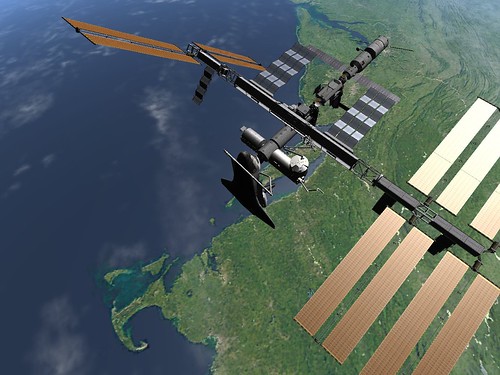
I was looking through some of my Flickr pictures the other day when I noticed a comment from six months ago. I have a lot of screen captures from Orbiter, and one of them was used in an article in an online travel magazine called Matador. It's the one shown here, with the shuttle docked at the ISS with Cape Cod below.

The article is "How to Travel to Outer Space," and it discusses most of the ways civilians have and might be able to get to space, orbital and suborbital - although the Russian Soyuz option to the ISS is probably not going to be available for a while even if you have the $30 million (or whatever the actual fare is). So it's talking about real travel, not virtual stuff like Orbiter. But they liked my picture, which is cool, and they even gave me credit. The Matador site is cool too - most of the trips are down to Earth, but they go to a lot of exotic places.

Update: Speaking of Flickr, NASA has a great Flickr site, NASA: 2Explore. It's not the only place to get NASA images, but it's got a nice selection in multiple sizes and includes current shuttle and ISS missions.

Tuesday, February 23, 2010

NASA Changes: Yes, that's it exactly

A lot has been written about the recent changes in NASA's mission and funding, including the cancellation of the under-funded Constellation "back to the Moon" program and the proposal to rely more on commercial space companies to support Earth orbital operations for both cargo and astronauts. I basically agree with this decision, and I hope that Mars will eventually be emphasized (and funded) as the next big destination for human space flight. I was busy with other things when much of this discussion was going on, but I just found an essay by Michael Belfiore that really sums up my feelings. He wrote a guest analysis for Popular Mechanics on February 1 entitled Human Space Flight Needn't Rely on NASA. This is a very clear-headed and succinct essay on this issue, and its final line on the new direction for NASA rings true:
JFK's let's-go-to-the-moon-in-this-decade battle cry it isn't. But in some ways it's even more exciting, because it points the way to truly sustainable development in space.
The picture above shows Elon Musk of SpaceX standing by his company's Falcon 9 launch vehicle which will launch for the first time this spring.

Wednesday, November 04, 2009

Beam Me Up, Scotty!


Here's a small step for space elevatordom and a giant leap for laser power beaming optics (or something like that). At the Space Elevator Games 2009 in California, the LaserMotive team qualified today for a $900,000 prize. They did it with a small laser-powered machine that pulled itself almost one kilometer up a helicopter-suspended cable. The laser was on the ground and had to track the climber to lock the beam onto the bottom-facing solar panels to keep it powered and climbing at an average speed of 3.72 m/sec (5 m/sec would qualify for the $1.1 million prize).Congratulations to the LaserMotive team! Two other teams will be climbing tomorrow. This is the first time that anyone has qualified for a prize in the Space Elevator Games (last time the goal was 100 meters - a big jump to 900 meters this year). Check out this cool video to see what's involved with this technology challenge (prizes funded by NASA).

This is not quite a space elevator, but remember, a geosynchronous journey of 35,790 kilometers begins with the first half-mile or so.

Galactic Suite 2012 - Really?


I guess I'm really slipping when it comes to keeping up with private space. Before seeing this Reuters item the other day, I had never heard of the Galactic Suite Space Resort project. Based in Spain, this company says they are on track to welcome their first orbital guests in 2012, by which time they will have apparently built a a tropical island training center and launch site, a modular space station, and an orbital rocket plane to carry four pax and two crew from the island to the resort. By 2012? It's not even clear that Virgin Galactic will be flying suborbital passengers by 2012, and they've been working on it for a while. Dudes, it's almost 2010!

Maybe they are actually in league with Bigelow Aerospace (which also mentioned 2012 for a space station, back in 2007).  Their announced price of $4.5 million for three days at the orbital resort compares very well with ~$30 million for a Soyuz ride to the ISS, but wait a minute.  I just watched a video that said they will use Russian flights until their space plane is ready, though Soyuz can only carry one passenger now, maybe two on an upgraded single-pilot version. Doesn't really add up, does it?  I'm very skeptical, even though Galactic Suite claims to have an ace in the hole in the form of an anonymous billionaire space enthusiast who has granted $3 billion to finance the project. I wonder if his name is Dr. Evil?

They have a few cool graphics on their web site, but not a whole lot of information. That pretty much seems to sum it up.

Wednesday, October 21, 2009

Warm-Blooded Plants and Freeze-Dried Fish


Somehow I stumbled on a 1997 Atlantic article by Freeman Dyson, "Warm-Blooded Plants and Freeze-Dried Fish." It's about space exploration and the prospects for humans to (eventually) explore and even colonize the solar system and beyond. Dyson is a distinguished scientist and writer and is well-known (I debated between renowned and notorious) for his independent and often contrary views on certain issues, most recently on the (possibly not-so-terrible) effects of climate change.

In the 1997 space article, I found myself agreeing with a lot of what he had to say (recall that 1997 was the year of Mars Pathfinder and NASA's period of "fast, cheap, and out of control" unmanned spacecraft, which clearly influenced some of his comments). For example, the case for continuing the shuttle and space station programs was not especially compelling (though they would go on for 12+ more years, even surviving a second shuttle disaster). But there are a lot of interesting things in the solar system, and with our rapidly advancing technologies and (eventual) ability to do things in space much more cheaply, places like Mars and Europa could (eventually) be well-worth exploring, though searching for freeze-dried fish orbiting in the vicinity of Europa is perhaps not the best strategy for finding life there (the Europafish would have been ejected by energetic objects crashing through the ice to Europa's hidden ocean - admittedly not a high-probability event). Warm-blooded plants and Mars plants that grow their own green-houses - if nature hasn't evolved them, we could (eventually) genetically engineer them. Maybe even really big ones to use as human shelters on Mars (greenhouse trees!).

Dyson ends up talking about harvesting comets and colonizing the Kuiper Belt - a pretty far-out notion indeed (though not as far as the Oort Cloud Housing Developments). I kept using the word "eventually" in the above discussion. Dyson's key point in all this is the need to be realistic about the goals and the timing. He says, "When emigration from Earth to a planet or a comet becomes cheap enough for ordinary people to afford, people will emigrate." But regardless of what Apollo accomplished in 10 years, the time scale for human expansion into the greater solar system is probably more like hundreds than tens of years.
No law of physics or biology forbids cheap travel and settlement all over the solar system and beyond. But it is impossible to predict how long this will take. Predictions of the dates of future achievements are notoriously fallible. My guess is that the era of cheap unmanned missions will be the next fifty years, and the era of cheap manned missions will start sometime late in the twenty-first century. The time these things will take depends on unforeseeable accidents of history and politics. My date for the beginning of cheap manned exploration and settlement is based on a historical analogy: from Columbus's first voyage across the Atlantic to the settlement of the Pilgrims in Massachusetts was 128 years. So I am guessing that in 2085, 128 years after the launch of the first Sputnik, the private settlement of pilgrims all over the solar system will begin.

This is where I'm afraid he may be right, though it's possible that accelerating technologies and/or one or more major global crises (man the lifeboats!) will speed things up a bit. But I still think it's right to aggressively pursue manned and unmanned space flight now, perhaps with more of it given over to the commercial side. As I wrote in 2007 in a discussion of John Barnes' "Kaleidoscope Century" SF series:
But space (private, public, whatever) could be part of a solution, could be a tool or a lifeboat or even a source of major help for this troubled Earth. Someday we may need every kind of tool we can get, and when we do, we will be glad for whatever preparation we have made in learning to live somewhere other than here. I don't expect everyone to get inspired by it - my most hopeful scenario for educational outreach is that a handful of kids get excited about learning something, get themselves educated, and start to tie a few knots for the flimsy rope bridge we are building toward the future, even while some other kids are playing with matches, trying to light the ropes on fire. And maybe some of the ropes are actually carbon nanotubes stretching thousands of kilometers into the sky.
The process of building and living for months aboard the ISS may seem expensive now, but if we ever do have a major crisis in which the survival of our species requires getting a small fraction of us off the planet in a hurry, we will be grateful for this experience when we are hollowing out our first asteroid and building our first housing project on Mars.

Sunday, September 20, 2009

Solar Power Sats


I've written a few times before about space solar power, and I was pleased to see a post about developments in this area on Friday's  Cosmic Log. After reading Alan Boyle's post entitled "making space power pay," I wondered if anyone had yet created an Orbiter add-on to model a solar power satellite. Orbiter add-on developers have simulated many futuristic systems such as space elevators and the Stanford Torus space colony, and solar power satellites are probably a better bet for the next 20 years (Orbiter add-on developers tend to favor manned spacecraft, but there are many examples of historic, current, and futuristic unmanned spacecraft as well).

So I checked on Orbit Hangar and did a Google search. I didn't find a powersat add-on, but I found a request for one in an Orbiter-forum post back in May. The requester was William Maness of PowerSat Corp., whom Alan Boyle quotes in his blog post. Maness was looking to contract an Orbiter add-on developer to create a powersat model for Orbiter that could be used in some visualizations and simulations of their proposed powersat system (a very cool deployable/inflatable concept). There was some interest and a lively discussion, though wasn't clear from the forum discussion whether he got someone to do it. But based on this video from PowerSat, it looks like they did, at least for visual purposes. Some parts of this video really look to me like Orbiter scenes (from 0:31 to 0:57 -  probably enhanced with video editing mainly to show the microwaves beaming down to Earth). Maness mentioned in the post that he hoped to simulate a launch to LEO on a SpaceX Falcon 9 as well as more specific technical aspects such as sun tracking and continuous thrust engines (presumably electric ion engines) to gradually boost the powersat from LEO to to its operational GEO orbit. Orbiter can do that sort of thing with some clever custom add-on programming.

There are obviously many challenges to developing and deploying solar powersats, but it's pretty exciting to be seeing even such early commercial development, and to think that Orbiter may have a small role to play in developing and promoting these systems.

Sunday, September 06, 2009

Good Article on SpaceX

There's a good article on SpaceX in the current Popular Mechanics, available online here. Written by Michael Belfiore, the article briefly covers the history and some future plans for Elon Musk's private space venture. It includes a "pencast" by SpaceX's propulsion chief, Tom Mueller. This is a narrated motion-capture "whiteboard" video in which Mueller sketches a diagram of his Merlin engine design and explains how it works. There's also a cool photo of a Dragon spacecraft in assembly (better than the November 2008 SpaceX photo shown here).

SpaceX has a contract from NASA to demonstrate cargo delivery to the ISS with the unmanned version of Dragon by the end of 2010. This will be launched on their Falcon 9 rocket for which they also have a number of commercial launches booked. NASA's future in human space flight is really up in the air right now. SpaceX embodies founder Elon Musk's passion for helping to get humans beyond the Earth (his first thought was Mars until he realized how expensive it was to launch things into space and decided to work that problem first). I'm hoping SpaceX and other private space companies will take up the slack through space tourism, launching research projects and astronauts for other countries, and whatever else it takes to keep things moving on the road to a spacefaring society.

PM has a number of other articles on the next 50 years in space online too.