Showing posts with label Moon. Show all posts

Monday, May 25, 2015

SevenEves: Bye Bye Moon


When I got super interested in space flight technology and orbital mechanics back in 2005, I played with the Orbiter space flight simulator for a few months and wrote a 181 page tutorial book for it called Go Play In Space. When Neal Stephenson got interested in space technology and orbital mechanics, he researched it for 9 years and wrote 880 pages to create a novel called SevenEves. The only common thread I can claim is that Neal and I both did our homework on the physics of space flight. But Neal did his homework on much more than this, and tied it all together into a fantastic story. Two major stories, actually -- one an extremely detailed, near-future "disaster movie" (the first two thirds of the book), the other an imaginative and ultimately exciting speculation on the lives of the survivors' descendants, 5000 years in the future. How many survivors were there? The book's title gives a clue that's at least partially correct (it's also a palindrome).

I really enjoy most of Neal Stephenson's writing, and when I learned that his next book would be based in space, I pre-ordered it immediately. When it was released last Monday, it jumped the queue of all the books I was reading or planning to read. I saw a couple of early reviews, including a fairly negative one focused on Stephenson's relative lack of character development and other novelish niceties, in favor of nerdish discussions of all technical sorts. To me, this is a feature, not a bug. I loved the wide-ranging and carefully researched details, and I thought the characters were mostly well drawn. The storytelling and pace are good, although I did feel that it bogged down in the first third of part 3 (the 5000 years from now part). In fairness, there's a lot of explaining to do when you introduce a complex future civilization and many new characters, and after all that setup, the last 300 pages are quite thrilling. Good save, Neal!

The book starts with the moon exploding for no apparent reason. It initially breaks into seven major pieces, but a popular public outreach astrophysicist nicknamed "Doob" (clearly modeled on Neil Degrasse Tyson) and his grad students figure out that it will soon break further into trillions of pieces, many of which will reenter Earth's atmosphere, destroying the atmosphere and everything in it. In 25 months (plus or minus 2 months). Scientists in many other countries independently reach the same conclusion.

Two years is not much time to get ready for the end of the world, so most of the 7 billion people and virtually all other living things will die.  And unfortunately, the incoming swarm of debris dubbed "hard rain" is estimated to continue for some 5000 years. So immediate repopulation of Earth's surface will not be possible. People will have to learn to live deep underground or in space, indefinitely -- somehow. The first 600 pages are mainly focused on a gigantic space lifeboat effort, although it's clear that only a relative handful of people (a few thousand at most) can make it to space in that short time, even with all of Earth's resources, industry, and minds focused on this.

Of course this immediately answers the question, what is the International Space Station good for? Why, to serve as the centerpiece of a swarm of hastily constructed and launched habitat spacecraft that will be used to save this small number of humans in hopes of some sort of future. It's fortunate that in this near future world, the ISS has been expanded to include an experimental rotating habitat and a captured asteroid for experimentation with mining using a fleet of small robots. That at least gives the planetless survivors a fighting chance. But to say there are challenges is a vast understatement. There are many close calls and heroic efforts that turn out to be essential -- like a hastily organized mission led by an Elon Musk-like space entrepreneur to retrieve a chunk of a comet.  This huge mass of water is needed for radiation shielding and to make rocket fuel. You can do that (extract hydrogen and oxygen) if you have enough electric power, like a nuclear power plant repurposed from a submarine. Since part 3 takes place 5000 years in the future, you know that somehow humanity makes it, but it is by the very thinnest of margins.

Is this book realistic? You have to just accept the premise that the Moon just blows up for some reason. The "agent" responsible for this is never really explained, but it doesn't really matter. Everything else within parts one and two ("now") is constrained by realistic physics and plausible current or near-future technology. Orbital mechanics is a major constraint and is handled very well. The problems of radiation, microgravity, growing food in space, living in crowded spaces, and many other issues are handled realistically. Space debris is a constant problem, especially once the "hard rain" starts throwing parts of the former moon in all directions. Space construction requires the help of thousands of small robots, but these are not especially smart robots -- plausible extrapolations of things I have read about in MIT Technology Review. All in all, I consider parts 1 and 2 to be some of the best "hard SF" that I've ever read.

Part 3 is more problematic for me, though ultimately enjoyable. The future space construction technology is massive, though still believable by extrapolation of robotic capabilities. But the tight connection between the personalities of the few survivors and the characteristics of the resulting race-driven civilization in 5000 years often did not ring true to me. There are a lot of interesting and plausible ideas, but also a lot that I thought was very silly, seemingly just made up, "because I said so." These are extrapolations of genetic and social engineering over 5000 years. I don't think you can say anything definitive about this based on anything we know, even if you accept genetic manipulation of the human genome as a required and well-understood tool.

Of course it is all just made up by the author. But it is in part 3 that I have to say to myself, "that's why they call it science fiction." It's still more than fantasy or magic, though I wouldn't call it hard SF. But overall, it's a really good book, and most of those 880 pages flew by over the last six days (actually 14,403 Kindle "locations," read mostly on my iPad).

It's a long book, full of interesting ideas and good writing. I learned a lot, as I always do from Stephenson's books. It is ultimately a hopeful book -- humans are resourceful and manage to barely survive, and eventually go on to build a new and very different civilization and to start to repopulate the Earth (with genetically engineered plants and animals, synthesized from a comprehensive DNA database that was saved from "Old Earth," since no actual animals and very few plants were brought to space -- the Old Earth mission planners did manage to preserve much of Earth's knowledge, genetic and otherwise). But as different as their new civilizations are, aggression and racial stereotypes remain -- even though the races are completely new. Even if we were capable of building a future "paradise," even a small handful of people will fail to agree that it is paradise -- some will want something else. Humans are difficult creatures. It will always be so.

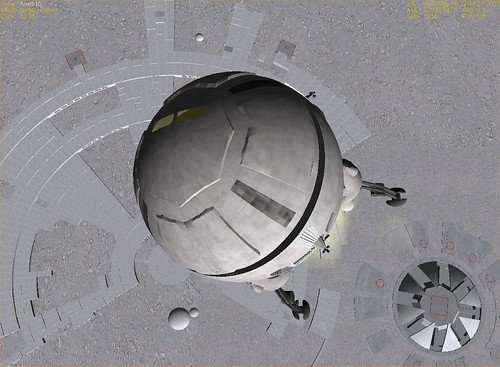
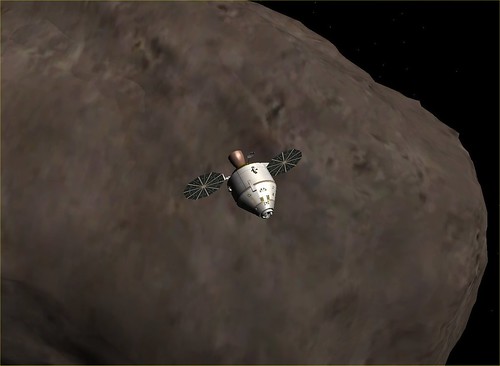
The images here are my own screen captures from the Orbiter space flight simulator, loosely inspired by early events in the book. Some of them are from a project I did in 2006 called "Mars for Less," a partial simulation of a human Mars mission using existing launch vehicles and orbital assembly. We used some of the techniques discussed in SevenEves, such tethering two spacecraft together and rotating them to generate artificial gravity. There are better artists' conceptions of some of the objects in the book here. There's a companion website for the book here, including the author's book tour schedule. He's in Cambridge, MA next Friday, so I'm going to hear him speak about the book. I hope to learn a little about how you go from a palindrome and some concerns about space debris to an 880 page book.

Thursday, September 13, 2012

Where It All Began


I meant to post this when it was actually 50 years to the day, but now it's after midnight. Oh well, it's still cool. Fifty years ago yesterday, September 12, 1962, President John F. Kennedy gave a speech at Rice University in Texas in which he stated the goal of landing a man on the moon by the end of decade. The famous part of the speech is this:
We choose to go to the moon. We choose to go to the moon in this decade and do the other things, not because they are easy, but because they are hard, because that goal will serve to organize and measure the best of our energies and skills, because that challenge is one that we are willing to accept, one we are unwilling to postpone, and one which we intend to win, and the others, too.
Guess what? Apollo 11 landed on the moon on July 20, 1969, fulfilling JFK's pledge. There's a lot more to the story of course. But it's still a pretty good story. 1962 was right around when I started to get crazy about space and all the associated technology. It's pretty amazing that when he made this speech, only four Mercury astronauts had flown in space, two very quick suborbital flights (Shepard and Grissom) and two brief orbital flights (Glenn and Carpenter), three orbits each. Wally Schirra would fly six orbits a few weeks after this speech. It's a long way from three orbits to the moon.

There's a video here. The text of the speech and other links can be found here.

Tuesday, February 07, 2012

Le Voyage Dans La Lune (1902!)

Today's Amazon MP3 Daily Deal is a new album by the French band Air for $3.99. Normally I'm not a big fan of Air's electronic/pop music, but this is an interesting special case. They composed a new soundtrack for the 1902 silent movie "Le Voyage Dans La Lune" which has recently been restored to its hand-colored original state (the video is included with the MP3 download). This 15 minute film is said to be the very first "science fiction" movie. Loosely based on Jules Verne, it depicts a trip to the Moon in a hollow artillery shell fired by a huge cannon.

The trip is fast and the shell hits the Man in the Moon right in the eye (so much for the science!). The band of intrepid French explorers soon encounters angry Moon natives and of course fighting ensues. They retreat to their capsule, which has been conveniently placed on a cliff with a rope attached to the nose, which one of the men uses to pull the spacecraft over the edge (I had always wondered about the return plan with an artillery shell spacecraft and no known cannons on the Moon). It quickly falls to Earth for an Apollo-like water landing, whence the explorers are rescued and hailed as heroes.

Considering this was made a year before the Wright Brothers flew, it's really pretty impressive despite a few liberties taken with the physics. For the price of a latte and 15 minutes, it's an amusing piece of space pre-history. And the music is OK.

Thursday, September 08, 2011

Apollo 17 from LRO!

I just love today's APOD, a low altitude photo of the Apollo 17 site taken recently by NASA's Lunar Reconnaissance Orbiter (LRO). With its orbit adjusted to make a low pass of about 22 km above the surface (about 14 miles or 73,000 feet), it was able to capture a very detailed view of the LM descent stage and other hardware left behind at the site, as well as the tire tracks from the Lunar Rover (LRV). The picture below shows the A17 descent stage just after the ascent stage launched on December 14, 1972 (video frame from the TV camera on the LRV, parked about 150 meters away as shown in the LRO photo above).

This should finally put to rest all the nonsense about how the moon landings were faked, but of course conspiracy theorists will take it in stride - after all LRO is a NASA spacecraft that is (allegedly) orbiting the moon, and how easy would it be to fake this picture with PhotoShop? Child's play! They've kept the secrets of the moon landings covered up for nearly 40 years, why stop now?

Saturday, July 09, 2011

Photographic Moon Book (v3.5)

This is something I just rediscovered on my hard drive while looking for something else. I wrote about Alan Chu's wonderful Photographic Moon Book in 2007. It is an observer's photographic guidebook to the Moon containing nearly 300 annotated images of lunar features as well as some great introductory material on the Moon. Alan has continued to update and improve it. He released version 3.5 in March 2011. It's a free PDF, and it's big - 125 MB. You can download it from Alan's own Hong Kong site, or from a US based mirror site.

When I first found this in 2007, there was also a smaller document called the "Moon Science Primer." Most of this material is in the introductory section of the Moon Book, but the Primer goes a little deeper on some topics. Although Google still has a link to this, there is no link on Alan's home page, and the Google link returns a "not found."

Tuesday, November 30, 2010

2001: Aries at Clavius #3


2001: Aries at Clavius #3, originally uploaded by FlyingSinger.
I just renewed my Flickr Pro account for another year and was looking through my "photos" (most of them are actually Orbiter screen shots). This is one of my favorites, recreating a scene from 2001: A Space Odyssey (using the great World of 2001 add-on). The Aries moon shuttle is making a near-vertical approach to Clavius Base. The animated dome is retracting.

Saturday, October 02, 2010

Moon (the movie) Revisited

I saw the movie "Moon" on an international flight some months back. It was seat-back video in economy on a 777, so we're not talking big screen here. I was probably tired too. I wanted to like it, but I thought it was stupid. When it showed up as a streaming Netflix movie (in HD), I decided to give it a no-cost second chance. I'm glad I did, because on a good size screen, the visuals were really cool and "realistic" in a 2001 sort of way. I liked Sam Rockwell's character, and this time I caught the early clues as to what was going on, so it didn't seem quite so arbitrary and confusing. Still quite implausible, but it paid off my suspension of disbelief well enough to forgive the original premise.

That premise is a lunar far-side Helium-3 mining base (in the semi-near future) that is essentially 100% robotically operated, except for a single human troubleshooter employee who is stationed there alone for a three-year tour, during which the lunar communication relay satellite that would allow direct communication with Earth seems to always be out of commission. I won't spoil it otherwise, but Sam eventually figures it out, with some significant help from his sidekick, a robot named Gerty (voiced by Kevin Spacey). Part of what's implausible is that with robotic AI technology as smart and sensitive as Gerty, why couldn't the base be completely robotic (with some help from telepresence systems that would allow Earth or lunar near-side humans to do the troubleshooting without living in total isolation for three years - or something like that).

One parallel with 2001 is a robotic assistant who (which?) goes crazy. Unlike HAL, Gerty doesn't become a psychotic murderer, but he does go so far outside of any conceivable programming that you could only call it crazy helpful (it's nice when your robot buddy tells you how to selectively erase some of his memories to prevent the boss humans from learning about something you're trying to hide that he/it would otherwise have recorded and would report). But hey, it's just a movie, and a pretty enjoyable (though sad) one at that.

Monday, August 02, 2010

Why Moon Landings Were Not Faked


I found this brief video clip through a Universe Today post from last week, but I just love it, so I have to post it here too. It's one of the few "space related" things that I find myself sharing widely with "civilians"  (i.e., friends and relatives who care nothing about space, also called "normal people"). And it's just so funny, I've watched it five or six times myself.

Admittedly this video is more about humor than space, but it does address something that has always puzzled me about moon landing conspiracy "theorists." Between 1962 and 1972, NASA's budget totaled about $260 billion (in 2007 dollars). Much of that was spent on the Apollo program, ostensibly to send astronauts into Earth orbit (11 times, since all the moon missions first orbited the Earth) and later to the moon (nine times with six successful landings - the others were the two planned orbital missions and Apollo 13 which flew once around the moon and back to Earth). According to Moon hoax fans, if this money was spent at all, it was spent on faking the moon landings through an elaborate conspiracy involving thousands of government and contractor employees. These people supposedly built a lot of real-looking but non-functional hardware (plenty of civilians saw the hardware) and applied amazingly advanced special effects technology to produce thousands of photographs as well as many hours of film footage, video, and audio recordings (including radio transmissions that seemed to come from the moon - though of course NASA also controlled the tracking antennas, so who knows?). They also produced a lot of scientific data and a few hundred kilograms of "moon rocks" (which could have come from Hawaii or someplace, right?).

That's all well and good, the joke's on us and all, but what about the Saturn V rockets? Thousands of people witnessed the launch of thirteen gigantic rockets in Florida from 1967 to 1973. Flames came out, loud noises, something went into the sky. Where did they go (some did go only into Earth orbit for tests and to launch the Skylab space station in 1973)? Well maybe the conspiracy people will allow that NASA can put things into Earth orbit. Are they still up there? Did they burn up and reenter the Earth's atmosphere? Wouldn't someone have noticed this? Or did they go to the moon, but without astronauts? Was NASA good enough to do that, but not to land and return the astronauts?

It's all so ridiculous, of course, and if you are in the conspiracy frame of mind, you can always come up with additional things that could have been faked to conceal the other fakes. But why thirteen Saturn V's? And why six "faked" landings (plus Apollo 13 which was aborted)? Why not just launch two or three Saturn V's (to prove you're testing them, of course) and then one successful faked landing? Then declare "mission accomplished, JFK honored, Soviets beaten" and spend the rest of the money on planes and bombs for Vietnam?

Recently the Lunar Reconnaissance Orbiter has sent back pictures of the Apollo landing sites. But who controls LRO? NASA of course. No doubt the conspiracy continues to this day. And there is no way to convince the conspiracy faithful, of course. But we can have a good laugh about it once in a while, as with the video that triggered this whole rant!

Friday, April 16, 2010

Asteroids & Mars on the Agenda

Orion CEV with Asteroid #2
After President Obama's speech at Kennedy Space Center, I think I'm pretty much with him and Buzz Aldrin on the new direction for NASA. I can understand the view of Neil Armstrong and others who feel that by not defining a specific near-term goal for NASA to accomplish (namely to return to the moon in a government spacecraft by some target date), Obama seems to be pulling the plug on human spaceflight for the USA. But the operative word there is seems - because a specific goal without the funding to achieve it is really not a goal at all, and certainly not a near-term one. It's more like a wish, accompanied in the case of the Constellation program by the hope of keeping many of the employees and contractors who now work on the shuttle employed for the many years it would take to get Ares I and Orion off the ground, at least until some cash-strapped future president finally cancels these programs. There was no serious plan or funding for the moon lander. But maybe if enough people believed in Constellation (like Tinkerbell the fairy), it wouldn't die.

I don't know. I love the Apollo program and all it accomplished, but it really doesn't seem like a sustainable approach absent a Cold War imperative and the willingness to pump a lot more money into NASA than anyone has done since probably 1967. And as Elon Musk of SpaceX said in this statement, "The President quite reasonably concluded that spending $50 billion to develop a vehicle that would cost 50% more to operate, but carry 50% less payload was perhaps not the best possible use of funds."

So what do we have now? A couple of specific human spaceflight goals for "the next decade" (visit an asteroid as shown above, and orbit Mars) that are quite far off (2025+) and not too detailed. A reinstated and scaled-back Orion capsule which will serve as a development platform for future human spacecraft and provide a government-built option for emergency escape from the ISS, which will be extended by five years to 2020. And a plan to develop the Ares V, a heavy lift vehicle that could support a variety of programs in future years. Plus more funding to encourage privately developed spacecraft and launch vehicles - call it the "private option" (you would think Republicans would be all over this - except that it conflicts with their Prime Directive, to oppose Obama on everything). And more funding for NASA to develop advanced propulsion systems and other technologies that will be needed for future missions but are too risky for companies to handle as "product development." Note that they are actually increasing NASA's budget by $6 billion over the next five years to help support these plans.

So all things considered, I think it's a pretty good plan, and President Obama summed it up pretty well in his speech:
Fifty years after the creation of NASA, our goal is no longer just a destination to reach. Our goal is the capacity for people to work and learn and operate and live safely beyond the Earth for extended periods of time, ultimately in ways that are more sustainable and even indefinite. And in fulfilling this task, we will not only extend humanity's reach in space -- we will strengthen America's leadership here on Earth.

Tuesday, February 23, 2010

Free NASA App for iPhone


With the changes underway in its mission and funding, I'm not sure if there will be a Lunar Electric Rover in NASA's future, but you can still learn about it and "drive" it in a free iPhone/iPod Touch app that's now available. It's not the most exciting game you'll find for the iPhone, but the graphics and background info are pretty cool. It's available from the iTunes App Store (search for NASA Lunar Electric Rover Simulator).

Wednesday, October 28, 2009

Apollo 17 Site from LRO at 50 km


NASA's Lunar Reconnaissance Orbiter (LRO) was moved to its final mapping orbit on September 15. Now orbiting just 50 km above the lunar surface, it passed over the Apollo 17 landing site on October 1 and took some great images showing the LM descent stage, Lunar Rover tracks, deployed scientific instruments, and even the American flag. These images are about twice the resolution of previous LRO Apollo site images (from higher orbit). The video here gives you a little tour.

Thursday, September 24, 2009

Lunar Water Parks?


Everybody's talking about this, so if you care, you probably already know that NASA has found water on the Moon. With concentrations like one liter of water per tonne of lunar regolith, we're talking about wading pools more than water parks (plus it's pretty much frozen). But still - all together there could be billions of liters of water, and it may be much more concentrated in some locations (like shadowed polar craters - LCROSS may give us more data soon). The evidence is spectroscopic, but comes from instruments on three independent spacecraft. Cool!

Thursday, September 17, 2009

Lunar Electric Rover


I just read this Technology Review article on NASA's Lunar Electric Rover (LER) which recently went through extensive "road tests" in the Arizona desert, simulating a two week moon mission. This is no Apollo-type "dune buggy" but more of a pressurized lunar RV. It's got some amazing capabilities. The video shows the assembly of the vehicle (for the presidential inaugural parade in Washington last January) and then some driving footage in some desert-like terrain, including a part where it drives sideways! The way the spacesuits dock to the vehicle is also really cool. I hope to see astronauts driving these things on the moon someday, but the way things are going it's going to be a long wait.

Thursday, September 03, 2009

Apollo 12 from LRO

Apollo 12 was probably my favorite Apollo mission, partly because of the fun-loving crew of Pete Conrad and Alan Bean, and partly because of the amazing fact that on the second Moon landing (in November 1969), they managed to land just 180 meters from the Surveyor 3 spacecraft and then bring parts of it back to Earth. All this after their Saturn V had been struck by lightning shortly after liftoff! What a crazy mission.

I wrote more about it back in December 2007 when I was reading about Apollo 12 in the book A Man on the Moon and decided to simulate the landing and Surveyor EVA myself using Orbiter and AMSO. I can even recall something of the "snowman" layout of craters that was apparent when I made my final approach to the landing site in Orbiter.

So I was really pleased today when I learned that the first pictures of the Apollo 12 site taken in August by the Lunar Reconnaissance Orbiter (LRO) had been released. Better pictures will come when LRO gets down to its lower final orbit in a few weeks, but in this one you can see the Lunar Module (Intrepid) descent stage at the top of Surveyor crater (11 o'clock position), with astronaut footprint tracks emanating from it (Surveyor Crater is the "body" of the snowman which is lying on its side with Head Crater to the left). Surveyor itself is at the lower right of Surveyor Crater (4 o'clock). Cool! There's a labeled LRO site picture and a summary of Apollo 12 here. Thanks to Emily at the Planetary Society Blog for the tip.

Note: in the LROC browser window for this image, it opens as a long vertical strip you can zoom with a slider at the bottom. The Apollo 12 site is near the left edge about 60% from the bottom of the long frame in the small locator image.

Sunday, August 02, 2009

Starry, Starry Starfest

Starfest 2009 went really well last night, thanks to the contributions of many volunteer members of the Aldrich Astronomical Society, not to mention some amazingly clear skies. The Moon looked a lot like the picture shown here (thanks to KCrawfish03 on Flickr for this shot). It was bright, but pretty low in the sky, so it allowed for some great Moon viewing and also allowed some other sky objects to be seen quite well by our telescope viewing guests once it got dark around 9:30.

Before that, we had some really cool presentations in several classrooms at Anna Maria College. I started out as a greeter, helping to explain the options to visitors as they arrived (they had to make some choices since we had a lot of presentations and activities to choose from). I then attended a really nice presentation on the Kepler mission to detect Earth-like planets orbiting other stars. Kevin Boucher's presentation included a demo using a Lego model of planets orbiting a light bulb "star" with a photodetector connected to the PC to graphically demonstrate how Kepler detects planets by accurately tracking the light output of some 100,000 stars.

My presentation "The Once and Future Moon" featured a small pep talk on how, yes, we really did send astronauts to the Moon from 1969 to 1972, including some recent pictures of the Apollo landing sites taken from the Lunar Reconnaissance Orbiter (it's a shame that you still have to talk about that, but Moon hoax conspiracy wackos are still out there). But the main event was a very noisy simulated Saturn V launch in Orbiter, followed by a simulated Apollo 11 Moon landing. The kids (and adults) seemed to really enjoy that, especially when Neil said "the Eagle has landed." Then it was 9 o'clock and I sent them all to get their telescope etiquette briefing so they could go look at the Moon itself through the telescopes behind the science building. I don't know how many guests we had, but it seemed like a lot of people, and they seemed to all be having a pretty good time.

Friday, July 31, 2009

Miracles of Science, the Moon, and MIT

It's great when friends visit from out of town. For one thing, you get to see things in your own area that you'd probably never see otherwise. When my friend Rob Simbeck visited from Nashville last week, we hung out and did music and stuff, but we also took a day trip into Cambridge. After lunch at the geek-chic Miracle of Science Bar & Grill, we spent a few hours at the MIT Museum, which amazingly enough, I had never visited.

The MIT Museum has especially great exhibits on robotics and holography, but I also liked the small exhibit on Apollo. Much of the work on guidance and navigation was done at MIT's Draper Laboratory, including the development of the AGC (Apollo Guidance Computer - try it for yourself, or read the history here). Some of the development hardware was on display, along with a reproduction of a large blackboard showing the Command Module GN&C Block Diagram (interactive version here). Very cool stuff.

It's also cool that forty years later, Draper Labs continues to be involved with systems for landing on the moon, as discussed in this recent article in the MIT Technology Review. Their system for NASA's Altair lander will be a lot smarter and friendlier than the AGC. It will use LIDAR (laser radar) to accurately characterize the lunar surface so the software can recommend the best landing options, as shown in the simulator image above.

Monday, July 20, 2009

We Choose the Moon

I just learned about "We Choose the Moon," a special "live +40 years" web site from AOL and the JFK Museum. It's feeding "real time" audio from Apollo 11, but displaced by 40 years! I happened to "tune in" at about 17 minutes before the Eagle landed (that was at 4:17 pm EDT). So now it's just a few minutes before landing, and it's audio-only, static and all, program alarms, NASA commentary, just like it was for those of us watching TV or listening to radios on this day back in July 1969. Very cool idea! I'll have to tune in for Neil's first steps tonight.

It Was Forty Years Ago Today

It was forty years ago today: of course I'm referring to Neil Armstrong and Buzz Aldrin landing on the moon on July 20, 1969, not when Sergeant Pepper taught the band to play (that was twenty years ago today). I'm having a busy summer, and what celebrating I was able to do for this historic anniversary took place last Thursday (July 16) which was the anniversary of the Apollo 11 launch. I spent the second of three Thursdays in July at the Boston Children's Museum, doing "live" demos to supplement their Living in Space exhibit. I say "live" because I was actually using the Orbiter space flight simulator and the great AMSO Apollo add-on package to perform simulated Saturn V launches and Eagle (LM) landings at Tranquility Base, while sharing my reminiscences of July 1969 with visiting kids and their parents. I had a number of other pre-planned simulation events (e.g., docking the shuttle with the ISS just like the real STS-127 mission now in progress), and with a billed schedule of such 15-20 minute "happenings," the second day was much busier and more fun than the first (for the kids and for me).

Only a few of the kids understood the significance of that historic week forty years ago. More of the parents got it, though most of them were too young to remember it themselves. And what was the significance of that week? If you read Tom Wolfe's NY Times essay on the Apollo 11 landing, you'll learn that it was "one giant leap to nowhere," and that this was because Apollo was actually a high-tech version of sword play between the Soviets and the Americans, and because while NASA had many scientists, engineers, and adminstrators, they had only one flawed (former Nazi, oops) "philosopher," Wernher von Braun - not enough fire power and "Words" to justify pushing on to Mars once the Soviets were beaten in the moon race. Bummer.

I know that NASA only got the budget that it got in the sixties because the space race was a proxy for the Cold War, and I know we've been "stuck in low Earth orbit" since 1972, but I'm still a bit of a romantic when it comes to interpreting Apollo 11, whatever its political genesis, and however delayed its ultimate effects may be. For the first time ever, humans left the Earth and landed on another body in the solar system. That was an insanely bold and cool thing to do, especially with the technology of the 1960's. It was way ahead of its time. But it showed that we could actually leave this planet when we want or need to, and go to other places.

Of course all the other places we will eventually visit and inhabit are much, much farther away than the moon, and the energy and technology required will be much greater. But when the time comes, we can do it, we can go to those places. Of course we should do our best to repair and maintain this planet - Earth is the Cradle of Mankind, and while one normally doesn't stay in the cradle forever, it has been a pretty spacious and human-friendly cradle, so most of us will stay as long as it remains habitable. But there's no guarantee that it will remain habitable forever - there are a lot of ways that we and/or "Nature" could mess that up, and I for one would like to have a long-term backup plan. Robots are great for science and exploration, as are humans, but I'm talking about places where humans can eventually live.

The Apollo program was an impressive proof of concept and down payment on those future developments, not to mention a tremendous inspiration to me and to many thousands of other engineers and scientists of my generation. Whatever Neil's exact words or intended words may have been when he hopped off that ladder, it was indeed one giant leap for mankind, and if there are still people around to remember things a couple of hundred years from now, I would bet that Apollo 11 will be one of the few events of the 20th century that will be considered worth remembering.

Tuesday, July 14, 2009

Apollo 11 on PBS


There are so many things happening to commemorate the fortieth anniversary of the first moon landing, and I just don't have time to absorb most of it. I did read a couple of interesting pieces in the New York Times (iPod edition) this morning, including a nice reminiscence by John Noble Wilford who covered the Apollo program for the Times back in the day (if you search nytimes.com for "wilford moon" you can pull up his original articles, though you have to pay to read such archive articles). Good thing I've been absorbing the Apollo program for a good 45 years myself or I'd really be feeling some pressure this week!

Thursday is the anniversary of the Saturn V launch for Apollo 11 (July 16, 1969), and I'll be at the Boston Children's Museum again, helping out with their "living in space" exhibit. I plan to use Orbiter to launch a few simulated Saturn V's for the occasion. And that evening I plan to watch a PBS special, "Apollo 11: First Steps on the Moon," which will air at 9 pm on my local PBS station (WGBH Boston). The video here is a brief trailer for the show.

Monday, July 13, 2009

Apollo 11 Memories

We're coming up on the 40th anniversary days for Apollo 11 - the mission launched on July 16, 1969, and the first moon landing was on July 20. I just listened to Nancy Atkinson's 365 Days of Astronomy podcast from July 11, "Apollo 11 Through the Eyes of a Young Girl." Nancy even put some of her memories into musical form with a folk-style song called "Who Flies the Ship When Mike Collins Goes to Sleep?" Neil and Buzz get all the glory, but it's good to remember Mike, too (pictured above, training for Apollo 11 - it's hard to find photos of Mike in space!).

My own memories of this time in 1969 are not musical (yet!), but they are pretty vivid. As I wrote back in 2007, that was the summer between my junior and senior years in high school, and I was lucky enough to spend six weeks of it at Ohio University in an NSF-sponsored Student Science Training Program. There was a TV in the lounge of my dorm (I think it was Washington Hall), and that's where I watched with a bunch of fellow high school science students from all around the U.S. as Neil Armstrong took his first steps on the moon (it wasn't all science - we had some great field trips and I even had time to develop a serious crush on a girl from Virginia).

I had just turned 16 in June and was still planning to be an aeronautical engineer - it really seemed like anything was possible that summer, and that the way to do "anything" was through science and engineering. I finally ended up an optical engineer (with a few detours along the way for computer science, physics, and music), but I certainly attribute my strong interest in science, math, computers, flying, and space to the U.S. space program, especially the Gemini and Apollo programs that I followed intently through my elementary, junior high, and high school years, 1962 to 1970.