Showing posts with label astronomy. Show all posts

Tuesday, January 24, 2017

Fermi Paradox Explained?


I’ve often thought that the whole “where are they?” question about SETI (i.e., the Fermi Paradox) is bogus, both because the universe is just so BIG, and because we still understand so little about it, even though we have learned in recent years that planets and even “Earth-like” planets seem to be quite common throughout the Galaxy. As smart as some of us may be, it seems likely that we are still as clueless about major chunks of physics as scientists in the 1800’s were about quantum mechanics and the scale of the universe. If there are wormholes or quantum foam or gravitational technologies we won't develop for another 200 years, there could be aliens popping in and out all the time, and we wouldn't even know what to look for. It would be like an airliner passing 37,000 feet above some remote tribe of people who have never encountered other humans or modern technology, as unlikely as that may be today.

Such advanced beings might find radio wave communication to be as quaint as rubbing sticks together as an energy technology. I’ve also read articles suggesting that we ourselves are probably approaching the end of our “radio age” due to fiber optics and other technologies. Though we still send out a lot of radio waves, they tend to be more directional (like radar, microwaves, etc.) or short range (cell phone towers, Wifi, Bluetooth, etc.). Maybe technical civilizations only use radio waves for a few years and any continued or specialized use eventually becomes very efficient with very little leakage to space.

Somehow I wandered over to Centauri Dreams, a blog that periodically blows my mind with advanced space exploration ideas. I found an article “CitizenSETI” about a couple of guys (Roger Guay and Scott Guerin) who decided to work out this Fermi thing. A key part is the lifetime of an IC (intelligent civilization), which really means the DETECTABLE lifetime. If that is very short (e.g., humans have been broadcasting for about 110 years and listening for only about 60 years), and if such civilizations are widely separated in time and space, you will have a big “synchronicity” problem – finding times and places where someone is broadcasting AND someone in range is listening.

Roger Guay created a simulation with LiveCode, a modernized version of my old, beloved HyperCard for the Mac (screen shot above). In his Advanced Civilization Detection (ACD) program, he can set various assumptions about the spacing, lifetime, and other factors and run this simulation at high speed. Under most reasonable assumptions it creates a sort of “firefly” effect with detectable IC’s flashing in and out of existence and only rarely being seen by other IC’s. If these assumptions and simulations are reasonable, IC’s could be plentiful and it might still take hundreds of years of observation to catch one of these “fireflies” before it flickers out.

I've been interested in this subject since I read Intelligent Life inthe Universe by Carl Sagan and Iosif Shlovsky back in 1974. This was a pretty early work on exobiology (or perhaps astrobiology), a field that still lacks data but provides an interesting framework for thinking about everything we know about ourselves. My guess is that unicellular life has probably evolved in many places but that the leaps to multicellular, intelligent, and technological stages are much rarer, though certainly possible (current sample size is N=1 if you give humanity the benefit of the doubt as an IC).

Based on this simulation work, we are not likely to expand that sample size anytime soon. Here is Roger Guay’s final paragraph on Centauri Dreams:

Conclusions? The ACD simulation dramatically demonstrates that there is indeed a synchronicity problem that automatically arises when ICs attempt to detect one another. And for reasonable (based on Earth’s specifications) Drake equation parameter selections, detection potentials are shown to be typically hundreds of years apart. In other words, we can expect to search for a few hundred years before finding another IC in our section of the galaxy. When you consider Occam’s razor, is not this synchronicity problem the most logical resolution to the Fermi Paradox?


Of course this is hardly the last word on the subject of the Fermi Paradox. In fact, while reading the blog posts that triggered this one, I discovered a recently updated book that goes into much greater depth, If the Universe IsTeeming with Aliens … WHERE IS EVERYBODY?: Seventy-Five Solutions to the Fermi Paradox and the Problem of Extraterrestrial Life (2015) by Stephen Webb. I've read the Kindle sample and I may have to buy it despite my insane backlog of books already waiting to be read. Author Stephen Webb also has an interesting blog

Saturday, November 26, 2016

Orbiter: 2016 vs. 2010


As I wrote recently in this blog and in an article in The Space Review, Orbiter 2016 was released in September. This is the first major release of this freeware space flight simulator since Orbiter 2010, and as I mentioned, not all of the many third-party addons for the 2010 version are working in Orbiter 2016. If you are familiar with Orbiter, you know that it's quite easy to have multiple installations of the software on the same PC, so there is no need to replace the 2010 version with the 2016 version -- as long as you have the disk space, you can keep multiple copies of both versions installed in separate folders and just run the one that has the features and addons of interest at the moment. In the picture pairs below, the top screenshot is from Orbiter 2010, the bottom one is from Orbiter 2016. 

You should also know that although there are some user interface changes in the 2016 version, they are really quite minor, so even if you are new to Orbiter, you can install and use both the 2010 and 2016 versions quite easily. Some developers have already updated their addons for 2016, and others no doubt will when they have the time and inclination. But Orbiter 2010 is still readily available, so if you are interested in the Apollo program, the advanced Shuttle Fleet, the fictional spacecraft of 2001: A Space Odyssey (sample screenshot at the top of this post) or Colliers Magazine, and many other addons, there's no need to wait for 2016 versions to come along. Note that the final version of Orbiter 2010 is often called 2010-P1 (patch-1) or 100830 (August 30, 2010).


Here are some observations and tips for working with both Orbiter 2010 and the new Orbiter 2016:

1. The biggest user interface difference is that the "no-cockpit" full screen pilot view has a control bar that appears when you hover the mouse near top edge in the 2016 version. In the 2010 version, the F4 key will pop up a small menu bar with same controls (in the 2016 version, F4 will toggle the top edge menu between "on" and "auto-hide"). See "no-cockpit" comparison screenshots above. 


2. The biggest visible difference in the 2016 is in its support for highly detailed surface terrain data complete with elevations, so mountains and craters are true 3D objects. This makes for some incredible eye-candy especially when you are flying low over the terrain, but in most situations in Orbiter, you are orbiting (oddly enough) 200 km or more from the surface, and the flat 2010 terrain textures look just fine. 

3. In addition to the general high-res 3D surface data for all of Earth, the Moon, Mars, and some other bodies, Kennedy Space Center (cockpit view above) and the Edwards AFB/Mojave region (see shuttle final approach screenshot below) have been given super-detailed makeovers in Orbiter 2016. Again, this doesn't matter much if you are in orbit or cruising to the Moon or Mars, but it does add a lot to the realism before you launch or when you are landing at Edwards AFB. 


4. There is a thread on the Orbiter Forum that reports addons that are known to work in Orbiter 2016. There are quite a few and there are probably many others that have not been tested but may work. Orbiter Sound 4.0 works with Orbiter 2016 though there are a few minor glitches such as incorrect audio feedback for some actions (e.g., the G key for "landing gear" in the Deltaglider will deploy the gear but audio will say "radiator deployed"). 

5. Some popular addons that currently seem to work only in Orbiter 2010 include AMSO (Apollo program in great detail), Shuttle Fleet V4.8 (which is freaking amazing), and the excellent "World of 2001" and "World of Colliers" addons by "Sputnik." Note that even for 2010, some addons may only work with Orbiter's "native" graphics (not the D3D9 Orbiter_NG client which offers better graphics quality and frame rate). I'm not sure how to know this for sure, but if you find that your spacecraft are invisible in the D3D9 client, you should try the native graphics version. 


6. One addon I especially like is the videnie module for orbital path drawing by "artlav." It renders orbital paths for spacecraft, planets, and other bodies in exterior views (green, red, and purple lines around Earth in screenshot above from Orbiter 2010). This is super cool and very helpful in understanding orbital paths, but it only works in native graphics mode (not orbiter_ng) with Orbiter 2010.

7. If you have plenty of hard drive space available, a good general tip is to create two separate "clean" installation folders, one for Orbiter 2010-P1 and one for Orbiter 2016, including whatever terrain data you prefer, and perhaps with Orbiter Sound 4.0 installed. Make a copy of the clean installations and install any desired addons there. Note that Orbiter 2016 installations with full terrain data can be very large (I have one installation that is 58 GB). 

8. Orbiter Sound supports mp3 playback with control over when the music plays (e.g., exterior views only). But since modern versions of Windows support multi-source sound multiplexing, I tend to just stream music from Amazon or iTunes while running Orbiter. An album of Strauss waltzes is a particular favorite, especially with the World of 2001 addon.


Note: The screen shots here are from Orbiter 2010 and Orbiter 2016, without modification. You can find them and various others in full screen resolution in this Flickr album

Wednesday, May 11, 2016

Sunspots


I love to write, though you might never guess this from my recent blog activity. While this is my first blog post of 2016, I used to blog a lot more -- some 1500 entries since I started this blog in 2005. Most of my writing these days is in a journal I keep on my iPhone and iPad using an app called Day One. I like keeping a journal, but recently I started to think about getting out of my comfort zone and doing something a little different with writing. Looking around, I found a wonderful organization called the Seven Bridges Writers' Collaborative in Lancaster, Massachusetts, just 20 minutes from me. There was an opening in one of their weekly creative writing groups, and I joined the spring session in late March. It's a small, informal group led by Winona Winkler Wendth, an experienced, insightful, and supportive writing teacher. I've enjoyed the writing exercises and the lively discussions each week with the group. And it has successfully gotten me out of my comfort zone, writing things I would never have thought to write, sometimes well, sometimes not so well.

Here is a new one that is very different for me. The prompt was simple -- write 300-500 words starting with "I counted. There were 27." It gave me some trouble for a day or so until I started thinking about the recent transit of Mercury, and about sunspots.

Sunspots

I counted. There were 27. Shining the sun on a paper plate with your telescope works great. I’ve never seen the sun like that. Is 27 a lot of sunspots?

Not really. Sometimes it can be over a hundred. It goes in cycles over something like eleven years. Twenty-seven is actually a pretty low number.

What do they mean?

What do you mean, what do they mean?

Sunspots. If you can’t see them without a special trick like this, why are they even there?

Well, they don’t mean anything. They’re just something that happens because of the way the sun works. Astronomers have figured out that sunspots are cooler areas on the sun, though they are still hotter than anything on Earth, and often they are as big as Earth. They only look small because the sun is so far away.

But how can they not mean anything? Isn’t there a reason for them?

There’s a difference between a reason and a meaning. Scientists can study the sun and figure out why events like sunspots and eclipses happen from information they can see and measure. In the past, people didn’t know as much about how the world works. They might see sunspots or eclipses as special signs, warnings about something bad. Some people still think this way, figuring that anything so strange and different from normal must mean something.

But isn’t that right? Grandma says everything happens for a reason.

Let’s think about what she means. Is she talking about science when she says that?

I don’t think so. She usually says it when someone gets sick or dies or something and people are sad.

Right. If everything were random and unpredictable, that could be pretty scary. But some things in the world happen pretty regularly, like day and night, right?

Sure.

And other things are not quite so regular, but we know something about them. We have weather forecasts, and we expect it to rain sometimes, and we know most summer days will be warmer than most winter days. If it rains and your baseball game is canceled, you might not be happy, but you don’t think it rained because someone didn’t want you to play your game, do you?

Of course not.

Rain happens for reasons you can study and learn about. But those reasons don’t have anything to do with what people want. And the rain doesn’t mean anything by itself, though you can find meaning in it. To some people rain means joy because it helps their flowers grow. Some may write poems and songs about the meanings they find in the world. Other people may be scientists and find joy and meaning in understanding the reasons for rain or sunspots or brain cells. People are the most complicated part of this complicated universe. Everyone studies people, but psychologists, writers, and some others do it in special ways.

Can we get ice cream now, Dad?

Yup.

Monday, November 09, 2015

No Explanation Needed


One definition of a tautology is the needless repetition of an idea, statement, or word. It strikes me that some of the "big questions" that are often discussed about the universe and life are little more than tautologies. They may be interesting to discuss, and if you believe in God or another cosmic consciousness or creator, they might even seem to have meaning. But based on what is actually observable, there is a big and complex physical universe that has been chugging along for billions of years, much longer than there have been human brains to do things like wonder why. And for a few thousand years, there have been human brains, some with enough security and free time to do the wondering. That's it!

The "anthropic principle" is the one that bugs me the most. This is the idea that since physical constants and conditions are suitable for stable matter, life, and intelligence, and since we can conceive of these things having been otherwise, someone or something must have set them that way so matter, life and intelligence can exist. But this is a tautology, since we wouldn't even be around if this were not true. If the conditions were wrong, or if there are multiple universes and some don't have these conditions, there would be no "we" around to wonder about this. It clearly assumes some purpose for the universe or a god or creator that could make decisions about this. And if that is the case, who or what created that creator, and in what universe, with what physical constants, defined by whom or what? It's an infinite regress.

Why not stick with what's observable? As far as I'm concerned, the universe simply is. That doesn't mean I can't be awed by its beauty or impressed with its intricacy, or that I can't be curious about its many parts and try to understand how some of them work (that's why I majored in physics). It just means I accept the universe as the natural state of things and that I don't believe it was created for the benefit of humans. We are simply one of the complex manifestations of its properties. Life with a cherry on top (more like cherry Jello).

There's a related question that is often asked about the universe: Why is there something rather than nothing? Again it's a tautology -- if there were nothing, nothing would exist to even think about this. There is no why there.

Sometimes people talk about "the will to live." I have often marveled myself at the enormous efforts that animals (including humans) will make to survive or even just carry on their normal life cycles. Things like certain migrating birds that fly thousands of miles twice a year to feed and reproduce. But the will to live is "baked into" life itself because natural selection eliminates those without it. So it's one of those things that is both amazing and commonplace, even inevitable. Of course it has some side-effects that we and some of our fellow creatures may perceive as happiness or contentment. When my dog and I are well-rested and well-fed and are enjoying the sights and smells of a walk on a sunny fall morning, that feeling came from evolution too. It's still pretty awesome.

And what about "are we alone in the universe?" This is a different kind of question, not a tautology. It's worth thinking about, and even doing some research, although it is not as exact question as some people may believe it to be. Clearly there is insufficient data now to evaluate this, though this may not always be so. Humans are certainly expending some effort to find information related to this question through space exploration and other means, and as we have identified thousands of exoplanets, we know at least that there are other places where life similar to ours could exist.

Many years ago, astronomer Frank Drake defined an equation that aims to estimate the number of intelligent civilizations in the universe. It identified some of the relevant parameters of this question, and defined them as probabilities, although some of them are not well enough defined to plausibly consider as a probability. Things like "the probability that an intelligent life form will develop a technological civilization." This is almost like asking "what is the probability that my karma is purple?" How to you define "karma?" Do karmas come in colors? How to you even define "intelligent life?" Does that mean "capable of developing technology?" Isn't that a tautology?

I just read an article describing a similar equation that considers the probability of detectable life. The "Seager Equation" is geared to our current knowledge of (many) exoplanets and how likely it is we could detect some planetary biosignatures. It is a bit more physical than Drake's equation, and does not consider intelligence or technology. A planet hosting only blue-green algae might have an oxygen-rich atmosphere detectable by spectroscopic methods if conditions like distance, star type, exoplanets in the habitable zone of the star, and others are right. The answer to this question? Her best estimate is 2. Not 42. Not millions. But not zero or .0005. That suggests it is worth looking.

I hope we are not alone in the universe. I hope there is simple life and intelligent life in abundance and that someday we can find it. But if we are alone, that's OK too. We will keep busy and maybe even survive to a ripe old age. We aren't here for any particular reason, but it's a great party, and I'm glad we crashed it.

-----

Nick Bostrom has a book on anthropic bias that apparently goes much more deeply into this subject. I haven't read it, but his web site has a lot of helpful information.

The picture here is by Slovak graphic designer Martin Vargic. It's a chart showing his artist's impressions of 500 of the some 2000 confirmed exoplanets arranged by mean temperature (x) vs. density (y). Although these planets have not been directly observed, the depictions are not completely  fictional, as they are based on temperature, density, metal content, and other factors (the rings are purely for looks -- they are pretty common in our solar system, but only prominent on Saturn).

Sunday, March 23, 2014

Rocking the COSMOS


I've now watched the first three episodes of the new TV series Cosmos: A Spacetime Odyssey, and I have to say I'm really impressed. I'm a great fan of Carl Sagan and the original Cosmos series from 1980. Although I greatly admire Neil deGrasse Tyson, I was concerned that the commercial influence of Fox might result in something... let's say less than the original series. But apart from the commercials (which DVR and a few minutes of delay can handle nicely), I think the new show is just great all around.

Of course you would expect fantastic visuals in 2014, and the CGI effects are definitely first-rate. I also like the simple animation style used for historical segments. I think Tyson is actually a better host and narrator than Sagan - he comes across as confident and authoritative, yet approachable and down to earth, and he's clearly comfortable on camera. But what really impresses me is the writing, especially the way that it humanizes science and scientists. Scientists are not perfect people, and science is not just a bunch of complicated facts and figures. Scientists are human beings who have retained and cultivated the curiosity of children. Science is an often messy process that builds on its past successes but is not afraid to discard what was accepted in the past in favor of new ideas that better fit the facts. It is based on evidence.

In tonight's episode, I really liked the way they portrayed Newton as a flawed and even petty person who happened to be a genius - except when he wasn't, as in his lifelong pursuit of alchemy and Biblical numerology. We are indeed fortunate that Edmund Halley (no slouch in the brains and energy departments himself) was able to recognize Newton's genius, and to encourage and advocate for him (even to the point of publishing the first edition of Newton's groundbreaking Principia at his own expense). Halley's use of Newton's new mechanics to correctly predict the return of the comet that bears his name was a great ending, handled in a nicely emotional and dramatic way. I also liked Neil's comment, "if you're watching this in 2061, you'll certainly know that Mr. Halley's comet is back again."


Along the way, Neil explained a bit about gravity, planetary motion, and comets, with some excellent visualizations. I think it's important that they get the science right, but that they also make it a great story with characters you can care about. They might not cover as many topics as some science fans might like, but I think they have a better chance of engaging younger viewers who might not care all that much about "science stuff" (yet!).

I'm really looking forward to the rest of the series, and to the release of a Blu-Ray edition with lots of cool extras before too long. I hope that young people do find it engaging, and that some of them will be inspired to study and pursue science, as many young scientists around today were inspired by Sagan's original Cosmos in 1980.


Saturday, March 22, 2014

Cosmic Inflation! And Physicists on Facebook!

I could probably just "reblog" this post from Astropixie (thanks Amanda!), but I guess I'll write a few words myself...

Cosmic inflation! Physics was in the news recently when new measurements appeared to confirm theoretical predictions about some expected properties of the cosmic microwave background (CMB) and how this relates to events that took place not long after the Big Bang. It's complicated but this wonderful comic by Jon Kaufman, one of the Ph.D. students who worked on the project, explains it pretty well. If you read the footnote on the comic, you'll learn that one of Jon's tasks on the project was to hang out for months at the South Pole, recharging the liquid Helium in the telescope that was used for the measurements (sometimes the South Pole just isn't cold enough!).

How cool is it that they can measure the polarization of the CMB? And how cool is it that there is something called PHD Comics

So of course this result will need to be confirmed by additional independent measurements, but physicists and astronomers seem to be pretty psyched about it. They're even discussing it on Facebook. What a world! What a universe!

Tuesday, March 04, 2014

Bulk Rate Planets in the COSMOS

From the March page of my 2014 Year in Space Calendar:
Kepler's light sensor is so sensitive it can detect a drop of 0.01% of a star's brightness - equal to a fruit fly passing in front of a car's headlight.
Go optics! Go detector engineering! Go zillions of software systems that allowed Kepler to steadily stare at its tiny patch of sky for months on end, looking for those tiny drops in brightness that might indicate a planet passing in front of its star. It worked great, and last week NASA announced that thanks to some advances in the algorithms used to process all that sensor data, more than 700 planet candidates had been determined with high confidence to be actual exoplanets, orbiting stars in solar systems that are light years from our Solar System. 715 new worlds, orbiting 305 different stars. Pretty amazing stuff. NASA also released a brief video explaining how these new planets were confirmed. According to the cool Exoplanet app on my iPad, there are now 1,767 confirmed exoplanets.


Speaking of amazing science stuff, I'm really psyched to watch the new TV series COSMOS: A Spacetime Odyssey, a 13-part series debuting on March 9 on FOX, National Geographic, and many TV networks around the world. It is hosted by Neil DeGrasse Tyson, who as I have occasionally mentioned, is one of my personal heroes for his work in science education. He's a worthy successor to another favorite scientist and author, the great Carl Sagan. Sagan's original COSMOS TV series and book are still great, but 1980 was a long time ago in terms of space exploration and astronomy, so I am really looking forward to this "major rewrite" of that show. Sagan's widow, Ann Druyan, herself a tireless promoter of science education, is one of the people behind the new series. 

Sunday, October 06, 2013

Stella, You Are Stardust!

My granddaughter Stella celebrated her first birthday this weekend. Pretty amazing that it's been a year already. It's a lot of fun being a grandparent and watching her grow. My daughter organized a great party with a lot of family and friends, and I took the opportunity to play Look at You, the song I wrote for Stella's birth last year. Stella laughed and clapped along - she's heard this song a few times and I like to think she knows it's her song, but in fairness, she seems to love all music and laughs and claps along with almost any song. Something we have in common.

Stella also shares my love of books, so I bought a few for her birthday, including a really cool one I decided to hold onto for a while. Although "Stella" actually means "star" (in Latin and Italian), I think she's not quite ready for the astronomy and other science concepts in You Are Stardust, a book I discovered through Brain Pickings (OK, so maybe I bought the book for myself, but I promise to share it with Stella in a year or so).

As Carl Sagan (and various others) said and wrote, "we are all made of star-stuff." This reflects the knowledge gained by astrophysicists that we are all products of "stella" evolution -- all of the chemical elements other than hydrogen were originally "cooked up" through nuclear fusion in stars that later exploded, spreading those materials as dust and gas that later condensed into new stars and their surrounding planets, such as our sun and its surrounding solar system - including the Earth and everything and everyone on it. And it only took a few billion years! You Are Stardust turns this idea into a beautifully illustrated story about the connectedness of everything in nature, starting with:
You are stardust...
Every tiny atom in your body came from a star that exploded long before you were born.
You started life as a single cell. So did all the other creatures on planet Earth.
For background on the making of the book and the illustrations, including the science behind it, check here. The illustrations are photographs of 3D dioramas created by artist Soyeon Kim. They are really lovely. There is also an iPad app based on the book which looks cool, though I have not yet decided to spend $4.99 and 392 megabytes of storage on it.

Wednesday, September 18, 2013

Carnival of Space #319

Check out the space and astronomy bloggers sharing some of their recent writing at the 319th Carnival of Space, hosted this week by Dear Astronomer.

As a reminder, if you are interested in the JPL Solar System Ambassador program, September is the month to apply.

Sunday, September 08, 2013

Carnival of Space #318


Check out a number of cool space and astronomy blog posts featured in this week's 318th Carnival of Space, hosted by Pam Hoffman's Everyday Spacer blog.

Be a Solar System Ambassador!

If you live in the US and have an interest in space, planetary exploration, astronomy, and/or science-related educational outreach, please check out the NASA/JPL Solar System Ambassadors volunteer program VERY SOON. September is the only month of the year that new ambassador applications are accepted for ambassadors to start in January 2014.

Although I have been an Ambassador since 2007, for various reasons, I have not been very active in the Ambassador program myself in the last few years. I hope to get more active again starting in 2014. Regardless of my own situation, I strongly believe in this program, and because of reductions of federal government funds related to sequestration, the need for volunteers is stronger than ever. That's because NASA's own employee-based educational outreach programs have been cut. Since the Solar System Ambassadors are volunteers, JPL plans to increase the number of new ambassador appointments for 2014 so there can be more volunteers available who can be involved with programs for schools, museums, libraries, astronomy clubs, and other educational events.

It's easy to apply, and you don't have to be an expert in space or astronomy to participate. Having an interest in educational outreach and a willingness to spend some time on it are more important than space flight expertise. JPL provides various materials and phone conferences that can help you prepare for presentations. These are fun and educational in themselves.

Monday, September 02, 2013

Carnival of Space #317


The 317th Carnival of Space is running this week at The Urban Astronomer's Blog.

Wednesday, August 28, 2013

Starmap Media: Personal Trainer

Starmap was the first astronomy app I bought when I got my first iPod Touch in 2008. Although I had used astronomy software like Stellarium on PC, I was amazed at the possibility of having a planetarium in my pocket. Something I could take outside with me and hold up to the sky to help identify objects, or search to find the expected positions of stars and planets based on current position and time. All with a simple touch, drag, and pinch-zoom interface. Over time, other astronomy apps emerged, I got an iPhone which included GPS and compass, and Starmap added even more features. Life is good for fans of iOS devices and night skies.

Now Starmap has been expanded to improve its usefulness as an astronomy learning tool. Starmap Media was recently released as both an add-in to Starmap and as a free standalone app. As with many iOS apps, "free" isn't the whole story. There are in-app purchases to provide most of the content, so at the first level,  Starmap Media functions as a specialized audio book reader for a series of "astronomy lessons" or stories.

But what's really cool is that the "lessons" are integrated with planetarium software that knows the time and location and what is visible in the sky at any given time (apart from such spoilers as clouds). So if you go outside on a clear night this week and fire up "Wandering the Summer Sky," the app will point you to the various objects of interest while the narrator tells you what to look for and why. It's like having an astronomer as your personal night-sky tour guide. It doesn't answer questions (yet), but it's still pretty amazing.

While there are a few free stories or "star tours"  supplied with the app, most are in-app purchases that cost 99 cents each to download (once downloaded, Internet access is not needed to use the stories). There are stories for beginners as well as intermediate and advanced topics. The writing, production, and narration are smooth and professional, with many multimedia features built in. These include animated overlays that explain the shapes and positions of objects and patterns in the sky, diagrams and pictures of nebulae, galaxies, etc., as well as historic and mythological background.

I tried out a few of the stories at beginner, intermediate, and advanced levels (full disclosure: I was given  free reviewer access to a number of stories). For example, "Stellar Smoke Rings" is a 12 minute story labeled intermediate. It points you to and explains several well-known planetary nebulae including the Ring Nebula and the Dumbbell Nebula. It was easy to follow the instructions to find the correct area of the sky. The narration waits for you to get there and touch an OK button. You can press pause at any time and an interactive contents list pops up, allowing you to jump backwards or forwards as needed.

Another intermediate story, "More Than Meets the Eye," points you to a couple of seemingly minor constellations as background for a nice explanation of stellar magnitudes and measures of sky viewing quality. The advanced story "The Arcturus Stream" talks about the behavior and properties of the easy-to-find star Arcturus, and about some aspects of star formation that can be inferred from the amounts of heavy elements such as metals that are present or absent in a star's spectrum (the "rainbow" of light from the star that astronomers use to determine what elements are in a star, using a telescope instrument called a spectroscope).

Any problems? For one thing, even the "advanced" stories I've seen so far don't seem very advanced for someone with a serious interest in astronomy who has done much reading. I have studied a lot of astronomy over the years, but I don't mind a review of a familiar topic presented in a fresh way. And the star tours include topics from recent research, such as the idea that the stars in the relatively fast-moving Arcturus stream may have originated in a small satellite galaxy that was gravitationally captured by our Galaxy. It's also nice to have a professional narrator presenting the material "in context" as you look at the star or constellation in question. It's like having a "personal trainer" for star gazing!

What about the cost? I think of it like a subscription to Sky & Telescope magazine. The sky is big, with many things to see and learn, and it changes through the year. This is why astronomy magazines sell, even though there are many astronomy books out there - they keep you up to date, show you things you may have missed, present information and recent research in new ways, and tie stories to current events such as spacecraft launches and encounters. Starmap Media stories are like astronomy magazine articles read by a professional narrator and keyed to what you can see in the sky right now (there is also a "couch mode" for exploring when skies are cloudy or the objects are out of view). You only buy the ones you want (you can download a brief free preview of any paid story to see if it interests you). Once downloaded, the stories are yours to enjoy whenever you like.

If you have an iPad, a bonus is that the free Starmap Media app is a universal app that works well on either iPhone/iPod Touch screens or larger iPad screens. The Starmap app itself comes in two versions, one for small screens and a more expensive HD version for iPads. You may want the HD or iPhone "pro" version for other features (such as expanded catalogs and telescope control), but it's nice that the Starmap Media star tours and sky displays work well on any iOS display (you can use the iPhone version of Starmap on an iPad, using the 2x button to fill the screen, but the fonts etc. don't look as nice when you view a scaled version of an iPhone app on an iPad).

Starmap Media is a really cool way to add to your enjoyment and learning while exploring the stars and planets. If you have an iPhone, iPod Touch, or iPad, try it out the next time you are out looking at the marvelous night sky.

Monday, June 10, 2013

Carnival of Space #305

The 305th edition of the Carnival of Space is on view this week at AARTScope Blog. A few members of the diverse space and astronomy blogging community share stories ranging from fast-moving galaxies, to new Mars maps, to a method of turning x-ray astronomy data into music (visualization becomes musicalization!).

Friday, June 07, 2013

iPad Astronomy

I love my iPad Mini. It follows me everywhere and is the most wonderful little tool for reading books and magazines, creating music, studying Japanese, and exploring the Universe, to name only a few frequent uses I have for it. I have around 13 astronomy and space related apps on my iPad right now, including my favorite "game," F-Sim Space Shuttle (I probably have bought a dozen more astronomy/space apps not currently installed - 32 gigabytes is not as big as it sounds). Back in April, I wrote about one of my favorite apps, Exoplanet. Recently I've found a few other astronomy apps that are really awesome. Here's some info on two of them.


Luminos is currently my favorite general astronomy or "planetarium" app. It is beautiful and packed with features, more than I have really managed to learn so far, although I can't say the interface is poor - it's just that there's a lot of stuff to see and do. It is comparable to Stellarium, the (free) planetarium program I have used the most on Windows, but of course more portable and with a touch-based UI. I like that in addition to the usual planets, stars, and deep-space objects, it also includes small bodies (comets and asteroids) and satellites. Everything is easily configurable for how much information to collect, update, and display.


Cosmographia is one of two really beautiful astronomy apps from Fifth Star Labs LLC (the other one is Sky Guide, which is based on real astrophotography and has the interesting feature of assigning musical tones to different types of sky objects when you touch them). Cosmographia is focused on the solar system, and it reminds me in some ways of my favorite (free) space flight simulator for Windows, Orbiter, though it doesn't include the user-controlled space flight aspects of Orbiter. It is wonderful for tooling around the solar system, exploring the planets and their moons, as well as various minor objects and spacecraft including including Cassini (Saturn), ISS (Earth), Galileo (Jupiter), the two Voyagers (now leaving the solar system), and several others. Each of these typically includes one or more "highlights" which are scripts you can select to run a simulation of an event such as a close fly-by of Enceladus by Cassini (select the spacecraft, then the circled i for info, then scroll down to the mission highlight links at the bottom).


This is the part that most reminds me of a replay in Orbiter (though in Orbiter you have the ability to define or change spacecraft encounters by flying the spacecraft yourself, assuming you have learned the operations and orbital mechanics needed to do this, as explained in my free e-book Go Play In Space). The planetary and spacecraft graphics are beautiful, and there is also extensive information on each of the objects. You have full control over time, so you can also use this app to see the positions of the planets at any given time and date, as well as control time acceleration to speed things up and observe the motions. The app is very configurable. You can see and control orbit trails, stars, asteroids, labels, etc. You can even watch Curiosity (MSL) approach Mars and enter its atmosphere - in theory anyway. If you choose one of these highlights, it works for a while, but when it gets close to Mars - poof! MSL just disappears, showing up as a labeled dot on the surface that you can't zoom into.  Aside from that small defect, this app looks and works great, and I highly recommend it to fans of the solar system and space exploration.

Monday, June 03, 2013

Wednesday, May 22, 2013

Phlogiston, Ether, Dark Matter, and Starships


I've been reading about and playing with space stuff again recently. There are so many great astronomy and space apps on the iPad (more later maybe), and so much interesting SF and non-fiction space stuff to read. Going Interstellar, edited by Jack McDevitt,  is a mix of SF stories and non-fiction articles related to interstellar flight, all written with the constraint that only “known physics” could be assumed. This means no warp drives or space-time worm holes, but fusion and anti-matter based propulsion and advanced AI are OK, even though a huge amount of “it’s just engineering” remains before such systems could possibly be built. And for anti-matter propulsion, even if you can build the reactors and starships, the energy costs and logistics of generating, collecting, and containing large amounts of anti-matter are non-trivial to say the least!

This limitation means that the starships in the fictional stories are limited to something like 0.2c (20% of the speed of light). While this is fast, a journey to Gliese 581 (20.1 light years) is going to take 100 or so years, so we are talking “generation ships,” or possibly some sort of hibernation technique to allow humans to survive the long journey (unless the travelers are technologically enhanced or even non-biological, advanced AI’s or hybrids of some sort). “Known physics” still allows a lot of room for imagination. The best story in the book is Michael Bishop’s Twenty Lights to “The Land of Snow,” in which a group of 990 Tibetan Buddhists sets off with the Dalai Lama to found a new homeland on a planet in the Gliese 581 system.

I also recently re-read Ender’s Game, where starships are still sub-light-speed, but there exists an advanced communication system captured from the enemy aliens. The “ansible”  somehow (quantum entanglement? It is never explained) allows instantaneous communication across interstellar distances. This supports the key plot point of a fleet of starships sent toward the enemy’s home world years before anyone knew who would command them. When Ender Wiggin finally arrives at the Earth orbiting Battle School to learn how to save the day, there needs to be a way for his commands to reach Earth’s faraway fleet with no light-speed delay.

All of this got me thinking about dark matter and the question of “known physics.” Of course SF authors have always felt free to assume that new and convenient features of the universe will eventually be discovered so that faster-than-light travel  and other amazing feats can be accomplished. The convenience of writing away the problem you need to solve is one of the luxuries of fiction. Quite possibly boring old Einstein is right and c is the ultimate speed limit. But once upon a time, there was phlogiston theory, which explained combustion in terms of a special essence contained within materials that burn. Chemistry and oxygen eventually provided a better explanation. And what about the ether? In the nineteenth century, physicists quite logically assumed that light waves would require a medium, much as do sound and water waves. Michelson, Einstein  and others showed that no such medium existed nor was needed.


“Dark matter” really sounds like phlogiston or the ether to me. A placeholder until some new Einstein comes up with a better explanation. Will that explanation allow matter or energy to travel faster than the speed of light? Not necessarily. Einstein was a pretty sharp dude and plenty of experiments have shown that going faster than c is pretty damn hard if not impossible.  I’m just saying that it’s quite likely that the physics we have now is nowhere near the final word on how the universe really works. It’s a very good approximation, as was Newton’s mechanics for most of the problems anyone could think to ask until around 1900, and still good enough for most purposes. Einstein’s special and general relativity theories are minor corrections for most mechanics problems even today (even for most orbital mechanics, but not quantum mechanics). Any “bigger and better” physics that may arrive in coming years will still have to reduce down to what we have now for most circumstances. But with any kind of luck, someone will figure out how to build some special circumstances into the back ends of starships, and when the new physics kicks in, we’ll be able to get to Gliese 581 in time for dinner.

Friday, April 19, 2013

Exoplanets Rising


Several new Earth-like exoplanets were recently announced, based on continuing observations from NASA's Kepler satellite (the above graphic is from NASA's Kepler page). This brings the number of confirmed exoplanets to 882, according to one of my favorite iPad apps, the aptly named Exoplanet (also for iPhone). Kepler-62 is a five-planet system with planets of 1.4 and 1.6 Earth radii orbiting in the habitable zone, according to the discovery paper (abstract). Could these planets actually have liquid water? And life? Too soon to tell, but we will sure have plenty of candidates to look at once we have some tools with sharp enough vision and sensors, like the upcoming JWST (James Webb Space Telescope). Of course at 1200 light-years from Earth, no one is going to be visiting the Kepler-62 system anytime soon (barring great advances in wormhole transportation systems).


Of course you can find such information directly from Google, NASA, and other sources, but the Exoplanet app is pretty much one-stop shopping for keeping up with newly discovered planets and how they compare with one another, through a variety of cool graphics and comparison tools. For example, the page for Kepler-62e above includes the relative sizes (with Earth just to the left of Kepler-62b) and the location within the star's habitable zone (shown in green), along with other information (you can touch each band for a full-screen version). You can also view lovely, zoomable graphics of the Milky Way Galaxy, showing its structure along with the location of any selected exoplanet, plus our own Solar System, for reference (example below).


The screen below shows the latest discoveries at the top of a detailed database table. There is also some great background information that explains what exoplanets are, how they are discovered, and how they vary. The basic app is free, but there are various low-cost in-app purchases to add more features and to remove ads. Updates for newly discovered planets are small and frequent free downloads within the app (when you have an internet connection). A cool tool.


Monday, February 13, 2012

Wow! Scale of the Universe 2 (Interactive Flash)

Yes, there are a lot of things that are "the coolest thing ever," but this is definitely in the running for that illustrious and ever-changing title. "The Scale of the Universe 2" is an interactive Flash activity with a slider that goes from a scale of 10**(-35) meters (ten to the minus thirty-fifth power, very small) to 10**27 meters (bigger than the known universe).

This "interactivity" was created by Cary Huang. It's similar to the famous "powers of ten" movie except you can control it in both scale and speed (about 13 seconds to go from smallest to largest at maximum scroll rate) and you can click on objects to learn more about them. It comes complete with spacy background music. Awesome! Thanks to Matt Bors for posting this on Facebook.
Tuesday, December 13, 2011

Exploring Space With Your Computer (Again)

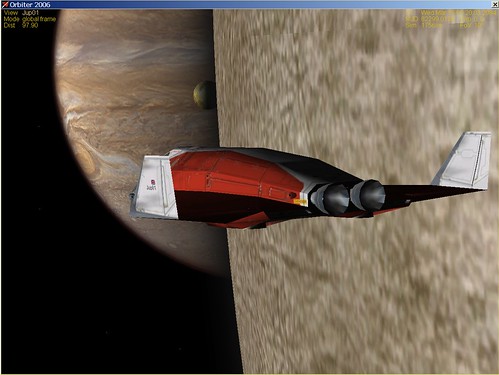
Podcast - Jupiter & Io Setting Over Europa

In April 2009, I contributed to the International Year of Astronomy daily podcast series with a podcast called "Exploring Space With Your Computer." It featured audio dramatizations of a mission to Europa and the final seconds of the Apollo 11 moon landing, as simulated in the free Orbiter spaceflight simulator. It also discussed the free planetarium program Stellarium and a few other free tools for exploring space from the comfort of your computer keyboard. I used sound effects from Orbiter and also wrote and recorded a spacey-sounding musical soundtrack for the podcast. It was fun to do.

The daily astronomy podcast program has continued beyond 2009, and today "Exploring Space With Your  Computer" is being featured as a "classic" thanks to someone's unexpected cancellation. It's nice to be featured, even as a rerun. I posted a set of Orbiter screenshots illustrating my simulated space adventures on Flickr. You can read more about the podcast (including web links) in this 2009 blog post. The podcast series is continuing into 2012 - maybe I'll even find time to do a new podcast next year.