Showing posts with label education. Show all posts

Friday, December 18, 2015

My Theoretical Interests


I was going through my daily Google spam notification email, thinking about all the theoretical interests I have that now mostly show up as marketing emails. Democratic Party appeals, astronomy magazines, Optical Society information, TAXI songwriting promo offers, musical instrument sale offers, AOPA private pilot news, Japanese and French language study information, and much more. Most of these represent past or perhaps intermittently current interests, now mostly theoretical interests in that I do nothing with them 90% of the time.

Even the 146 apps on my iPad show this. So many astronomy, language study, music making, photography, and game apps that I hardly have time to even look at. But they don't take up any physical room, and you never know when some interest will strike again (hope springs eternal that 24 hours a day is only a temporary constraint). Books are like this too. An ever-growing backlog and I will probably never read 75% of them. I should at least clear out the many shelves of paper books that I am less likely than ever to read now that I'm totally hooked on the convenience of ebooks. But there I have the 10% problem -- I'm sure I will never need 90% of the paper books in my house. But I can't get rid of them until I identify the 10% I might need, and that is not a weekend project.

First world problems, I know, right? Such an abundance of riches. One that still grabs me is The Great Courses (this was the part of my daily spam that triggered this particular rant). College level lecture courses in every subject by some of the greatest professors in the world. I have a number of them as DVD and a couple as audio, and have watched or listened to a few lectures from some of them, but never completed one course. Yet I look every time for more, especially when there's a "big sale" (as there usually is). These days I rarely order any new courses because I know about my theoretical side. Like the way I'm a theoretical pilot and singer-songwriter ("flying singer," get it?).

[begin-rationalization] In fairness to myself, these theoretical interests really do still interest me, even if I don't have time to actively pursue everything. I like to "keep in touch" with private pilot, songwriting, and astronomy magazines and I follow some related organizations and people on Facebook (a source of serendipity as well as a few laughs every day). Every time I go to Japan, I brush up on my reading and conversation and learn a few new things (or buy a new app). On two trips to Korea this year, I taught myself enough Hangul phonetic script to decipher many signs. And I do read a lot of books on all sorts of subjects. Donald Trump has already scared me enough to start giving money to the Dems again (spam and fear are a winning combination, Democrat marketers). And every December (triggered by my company's year-end shutdown), I magically turn back into a singer-songwriter for a week or two, writing and recording some new songs with my producer and friend Roger Lavallee. Plus I have a job that still uses the optics I studied back in the 70s. So I guess I'm not a complete deadbeat. [/end-rationalization].
.

Sunday, March 23, 2014

Rocking the COSMOS


I've now watched the first three episodes of the new TV series Cosmos: A Spacetime Odyssey, and I have to say I'm really impressed. I'm a great fan of Carl Sagan and the original Cosmos series from 1980. Although I greatly admire Neil deGrasse Tyson, I was concerned that the commercial influence of Fox might result in something... let's say less than the original series. But apart from the commercials (which DVR and a few minutes of delay can handle nicely), I think the new show is just great all around.

Of course you would expect fantastic visuals in 2014, and the CGI effects are definitely first-rate. I also like the simple animation style used for historical segments. I think Tyson is actually a better host and narrator than Sagan - he comes across as confident and authoritative, yet approachable and down to earth, and he's clearly comfortable on camera. But what really impresses me is the writing, especially the way that it humanizes science and scientists. Scientists are not perfect people, and science is not just a bunch of complicated facts and figures. Scientists are human beings who have retained and cultivated the curiosity of children. Science is an often messy process that builds on its past successes but is not afraid to discard what was accepted in the past in favor of new ideas that better fit the facts. It is based on evidence.

In tonight's episode, I really liked the way they portrayed Newton as a flawed and even petty person who happened to be a genius - except when he wasn't, as in his lifelong pursuit of alchemy and Biblical numerology. We are indeed fortunate that Edmund Halley (no slouch in the brains and energy departments himself) was able to recognize Newton's genius, and to encourage and advocate for him (even to the point of publishing the first edition of Newton's groundbreaking Principia at his own expense). Halley's use of Newton's new mechanics to correctly predict the return of the comet that bears his name was a great ending, handled in a nicely emotional and dramatic way. I also liked Neil's comment, "if you're watching this in 2061, you'll certainly know that Mr. Halley's comet is back again."


Along the way, Neil explained a bit about gravity, planetary motion, and comets, with some excellent visualizations. I think it's important that they get the science right, but that they also make it a great story with characters you can care about. They might not cover as many topics as some science fans might like, but I think they have a better chance of engaging younger viewers who might not care all that much about "science stuff" (yet!).

I'm really looking forward to the rest of the series, and to the release of a Blu-Ray edition with lots of cool extras before too long. I hope that young people do find it engaging, and that some of them will be inspired to study and pursue science, as many young scientists around today were inspired by Sagan's original Cosmos in 1980.


Thursday, November 21, 2013

Bulgaria, Bad Knees, and Japanese


October and November tend to be my busiest business travel months, with at least one trip each to Europe and Asia. In October I did a customer visit tour in "only" four countries: UK, France, Bulgaria (sunset in the hills near Sofia, above), and Czech Republic (though I slept one night at the Vienna airport and drove through part of Slovakia). London, Nice, Manchester, Wales, London, Sofia, Vienna, Paris, and then home. This is a light five-day schedule for our European distributor.

Not much chance for fine European dining on this type of trip (unless gas station sandwiches and airline lounge snacks are your thing), but it's actually kind of fun. Although most business discussions are in English, I do try to practice a little French now and then, mostly in restaurants and by buying and reading science magazines like this recent special Mars issue of Science et Vie.

A special wrinkle on this trip was a bad knee. After months of increasing pain, I was recently diagnosed with a torn meniscus in my right knee. I was worried about long flights, big airports, train station stairs, and long car rides, but most of it went OK with the help of a new rolling backpack computer bag and a special effort to pack light. The fact that I don't have to carry books anymore helps a bit on this - I have hundreds of Kindle books on my iPad Mini, iPhone, and Kindle, and now the airlines even let you use these small devices in "airplane mode" from gate to gate (at least inside the US). After an MRI and two orthopedic opinions, I will have arthroscopic surgery to repair the meniscus next month. So I should be good as new (plus or minus a few decades) by January.

I spent last week in Japan, after working several weeks to prepare for optical/software presentations and product demos that I don't typically do in my day to day work these days. Since long ago I studied and still enjoy optics and pretending to design lenses (we call these "demos"), I look forward to these fall trips when I get to meet with some of the Japanese engineers who have designed many of the camera zoom lenses, DVD player lenses, and what-not that I have bought and used over the years. This trip involved even longer flights as well as many trains and train stations. In spite of all the stairs in the subway stations, my knee felt pretty good, which made me realize (this week) that most of my knee pain is triggered by driving, not by walking and climbing stairs.

I still like to play with Japanese when I'm in Japan, and thanks to the iPhone and iPad, I can now carry around the best Japanese dictionary I ever owned, which happens to be a free app called Imiwa? (the name means "what about the meaning?"). I use this to refresh my fading knowledge of Japanese, taking notes on various interesting words or phrases that I hear or see. I also bought a few copies of a children's magazine that I haven't bought in many years, Takusan no Fushigi ("A World of Wonders" in English). Intended for Japanese children 8 years and up, each monthly issue focuses on a particular non-fiction topic, from a museum of curiosities in Paris, to the life cycle of a certain moth, to the workings of Air Traffic Control (ATC, October 2012, at left), among many others (hundreds of titles published since the 1980's when I first discovered them when exploring Japanese bookstores on my early trips).

Just for fun, I read the ATC one on my flight home (cool because I like flying stuff as well as Japanese). A key point is that most of the kanji ("Chinese characters") are printed with furigana, small phonetic characters that give the pronunciation. Japanese adults don't need these, but Japanese children (and I) do for all but the basic kanji, of which I know around 200 or so. Since I know how ATC works (from private flying and from listening to United's channel 9 for many years), it was fairly easy for me to follow the text, which consisted mostly of radio exchanges between pilots and controllers (although in fact ATC in Japan and in most of the world is done almost entirely in English, because the many international pilots cannot understand Japanese). I still had to look up probably every fourth or fifth kanji-based word (many flight-related words in Japanese are adapted from English and spelled phonetically in katakana, so those are easy to read).


This trip was also the first time in 31 years of travel to Japan that I tried fugu (known as blowfish or pufferfish). I've wanted to try it for years, but it's too expensive for an expense report, and no one ever invited me! Fugu has a bad reputation because its liver is deadly poison, and if it is not prepared properly, the poison can contaminate the meat, and you can die (this sometimes happens to amateurs who try to prepare fugu at home without special training). Restaurants are of course very careful, and it is actually quite safe, and pretty tasty. It is cut almost translucently thin for sashimi (photo above - it is light pink, but the dark pattern of the plate shows through making it look gray in places in the photo), but we also had it in soup, fried, and broiled. Oishikatta! (It was delicious.)

This was also the second time I had tried hirezake, a rather strange drink. It is warm sake with the fin of a fugu soaking in it. It sounds strange (ok, it IS strange), but it tastes pretty good. So I guess technically, I had "experienced" fugu once before. It's also popular enough that you can buy it in individual cans from some drink vending machines. Japan has many vending machines that dispense small cans of cold or warm beverages (typically coffee or tea). In this case, the sake is warm, and the fish fin (possibly not always fugu?) is in a separate small container on top that you add to the sake yourself. I guess you don't want that super-soggy-fish-fin taste in your hot Japanese rice wine, do you?

Sunday, October 06, 2013

Stella, You Are Stardust!

My granddaughter Stella celebrated her first birthday this weekend. Pretty amazing that it's been a year already. It's a lot of fun being a grandparent and watching her grow. My daughter organized a great party with a lot of family and friends, and I took the opportunity to play Look at You, the song I wrote for Stella's birth last year. Stella laughed and clapped along - she's heard this song a few times and I like to think she knows it's her song, but in fairness, she seems to love all music and laughs and claps along with almost any song. Something we have in common.

Stella also shares my love of books, so I bought a few for her birthday, including a really cool one I decided to hold onto for a while. Although "Stella" actually means "star" (in Latin and Italian), I think she's not quite ready for the astronomy and other science concepts in You Are Stardust, a book I discovered through Brain Pickings (OK, so maybe I bought the book for myself, but I promise to share it with Stella in a year or so).

As Carl Sagan (and various others) said and wrote, "we are all made of star-stuff." This reflects the knowledge gained by astrophysicists that we are all products of "stella" evolution -- all of the chemical elements other than hydrogen were originally "cooked up" through nuclear fusion in stars that later exploded, spreading those materials as dust and gas that later condensed into new stars and their surrounding planets, such as our sun and its surrounding solar system - including the Earth and everything and everyone on it. And it only took a few billion years! You Are Stardust turns this idea into a beautifully illustrated story about the connectedness of everything in nature, starting with:
You are stardust...
Every tiny atom in your body came from a star that exploded long before you were born.
You started life as a single cell. So did all the other creatures on planet Earth.
For background on the making of the book and the illustrations, including the science behind it, check here. The illustrations are photographs of 3D dioramas created by artist Soyeon Kim. They are really lovely. There is also an iPad app based on the book which looks cool, though I have not yet decided to spend $4.99 and 392 megabytes of storage on it.

Sunday, September 08, 2013

Be a Solar System Ambassador!

If you live in the US and have an interest in space, planetary exploration, astronomy, and/or science-related educational outreach, please check out the NASA/JPL Solar System Ambassadors volunteer program VERY SOON. September is the only month of the year that new ambassador applications are accepted for ambassadors to start in January 2014.

Although I have been an Ambassador since 2007, for various reasons, I have not been very active in the Ambassador program myself in the last few years. I hope to get more active again starting in 2014. Regardless of my own situation, I strongly believe in this program, and because of reductions of federal government funds related to sequestration, the need for volunteers is stronger than ever. That's because NASA's own employee-based educational outreach programs have been cut. Since the Solar System Ambassadors are volunteers, JPL plans to increase the number of new ambassador appointments for 2014 so there can be more volunteers available who can be involved with programs for schools, museums, libraries, astronomy clubs, and other educational events.

It's easy to apply, and you don't have to be an expert in space or astronomy to participate. Having an interest in educational outreach and a willingness to spend some time on it are more important than space flight expertise. JPL provides various materials and phone conferences that can help you prepare for presentations. These are fun and educational in themselves.

Monday, September 02, 2013

Why Do I Like What I Like?

I believe that biochemically, serotonin and dopamine are more or less the only two things I enjoy. But at some other level, I often wonder why I like what I like. A lot of it seems to be about novelty. Although there is probably not much that is truly new, novelty emerges in a lot of ways. Surprise is one (perhaps obvious) way. This seems to be the key to a lot of humor - a funny writer or comedian sets up a certain expectation and then takes it in another direction.Creativity is another path to novelty. What could be more novel than a drawing or song you create yourself? Travel is another path. Simulation and gaming too - artificial travel, in a sense. Books are still a pretty good simulation (they run on that old school, low-energy, mobile processor we like to call "the mind"). There are lots of things to like in the world, but I don't like or even notice most of them.

What about a new song by someone other than myself? I often enjoy the sense of familiarity and surprise that this entails. A three-minute pop song has a fairly predictable structure. It will usually incorporate typical musical elements (western scales, chords, and harmonies, common instruments like guitars, keyboards, and drums). But I hear many new songs that do nothing for me, even if others might think they are great. And then once in a while - BAM. A new song just hits me. Why is that?


Here's an example of a recent song that just grabbed me, "Is This How You Feel?" by the Australian band The Preatures. I heard it on the radio (KCRW) when I was Los Angeles recently, and I instantly turned it up. I was about to stop the car to enter a restaurant for dinner, but I waited to hear the rest of the song, and to use the iPhone Shazam app to identify it. I went back to the hotel after dinner and found the song on SoundCloud and YouTube. The video is basic but effective enough. It's a strongly rhythmic and extremely catchy song. I love it, and even after hearing it twenty or more times, it still makes me smile. I don't know why. It's not the lyrics, which are barely coherent (best I can tell, it says, "I'm excited about you, do you feel the same?"). The singer sounds sexy and excited, and many listeners seem to find the song infectious. I had never heard anything from or about this band before, but now I expect I will buy their EP or album once it becomes available in the US. It reminds me somehow of the old song "Semi-Charmed Life" by Third Eye Blind, though it's a love song rather than a drug song. I'm not sure what's the same about them but they seem to trigger some of the same pathways in my brain, and that 1997 song is one of those I will listen to nearly every time it pops up.

Here's another example, Paul McCartney's brand-new song "New." This one is not quite so hard to fathom - the basic rhythm and tonality evoke Paul's Beatles classic "Penny Lane." It's not the same as "Penny Lane," but there is definitely something strongly "Beatleish" about this song, even if Paul's 71 year old voice is not quite as smooth as it was in 1967, it's still Paul, and it's still damn good. There are some very deep neural pathways that trigger on almost anything that evokes the Beatles (even partial matches like the bands Badfinger and Jet and the nearly forgotten early 70's singer-songwriter Emitt Rhodes). And yet... Paul has put out maybe 20 albums since the Beatles. I probably have half of them and love perhaps 3 or 4. Even Sir Paul himself doesn't trigger all my "Beatles = Good" neural patterns. I'm not sure why.

It's not all about other people's music. I like a lot of my own music, and I especially like the feeling of completing a new song or a new recording, sort of a "creative rush." Finishing a larger work like my three albums gets an especially big "like." But even my own work doesn't get an "all access pass." There are many things I write or record that do nothing for me a few days or weeks later.Even finishing a blog post is a little "creative rush." Pretty much any act of creation, though some can be so long in birthing (like my 2005-2006 space flight how-to book Go Play In Space), that it's hard to know whether I like it or not! With some distance, it eventually seems worth all the work, and I feel satisfaction in having completed such a project. Learning something complex (like how to fly, or Japanese) is another "project" type of thing with more long-run satisfaction than "creative rush," though there are some milestones that can be quite a thrill (like my first solo flight back in 2000).


It's not all about music. Books are still a major thing in my life. I just finished the final novel (Dust) in a SF trilogy by Hugh Howey. I discovered the first book Wool a few months ago on Amazon, and I found it to be a very enjoyable piece of post-apocalyptic science fiction. This tends to be one of my favorite SF sub-genres. That seems odd even to me. How can stories of the end of the world and its aftermath be "enjoyable?" I don't know - maybe it's the puzzle aspect of figuring out how to survive. Maybe I identify with the heroes and heroines of these stories. I don't know - I just like many of these stories. I also like many books in many other genres, most of it non-fiction.

But what about the familiar? Why do I still love to hear many Beatles songs some 45 years after I first heard them? Why do I still enjoy pizza or haddock or Cocoa Krispies every time? Or seeing the ground or the clouds from 3,500 or 35,000 feet? Or seeing pictures of planets or galaxies from Cassini or Hubble? Or playing the guitar? Or speaking Japanese or French? These things are not exactly novel. I don't know. I guess there are a lot of ways to trigger those little shots of serotonin and dopamine. Evolution came through with some pretty fine home-grown drugs!

Wednesday, August 28, 2013

Starmap Media: Personal Trainer

Starmap was the first astronomy app I bought when I got my first iPod Touch in 2008. Although I had used astronomy software like Stellarium on PC, I was amazed at the possibility of having a planetarium in my pocket. Something I could take outside with me and hold up to the sky to help identify objects, or search to find the expected positions of stars and planets based on current position and time. All with a simple touch, drag, and pinch-zoom interface. Over time, other astronomy apps emerged, I got an iPhone which included GPS and compass, and Starmap added even more features. Life is good for fans of iOS devices and night skies.

Now Starmap has been expanded to improve its usefulness as an astronomy learning tool. Starmap Media was recently released as both an add-in to Starmap and as a free standalone app. As with many iOS apps, "free" isn't the whole story. There are in-app purchases to provide most of the content, so at the first level,  Starmap Media functions as a specialized audio book reader for a series of "astronomy lessons" or stories.

But what's really cool is that the "lessons" are integrated with planetarium software that knows the time and location and what is visible in the sky at any given time (apart from such spoilers as clouds). So if you go outside on a clear night this week and fire up "Wandering the Summer Sky," the app will point you to the various objects of interest while the narrator tells you what to look for and why. It's like having an astronomer as your personal night-sky tour guide. It doesn't answer questions (yet), but it's still pretty amazing.

While there are a few free stories or "star tours"  supplied with the app, most are in-app purchases that cost 99 cents each to download (once downloaded, Internet access is not needed to use the stories). There are stories for beginners as well as intermediate and advanced topics. The writing, production, and narration are smooth and professional, with many multimedia features built in. These include animated overlays that explain the shapes and positions of objects and patterns in the sky, diagrams and pictures of nebulae, galaxies, etc., as well as historic and mythological background.

I tried out a few of the stories at beginner, intermediate, and advanced levels (full disclosure: I was given  free reviewer access to a number of stories). For example, "Stellar Smoke Rings" is a 12 minute story labeled intermediate. It points you to and explains several well-known planetary nebulae including the Ring Nebula and the Dumbbell Nebula. It was easy to follow the instructions to find the correct area of the sky. The narration waits for you to get there and touch an OK button. You can press pause at any time and an interactive contents list pops up, allowing you to jump backwards or forwards as needed.

Another intermediate story, "More Than Meets the Eye," points you to a couple of seemingly minor constellations as background for a nice explanation of stellar magnitudes and measures of sky viewing quality. The advanced story "The Arcturus Stream" talks about the behavior and properties of the easy-to-find star Arcturus, and about some aspects of star formation that can be inferred from the amounts of heavy elements such as metals that are present or absent in a star's spectrum (the "rainbow" of light from the star that astronomers use to determine what elements are in a star, using a telescope instrument called a spectroscope).

Any problems? For one thing, even the "advanced" stories I've seen so far don't seem very advanced for someone with a serious interest in astronomy who has done much reading. I have studied a lot of astronomy over the years, but I don't mind a review of a familiar topic presented in a fresh way. And the star tours include topics from recent research, such as the idea that the stars in the relatively fast-moving Arcturus stream may have originated in a small satellite galaxy that was gravitationally captured by our Galaxy. It's also nice to have a professional narrator presenting the material "in context" as you look at the star or constellation in question. It's like having a "personal trainer" for star gazing!

What about the cost? I think of it like a subscription to Sky & Telescope magazine. The sky is big, with many things to see and learn, and it changes through the year. This is why astronomy magazines sell, even though there are many astronomy books out there - they keep you up to date, show you things you may have missed, present information and recent research in new ways, and tie stories to current events such as spacecraft launches and encounters. Starmap Media stories are like astronomy magazine articles read by a professional narrator and keyed to what you can see in the sky right now (there is also a "couch mode" for exploring when skies are cloudy or the objects are out of view). You only buy the ones you want (you can download a brief free preview of any paid story to see if it interests you). Once downloaded, the stories are yours to enjoy whenever you like.

If you have an iPad, a bonus is that the free Starmap Media app is a universal app that works well on either iPhone/iPod Touch screens or larger iPad screens. The Starmap app itself comes in two versions, one for small screens and a more expensive HD version for iPads. You may want the HD or iPhone "pro" version for other features (such as expanded catalogs and telescope control), but it's nice that the Starmap Media star tours and sky displays work well on any iOS display (you can use the iPhone version of Starmap on an iPad, using the 2x button to fill the screen, but the fonts etc. don't look as nice when you view a scaled version of an iPhone app on an iPad).

Starmap Media is a really cool way to add to your enjoyment and learning while exploring the stars and planets. If you have an iPhone, iPod Touch, or iPad, try it out the next time you are out looking at the marvelous night sky.

Sunday, August 11, 2013

Kerbal Space Program?!?


I read something about KSP (Kerbal Space Program) a couple of years ago but I didn't do anything about it. Then the other day I saw this comic on xkcd, referencing KSP. If you hover your mouse over the comic, the comment says "Ahem. We are STRICTLY an Orbiter shop." Me too! But I was curious about what had happened to KSP since it was last (vaguely) on my radar.

Quite a bit, it turns out. It's still in an extended alpha development phase, but it's already got some interesting capabilities for people who like to "play in space" (something I once wrote a book about). After looking at a few web sites and videos, I decided to download and try KSP for myself (current version is 0.21.1, and it costs $23, including future updates). So what is KSP? From the web site:
KSP is a game where the players create and manage their own space program. Build spacecraft, fly them, and try to help the Kerbals to fulfill their ultimate mission of conquering space.
Essentially it's a space flight simulator with reasonably accurate physics, wrapped in a game-like interface with pretty decent graphics and some quirky alien-like astronaut characters (KSP's developers also seem to have a quirky sense of humor). It is just now starting to emerge from its "sandbox" phase (with the ability to build and fly your own spacecraft, but without any specific game-like goals). At this point, it's something like 3D simulated model rocketry, but with the ability to launch the rockets you design into space (orbital mechanics is involved, but the math is hidden behind clever controls and displays). You can dock with space stations, travel to and land on other planets, and try to navigate your spacecraft back to Kerbin for a safe landing.


Yes, Kerbin, not Earth. This fictional solar system has real physics (orbital mechanics and atmospheric flight) but it doesn't use the names and specific physical properties of our own solar system. Kerbin is an Earth-like "exoplanet" with two moons (Mun and Minmus - you can fly to and land on them).

So far I've only scratched the surface of KSP, and I don't know how much time I will spend with it. It depends in part on whether I start to do some space-related educational outreach again. I haven't done any for quite a while. When I have done school presentations, I have generally used Orbiter to dynamically demonstrate certain aspects of space flight and the solar system. That's cool for demos, and it beats simply using PowerPoint, but Orbiter's learning curve is quite steep, and it's hard for me to recommend to any students younger than maybe 11 or 12. KSP is definitely more kid-friendly. The rocket building section (see picture at top of this post) is simple yet powerful (though there is no guarantee that what you build will fly well or at all - the physics is pretty realistic, so you have to worry about mass, thrust, stability, etc.). As the Minecraft craze shows, kids (and adults) love to build stuff inside virtual worlds (and real ones). While building your own spacecraft for Orbiter is certainly possible, it's a separate "add on" development process, not integrated with the simulation itself.


KSP also integrates the instruments and controls needed to change orbits directly within the 3D views (spacecraft and map), making it easier and less abstract to see the effects of firing your rockets at certain times, locations, and directions. The screenshot above is from the integrated Orbiting 101 tutorial, and it shows the "maneuver node system" being used to predict the effect of a pro-grade burn at the low point of the orbit (periapsis). Dragging the pro-grade symbol changes the delta-V (speed change) value, and the dotted orbital path shows the predicted effect in real time (your path doesn't actually change unless you make that proposed burn at the proper time and with the correct ship orientation). Orbiter has similar capabilities (and much more) with its various "MFD" instruments, but these work like display screens in the cockpit, not directly in the 3D view. More realistic but also harder to visualize and understand.


KSP allows you to build and fly some pretty cool and complex space vehicles such as multi-stage rockets with strap-on boosters, and even Apollo LM-like landers such as the one shown above (docked with an Apollo-like command module housing three Kerbals who are about to land on the Mun - this is a supplied sample scenario). Although it's easy to build monster rockets with many engines, you do need to pay attention to structural integrity, symmetry, and stability or your giant booster may tumble out of control, crash, and burn. Unlike in Orbiter, things can and do blow up in KSP, though at the moment the hardy Kerbal astronauts are immune to G-forces, allowing you to perform high-G atmospheric entries and the like with impunity (this will undoubtedly change in future versions).

Future versions will also include a flight sim-like "career mode" with awards for completing certain missions or milestones like docking or landing on the Mun). I suppose that training options will also expand, although there is already some basic training in the game, and a variety of user-created tutorial videos and PDF's available on the web. Note that since changes between versions can be pretty extreme, there is no guarantee of backwards compatibility for previously built things when you upgrade.

I think KSP is already a great educational tool, because it is sufficiently "toy like" to be fun and non-threatening (think building robots with Lego MindStorms, but much cheaper), but powerful enough to allow really interesting and challenging activities. I really like the emphasis on what is essentially engineering - designing, building, testing, and thinking about why things work or don't work so the next iteration can be better. And remember, to engineer is human (and sometimes fun too).

Wednesday, April 03, 2013

Tyson is My Hero


Neil DeGrasse Tyson is my hero. Astrophysicist, science educator, eloquent proponent for space exploration, writer, PBS television host. His book Space Chronicles: Facing the Final Frontier is one of about ten Kindle books I am actively reading on my iPad (it's a collection of previously published articles and essays on various space exploration topics). I've read interviews with him and watched a number of his videos, always impressed with his ability to communicate clearly and in a (yes) down-to-earth way on the issues of science, including space exploration and the role that it could play in building a better future for all of us, starting with the inspiration it could provide to the next generation of scientists and engineers.

Tyson is not the first to talk about the fact that Apollo was fundamentally a Cold War program, a technologically sophisticated battle with the Sputnik-launching, human-orbiting Soviets, which I have understood for years. NASA didn't receive as much as 4.4% of the federal budget in the 1960's [vs. around 0.5% now] with the goal of cracking the secrets of the universe or inspiring kids to study science and technology, but inspire it did. I'm one of those kids, even though I ended up an optical engineer rather than an astronaut or aeronautical engineer as I originally hoped I would be. Space has been and can continue to be a huge technology and education multiplier, and I hope that our leaders can come to see this in the next few years, even as private space begins to take over more of the routine aspects of spaceflight in low Earth orbit. Private space may get us to Mars someday, but NASA and other space agencies around the world really should be deeply involved with the vision and the parts that require big long-term investments.

If you want to learn more about the value of space exploration, you could read his Space Chronicles, or just search for Neil DeGrasse Tyson on YouTube or Google. He's a very engaging speaker and writer. This video, "Message to the Future" (apparently a speech from fall 2012) is a good place to start. He tells the story a lot better than I do.

Monday, February 13, 2012

Wow! Scale of the Universe 2 (Interactive Flash)

Yes, there are a lot of things that are "the coolest thing ever," but this is definitely in the running for that illustrious and ever-changing title. "The Scale of the Universe 2" is an interactive Flash activity with a slider that goes from a scale of 10**(-35) meters (ten to the minus thirty-fifth power, very small) to 10**27 meters (bigger than the known universe).

This "interactivity" was created by Cary Huang. It's similar to the famous "powers of ten" movie except you can control it in both scale and speed (about 13 seconds to go from smallest to largest at maximum scroll rate) and you can click on objects to learn more about them. It comes complete with spacy background music. Awesome! Thanks to Matt Bors for posting this on Facebook.

Tuesday, December 13, 2011

Exploring Space With Your Computer (Again)

Podcast - Jupiter & Io Setting Over Europa

In April 2009, I contributed to the International Year of Astronomy daily podcast series with a podcast called "Exploring Space With Your Computer." It featured audio dramatizations of a mission to Europa and the final seconds of the Apollo 11 moon landing, as simulated in the free Orbiter spaceflight simulator. It also discussed the free planetarium program Stellarium and a few other free tools for exploring space from the comfort of your computer keyboard. I used sound effects from Orbiter and also wrote and recorded a spacey-sounding musical soundtrack for the podcast. It was fun to do.

The daily astronomy podcast program has continued beyond 2009, and today "Exploring Space With Your  Computer" is being featured as a "classic" thanks to someone's unexpected cancellation. It's nice to be featured, even as a rerun. I posted a set of Orbiter screenshots illustrating my simulated space adventures on Flickr. You can read more about the podcast (including web links) in this 2009 blog post. The podcast series is continuing into 2012 - maybe I'll even find time to do a new podcast next year.

Wednesday, September 07, 2011

JPL Wants YOU!

September is the only month in which you can apply to become a JPL Solar System Ambassador. This is a great volunteer program for educational and community outreach on space exploration and astronomy themes. If you have an interest in space exploration, enjoy sharing your enthusiasm with others, and would like to learn more about space exploration yourself, this program might be just the thing for you! Although I haven't been as active recently as I was a few years ago, I've really enjoyed the outreach events I have done and the training I've received as a Solar System Ambassador. And you have to admit it's a cool title.

You can find more information and a link to the application here. The program only operates in the United States.

Thursday, December 30, 2010

My Tiny ISS Connection

In March 2009, I exhibited at the annual Space Expo held at the New England Air Museum at Bradley Airport, Connecticut. As I often have done, I used Orbiter to demonstrate some aspects of space flight, with a second computer set up with a joy stick to allow attendees (mostly kids) to have a try at landing a simulated space shuttle from final approach. This is a good hands-on demo because it only requires two controls (the joystick and the G key, to drop the gear). But it's harder than it looks.

Unfortunately, this demo was so popular, that I only managed to catch about 5 minutes of a talk by the Space Expo's special guest, astronaut Cady Coleman. But fortunately, Col. Coleman was kind enough to take a some time at the end of the day to visit with some of the exhibitors, including me. We chatted for a few minutes, and I told her about Orbiter in hopes that she would take some interest in this for educational purposes (or perhaps share it with some colleagues at NASA). She was quite interested to see Orbiter (she said "why didn't I know about this?"), and she asked me to send her some information, which of course I did. I was pretty happy when she replied the next day to my email:
Bruce – it was a pleasure to meet you – and I look forward to being in touch.  I can’t wait to start playing – and am soooo thankful that a manual exists….  I’m sure I’ll still have questions, knowing me!    My to-do list is a bit long these days – so I may not get to try it out right away - but this is really really neat stuff.  I’m assuming that you won’t mind if I share it with other folks in my office?  Thanks for taking the time to write – not to mention taking the time to come to the event.  I thought it was a great event – although I’ll tell you that I slept well on Sunday night…. I’m sure you did as well.  It is good work – but takes a lot out of you!  Thanks again -   Cady
...but I didn't expect to hear much more for a while, once I realized that she was already preparing for a late 2010 Soyuz flight to the ISS. On December 15, she launched on that flight, and she is now part of the Expedition 26 crew of the International Space Station (here are some of her thoughts just before she launched). I also learned today that she actually lives not far from me, in Western Massachusetts (when she's not in Houston, Russia, or space!). So it's not like Cady Coleman and I are best friends or anything, but it is pretty cool to have even this tiny connection to the ISS. Sometime after she gets back to Earth next May, I'll follow up on that email.

The video below features the ISS Expedition 26 Commander Scott Kelly of NASA and Flight Engineers Cady Coleman of NASA and Paolo Nespoli of the European Space Agency offering Christmas and New Year's greetings to all people on Earth on Dec. 21.

Saturday, October 02, 2010

CK12.org FlexBooks - Very Cool!

I stumbled on this while looking through Amazon's list of free e-books for Kindle. I've gotten some really amazing free books since I started using the Kindle apps on my iPod Touch and PC, so I sometimes check. Many of the free ones are public domain books, classics and others, but sometimes you find recent books that publishers are giving away to promote an author or a series (this is how I discovered Naomi Novik's great "Napoleonic Wars with dragons" Temeraire series).

This time I found some interesting free science textbooks from something called ck12.org. I downloaded several (earth science, "people's physics," nanotechnology, calculus, biology) and started reading one on "21st century physics" that is really interesting and well written*, with a sort of dialog format on subjects including gravitation, nuclear energy, particle physics, biophysics (medical imaging), etc. This is apparently intended to supplement basic physics topics found in standard textbooks with updated material on diverse, interesting topics and many web links. But who is offering this? I found this on the web site:
CK-12 Foundation is a non-profit organization with a mission to reduce the cost of textbook materials for the K-12 market both in the U.S. and worldwide. Using an open-content, web-based collaborative model termed the "FlexBook," CK-12 intends to pioneer the generation and distribution of high quality educational content that will serve both as core text as well as provide an adaptive environment for learning.
Cool. I also watched a video and found that these FlexBooks can be viewed in various formats, printed, and even customized by teachers! Wow. This is good. I will learn more.

* the "well written" part varies by topic, with each chapter of this book written by a different author. I just read a chapter on on nanoscience that has several serious errors that completely change the meaning of some sentences.  Textbooks need editors, even if they are free electronic textbooks.

Tuesday, September 07, 2010

JPL Solar System Ambassadors: Sign-up Time

The JPL Solar System Ambassador program is for volunteers (non-NASA employees) who wish to be involved in educational and community outreach related to space exploration. Provided materials (mostly web-based) and telephone briefings tend to be mostly related to JPL programs, but ambassadors are free to define their own presentation subjects and styles. I've been in this program since 2007, and I have really enjoyed doing presentations at schools, libraries, museums, and scouting events. I personally tend to use a lot of simulation software (especially Orbiter and Stellarium) in my presentations, which is purely my choice based on my interests and skills. Other ambassadors may focus more on PowerPoint, video, hands-on activities, and sky observations.

If you live in the United States and are interested in becoming a JPL Solar System Ambassador, September is the only time you can apply, so act now! You certainly don't have to be an engineer, scientist, or teacher, though many ambassadors do have such backgrounds (many are also amateur astronomers). The main thing is that you have an active interest in space exploration and that you enjoy sharing your interests with other people, often but not always children.

Sunday, July 11, 2010

Pocket Solar System

There are a number of great astronomy and space apps for the iPhone and iPod Touch, and I've discussed some of them here before. I just got a new one called Solar Walk - 3D Solar System (it's "3D" because it actually supports red/green 3D glasses for some images, though I didn't find this to be very exciting on the iPod Touch). Although it's easy to tool around the solar system in Orbiter (free space flight simulator for Windows), Solar Walk is available in my pocket and is better for certain "big picture" questions about the solar system.

Case in point: the recent prominent alignment of Venus, Mars, and Saturn in the early evening western sky. Here's a screen shot from Star Map on the iPod Touch showing their positions this evening around 19:40 local time:


Why are they showing up that way? If you launch Solar Walk and touch the little orbital diagram icon, you can pull up an interactive "orrery" that shows the correct relative positions of the planets in their orbits for any given date and time. Here it is for this evening at about the same time as the above sky shot:


So you can see how this apparent alignment occurs from the positions of Venus, Mars, and Saturn in their orbits (of course the sizes of the planets and orbits in this diagram view are not correct - they need to be visible on the small display - but the angular positions are correct). Solar Walk also lets you zoom in on the planets and their moons - enough to see the main features of each planet, though not very close up. There is also a fair amount of information on each body and on the spacecraft that have visited it as in this screen about Saturn:


There's nothing right now on dwarf planets and asteroids, but what it has is really useful for understanding and explaining what is happening with the main members of our solar system.

Tuesday, June 22, 2010

Not In My Back Yard...

...but I wish it was! What a great educational aid it would be to have a scale model solar system with Earth the size of maybe a basketball (roughly 56 million to one). The orbits are in order but of course not to scale for orbital distance - that would require a lot of land. This could be my next landscape architecture project (though my wife probably has other ideas).

Update: the sun doesn't appear to be in scale, but it's rather foreshortened in this view so you can't tell that it's really just a small chord of the sun's circular disk and it could easily be 9.7 Jupiter radii if you extended it.

Thursday, April 29, 2010

Orbiter On My Mind

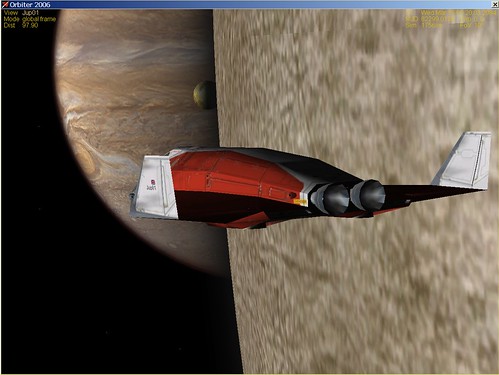
I haven't been doing too much with Orbiter the last year or so, but I've recently been in touch with a couple of Orbiter friends and have started thinking about it again. One thing that's cool is the possible translation of my Orbiter tutorial book Go Play In Space into Russian. I heard about this from Andy McSorley, my co-author on the second edition, and I got in touch with "Kulch" through the Orbiter Forum (Kulch is the creator of many great Orbiter add-ons including the cool TX Winged Space Launcher shown above). He confirmed that he and some other Russian Orbiter users had started the translation project, and I offered to help out by sending my original Word and graphics files. I studied Russian for two years in college, but that was a long time ago and I've forgotten almost everything but the alphabet and a few words and phrases. But it would still be great to have a Russian version of my book, and more importantly, for prospective Russian "Orbinauts" to be able to use my tutorial more easily. Oчень хорошо!

Speaking of using my tutorial, I haven't been on the Orbiter-Forum much recently, so I spent some time looking around and catching up. While there hasn't been a new Orbiter release since 2006 (there are rumors of a 2010 version coming soon), there is still plenty of activity with add-ons, challenges, videos, technology discussions, etc., and with new people joining the forum and asking questions about how to dock with the ISS, get to the moon, navigate to Mars, etc. It's cool to see that people are recommending Go Play In Space as the basic tutorial for Orbiter, and that new users are still finding it useful. I originally wrote it to help myself learn Orbiter, but I'm glad that it's helping other people to climb that fairly steep learning curve (into orbit!) and enjoy this challenging, fun, and still free space flight simulator.

Sunday, March 28, 2010

Evo Devo on Nova

I watched a wonderful 2-hour Nova special on my iPod this weekend, one of several recent Nova episodes available as "Vol. 4" at the iTunes store (only $1.99 per episode - bargain!). "What Darwin Never Knew" explores the mechanisms of evolution at the level of embryonic development, a field now called evolutionary developmental biology (or evo devo). It is based largely on two books by biologist Sean Carroll, including The Making of the Fittest which I read and discussed here in 2008 (I called that post "Evolution: Under the Hood"). Carroll himself is one of a number of researchers who are interviewed about their research in this episode of Nova.

Charles Darwin was an amazing scientist - his explanations of the power of natural selection to produce "endless forms most beautiful" has truly stood the test of time. But there was a lot that Darwin couldn't know that scientists can and do know know now, thanks to their ability to read and interpret the genetic code. Of course "interpret" is the tough part, since just knowing the sequence of DNA (e.g. the remarkably similar genomes of humans, chimps, fruit flies, etc.) is just the first step. It's a great detective story involving genes that activate other genes that in turn control still other genes. Scientists have not only found intermediate fossil forms such as a fish with leg-like front fins, they have figured out how the genetic control methods work to make huge changes in function (fins, hands, wings, etc.) from relatively small changes in the DNA.Great stuff!

Update: Embryos of fish, dogs, and other creatures are amazingly similar. See if you can tell what's what in this interactive quiz.

Sunday, November 08, 2009

Journey to Palomar


Busy week, but I had a little time to kill with my iPod handy, and I finally watched Journey to Palomar, a PBS science special that I bought back in September (from the iTunes store for $1.99). This is an excellent documentary about George Ellery Hale (1868-1938) and his lifelong quest to build the biggest telescopes in the world while also managing to find time to do groundbreaking work in solar astronomy and especially spectroscopy.

In persuading financial backers and managing some of the biggest scientific projects of his time, he was directly responsible for the existence of the Yerkes telescope in Wisconsin (102 cm/40 inch refractor), two telescopes at Mount Wilson, CA (the 1.5 meter/60 inch Hale Telescope and the 2.5 meter/100 inch Hooker Telescope), and the 5.08 meter/200 inch Hale Telescope at Palomar Mountain, California (completed 10 years after his death - the project was put on hold during WWII). He also helped to establish Caltech in Pasadena. He accomplished all this and more while overcoming a lifelong struggle with mental illness. I knew very little of this amazing man, and I highly recommend this 90 minute documentary. In addition to the biographical aspects, there is great information (including amazing film clips) on the design and construction of the telescopes.