Showing posts with label Mars. Show all posts

Tuesday, August 07, 2018

My Inner Space Child


Not very deep inside me is a still-space-obsessed Inner Child who thinks space flight is the coolest thing ever. As a kid in the sixties, I was super-excited to follow the Mercury and Gemini and Apollo missions as they happened, and I covered the walls of my bedroom with the space posters NASA would send me by the ton whenever I wrote to ask. Space was real then. Apollo 8 orbited the moon in 1968, and in that same White Album year, 2001: A Space Odyssey convinced me that space ships full of people would be tooling around the solar system before I was even 50 years old. I wanted to go!

Of course it didn’t quite pan out that way. The moon landings ended in 1972 and I never got to be a test pilot and an astronaut which was my plan since I was ten. We did have a cool space shuttle for a while, and astronauts on the International Space Station (ISS) still circle the globe every 90 minutes. We’ve also sent a bunch of amazing robots to tool around the solar system on our behalf. This isn’t as exciting as the 2001 movie, but I like all of that stuff too.

Even though my obsession is usually turned down to a low simmer, every once in a while something will trigger my Inner Space Child and I will get super-excited again. Sometimes it’s a book, often by Kim Stanley Robinson. Sometimes it’s a movie like The Martian in 2015. But most often it’s something Elon Musk says or does. NASA is still doing lots of important work but it seems that SpaceX gets all the glory. That’s probably because of Elon Musk’s hyperactive Inner Child, and because Elon (yes, I call him Elon) has huge ambition, a huge fortune, and a huge ego, so he can say, “wouldn’t be cool if we could build a rocket that’s bigger than a football field that could fly dozens of people to Mars” and the SpaceX engineers will all say “I’m on it.” And they are. That’s the already-in-work “BFR” which stands for “Big Falcon Rocket” (sure it does). I’ve also seen it called BFS for Big Falcon Ship, and if it really happens as planned, it will certainly be the first true space SHIP, huge and fully re-usable. Elon says that “short test flights” will begin in 2019. That probably means 2020 or 2021, but still. They are seriously building a space ship to colonize Mars (it will do lots of other stuff too).

This week I got excited when I learned about a new SpaceX add-on for the Orbiter 2016 space flight simulator. Orbiter is a free space-flight simulator that runs on a PC. It has accurate physics and beautiful graphics and it is a Space Nerd Inner Child’s dream come true. I spent about a year obsessed with it when I first discovered it in 2005. I even wrote a book about it, Go Play In Space, which teaches you how to do just that.  I still fire up Orbiter on my PC every now and then, usually when I hear about some new features or some cool new add-on developed by someone in the Orbiter community.

The new add-on is a model of the SpaceX Crew Dragon spacecraft that is set to start carrying astronauts for NASA in 2019 (an “add-on” is a user-developed set of 3D models and computer code that work within Orbiter to simulate a specific spacecraft). This one was the latest work of “BrianJ,” a talented add-on creator who has also made an add-on of the SpaceX Falcon 9 rocket needed to carry the Crew Dragon or other payloads into virtual orbit. In late 2017 another prolific add-on maker (“francisdrake”) created a model of the SpaceX BFR.

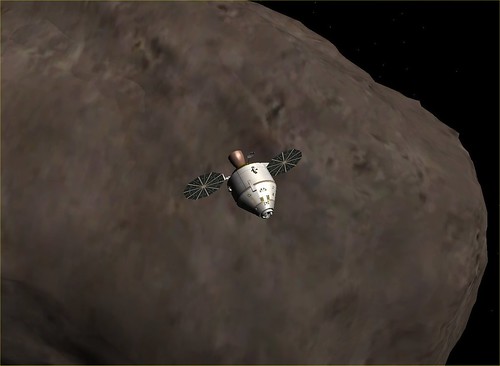
To capture the picture above, I created a scenario in Orbiter 2016 with the Crew Dragon docked to the “top” of the BFR in low Mars orbit (BFR's "wings" are actually solar panel arrays that deploy like Japanese fans). For scale, the SpaceX Crew Dragon with its “trunk” is about 27 feet or 8 meters long, taller than a two-story house. So you can see that the BFR is indeed a Big something Rocket. Search for "BFR size comparison" and you will find many illustrations of its incredible size. Also check out this speculative but suggestive cutaway diagram of the interior of the BFR's second stage (the part that will go to Mars). 

But Orbiter add-ons are more than just pictures or even 3D models. They are working models of the spacecraft, so they can be launched, flown to orbit (or to Mars), maneuvered, entered in the atmosphere, and landed. The Falcon 9 first stage and the BFR are “tail sitters” so they land with rockets blazing. I haven’t tried this yet with the BFR, but I have flown BrianJ’s Falcon 9 and Falcon Heavy a few times (the built-in autopilot makes this rather easy). If you’d like to see it without bothering to install Orbiter, you can watch a video like this one. It's really amazing to see the first stage boosters turn around and fly themselves back to their landing pads. 

Is it weird to be so obsessed, still space-crazy after all these years? Maybe. But I prefer to think that I’m nurturing a sense of wonder that never quite left me. Or something like that. 


This picture shows BrianJ's SpaceX Crew Dragon orbiting the moon in Orbiter 2016.

Thursday, November 21, 2013

Bulgaria, Bad Knees, and Japanese


October and November tend to be my busiest business travel months, with at least one trip each to Europe and Asia. In October I did a customer visit tour in "only" four countries: UK, France, Bulgaria (sunset in the hills near Sofia, above), and Czech Republic (though I slept one night at the Vienna airport and drove through part of Slovakia). London, Nice, Manchester, Wales, London, Sofia, Vienna, Paris, and then home. This is a light five-day schedule for our European distributor.

Not much chance for fine European dining on this type of trip (unless gas station sandwiches and airline lounge snacks are your thing), but it's actually kind of fun. Although most business discussions are in English, I do try to practice a little French now and then, mostly in restaurants and by buying and reading science magazines like this recent special Mars issue of Science et Vie.

A special wrinkle on this trip was a bad knee. After months of increasing pain, I was recently diagnosed with a torn meniscus in my right knee. I was worried about long flights, big airports, train station stairs, and long car rides, but most of it went OK with the help of a new rolling backpack computer bag and a special effort to pack light. The fact that I don't have to carry books anymore helps a bit on this - I have hundreds of Kindle books on my iPad Mini, iPhone, and Kindle, and now the airlines even let you use these small devices in "airplane mode" from gate to gate (at least inside the US). After an MRI and two orthopedic opinions, I will have arthroscopic surgery to repair the meniscus next month. So I should be good as new (plus or minus a few decades) by January.

I spent last week in Japan, after working several weeks to prepare for optical/software presentations and product demos that I don't typically do in my day to day work these days. Since long ago I studied and still enjoy optics and pretending to design lenses (we call these "demos"), I look forward to these fall trips when I get to meet with some of the Japanese engineers who have designed many of the camera zoom lenses, DVD player lenses, and what-not that I have bought and used over the years. This trip involved even longer flights as well as many trains and train stations. In spite of all the stairs in the subway stations, my knee felt pretty good, which made me realize (this week) that most of my knee pain is triggered by driving, not by walking and climbing stairs.

I still like to play with Japanese when I'm in Japan, and thanks to the iPhone and iPad, I can now carry around the best Japanese dictionary I ever owned, which happens to be a free app called Imiwa? (the name means "what about the meaning?"). I use this to refresh my fading knowledge of Japanese, taking notes on various interesting words or phrases that I hear or see. I also bought a few copies of a children's magazine that I haven't bought in many years, Takusan no Fushigi ("A World of Wonders" in English). Intended for Japanese children 8 years and up, each monthly issue focuses on a particular non-fiction topic, from a museum of curiosities in Paris, to the life cycle of a certain moth, to the workings of Air Traffic Control (ATC, October 2012, at left), among many others (hundreds of titles published since the 1980's when I first discovered them when exploring Japanese bookstores on my early trips).

Just for fun, I read the ATC one on my flight home (cool because I like flying stuff as well as Japanese). A key point is that most of the kanji ("Chinese characters") are printed with furigana, small phonetic characters that give the pronunciation. Japanese adults don't need these, but Japanese children (and I) do for all but the basic kanji, of which I know around 200 or so. Since I know how ATC works (from private flying and from listening to United's channel 9 for many years), it was fairly easy for me to follow the text, which consisted mostly of radio exchanges between pilots and controllers (although in fact ATC in Japan and in most of the world is done almost entirely in English, because the many international pilots cannot understand Japanese). I still had to look up probably every fourth or fifth kanji-based word (many flight-related words in Japanese are adapted from English and spelled phonetically in katakana, so those are easy to read).


This trip was also the first time in 31 years of travel to Japan that I tried fugu (known as blowfish or pufferfish). I've wanted to try it for years, but it's too expensive for an expense report, and no one ever invited me! Fugu has a bad reputation because its liver is deadly poison, and if it is not prepared properly, the poison can contaminate the meat, and you can die (this sometimes happens to amateurs who try to prepare fugu at home without special training). Restaurants are of course very careful, and it is actually quite safe, and pretty tasty. It is cut almost translucently thin for sashimi (photo above - it is light pink, but the dark pattern of the plate shows through making it look gray in places in the photo), but we also had it in soup, fried, and broiled. Oishikatta! (It was delicious.)

This was also the second time I had tried hirezake, a rather strange drink. It is warm sake with the fin of a fugu soaking in it. It sounds strange (ok, it IS strange), but it tastes pretty good. So I guess technically, I had "experienced" fugu once before. It's also popular enough that you can buy it in individual cans from some drink vending machines. Japan has many vending machines that dispense small cans of cold or warm beverages (typically coffee or tea). In this case, the sake is warm, and the fish fin (possibly not always fugu?) is in a separate small container on top that you add to the sake yourself. I guess you don't want that super-soggy-fish-fin taste in your hot Japanese rice wine, do you?

Tuesday, August 13, 2013

The 100*Pi Carnival of Space!


Well, 314 is approximately 100*(pi), right? Anyway, the 314th weekly blog carnival of space is live at the Dear Astronomer blog. Like the summer, it's short but sweet (and hey Curiosity, congrats on your first Earth year on Mars!).

Monday, June 10, 2013

Carnival of Space #305

The 305th edition of the Carnival of Space is on view this week at AARTScope Blog. A few members of the diverse space and astronomy blogging community share stories ranging from fast-moving galaxies, to new Mars maps, to a method of turning x-ray astronomy data into music (visualization becomes musicalization!).

Monday, April 08, 2013

"The Martian" - Great SF Book

This was a great find and practically a steal at 99 cents for a full-length SF Kindle e-book. Andy Weir's The Martian was recommended to me, probably because I had recently bought another Kindle SF title, Wool by Hugh Howie (also a great read from an "indie writer"). 

I tend to prefer so-called "hard" science fiction, stories that have at least some plausible claim to feasibility based on physics and technology, even if it's some pretty far-out physics and technology (I mostly don't like stories based on magic and fantasy, with occasional exceptions).  The Martian is definitely hard SF, but it's also a riveting story line. I read it in a couple of days. 

The story takes place on a NASA manned Mars mission (you immediately see the fiction here!), perhaps 30-40 years in the future. An ion-engine-powered (VASIMR actually) Mars transfer vehicle (the Hermes) has been built and used on two previous manned missions. These are short-term missions (about a month on the surface), using fairly extensive infrastructure delivered to the surface by multiple unmanned supply ships. Although not defined in detail, the mission architecture seems to borrow from Mars Direct and various NASA Mars Reference Missions, with in situ rocket fuel production, a fairly large "hab" to house the astronauts, large pressurized Mars rovers, and a separate MAV (Mars Ascent Vehicle) used to return the astronauts to the Mars-orbiting Hermes. These facilities all feature importantly in the story.

The six astronauts of Ares 3 run into trouble a few days after landing - an extra-powerful dust storm with winds that could damage the MAV, necessitating as hasty abort. As the crew of six makes its way to the MAV for emergency departure, Mark Watney is injured by flying debris. Telemetry indicates that he has died due to a large breach in his spacesuit. With the MAV about to topple in the wind, the rest of the crew barely escapes, leaving Mark's body behind.

Of course, Mark doesn't actually die (his suit was breached and he was injured, but some lucky circumstances allowed the suit to seal off the breach). The hab is still intact and stocked with food for six for a month-long mission, but all antennas have been lost, so Mark is unable to communicate with his crew mates or with Earth. Due to orbital mechanics and complex logistics, a rescue is unlikely even if he can reach someone, and even with rationing, the food supply will only give him a few months. But Mark figures he might as well try to survive, and as a clever and stubborn guy, as well as a botanist and mechanical engineer (every crew member is chosen for multiple skills), he manages to solve a steady stream of problems that Mars and his situation throw at him (none of them are aliens or demons as in some other Mars mission books and movies). 

I won't tell you more than that, except to say that with logbook entries as the format, I was skeptical that this could really hold my interest. But Mark (or should I say Andy) is quite funny, and his descriptions of his problem solving are extremely interesting (and detailed). This book made me think that humans on Mars will have a tough time, but that we will ultimately prevail in spite of the hostile environment. It also gave me a "real" use for the Mars Globe app that I have had on my iPod Touch and iPad for quite some time. I won't explain that any further - read it yourself! 


Tuesday, February 12, 2013

Mars in 2023?

Mars Direct at Vallis Dao

Considering that this started out as something of a "space blog," it's odd that I haven't actually written about space in quite a while. Of course my tag line gives me a pretty wide charter: "Space flight, simulators, astronomy, books, flying, music, science, education: whatever the obsession of the moment might happen to be." And for the last couple of years, I've been occupied with other things, such as music and travel (not to mention work). So it goes.

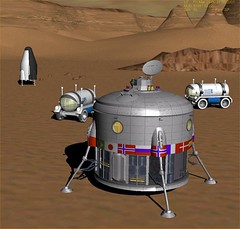
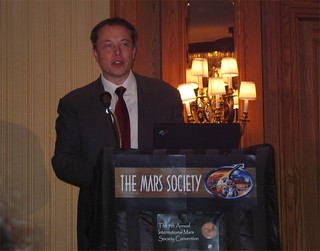
But I really am still quite interested in space, even if I'm not writing books about space flight simulators (simulated Mars Direct mission in Orbiter shown in picture above) and attending space conferences as I did a couple of times back in 2006 and 2007. Two weeks ago, I made a special effort to go see the space shuttle Endeavour at its new museum home in Los Angeles. And I continue to follow developments in private space with great interest, including the accomplishments of SpaceX and its founder, Elon Musk, whom I heard speak at the Mars Society conference in Washington in 2006:

Elon Musk at MSC 2006

Today I was reading the tenth anniversary edition of The Space Review, a weekly roundup of space related articles published by Jeff Foust (congratulations Jeff!). One of the articles is "Can Elon Musk retire on Mars in 2023?" This is something I had heard about back in 2010 but mostly had forgotten. Musk told a newspaper interview that he planned to retire to Mars (not for a while I suppose, as he is only 41). Really? Could that be possible? I mean, I know Elon has had long-term goals for Mars and for human expansion into the solar system. But how soon could there be something on Mars that one might retire to? 

Maybe sooner than we might think if Mars-One has its way. I had not heard too much about this Netherlands-based private organization, but they've got some big plans, including the start of Mars colonist selection in 2013. Whoa, that is now! It's pretty wild and I don't know whether their "Mars colonization as a global reality TV show" could really work for funding. But they are thinking big by thinking small, as in, don't assume any major technological breakthroughs. Plan to use what we know how to make and do now, including rocket boosters from SpaceX, and various technology developed and used for the International Space Station. They claim it is indeed possible.


If they stay on schedule, they will launch a Mars communication satellite and a first pre-supply mission in 2016 (above), and land the first four colonists on Mars in 2023 (one major simplification of their humans-on-Mars program is that all trips are one-way, not round trip - if you go, you plan to stay). Four more colonists will land every two years in the initial plan, though other short-term colonization proponents believe that a viable colony will need to (and could) grow faster than this. By the time Elon reaches a still youngish retirement age of say 60 (in 2031), perhaps there could be a few dozen to a few hundred colonists he could join in a small Martian town.

I certainly believe that it's a good idea to expand humanity into the solar system, in part to provide a genetic backup of sorts in case of some unexpected disaster on Earth. And I would really be excited to see a private humans-on-Mars program starting as early as 2023 - just ten years away! I may be getting ready for retirement around then myself - but unlike Elon, I don't plan to join a Martian retirement village. I will enjoy watching from afar (I hope there's a virtual reality feed I can subscribe to), but I'm rather attached to Earth and many of the people who share it with me. I think I will just stay here and re-read some of Kim Stanley Robinson's novels like Red Mars and 2312

Thursday, August 23, 2012

Mars "Beach" Photos

Lest I get too Earth-centric in this blog, I want to mention the progress of MSL (Curiosity to her friends) on Mars. While the JPL team is still taking things slow to make sure everything is carefully checked out, there has been some cool progress, including at least one laser shot and a very short drive away from the landing site. The pictures are amazing, and I think one of the pluses here is that Curiosity's mast cameras are roughly at human eye level, so the perspective is like you would see if you were standing on Mars.


While the color photos are great, I'm really digging the sharp B&W shots we've been seeing recently. Our own robotic Ansel Adams on Mars. They somehow remind me of beach photos from when I was a kid and my parents took me to Cape Cod. I know, I know. No mountains in Cape Cod. No ocean on Mars. But the look of the B&W just does that for me. Takes me back to 5 years old, playing in the sand with my geological drill and laser spectrometer.

There are great official images here. My favorite spot for MSL news is Emily Lakdawalla's blog at the Planetary Society. She really digs up the latest Mars dirt (so to speak). Today she showed a wonderful full color panorama including the mountain. MSL's first tire tracks at the Ray Bradbury Memorial Landing Site on Mars are seen in this August 22 panorama:


Monday, August 06, 2012

6 More Wheels on Mars!

I decided to go to bed rather than wait for Curiosity's planned 1:30 a.m. landing, but without setting any alarm, my wife and I both woke up at about 1:20, and we used the iPad to watch a video feed from the Planetary Society's  Planetfest in Pasadena. We tuned in just after cruise stage separation, and both the Planetfest crowd and the JPL control room teams were already going wild. It was very exciting and emotional, and it all went perfectly, including the almost immediate display of a couple of low-res "hazcam" photos showing that Curiosity was indeed safe and sound. Awesome. I was glad I had watched the Eyes on the Solar System EDL simulation earlier in the evening so I could really picture each event as it was called out. We watched for about 20 minutes then went back to sleep.


This morning I checked the Planetary Society Blog where Emily Lakdawalla reported that there appeared to be a "puff" of something on the horizon in the very first hazcam image that was not there in a later shot after the transparent lens cover was opened. Her thought was that this might have been a dust cloud from the impact of the descent stage, which was programmed to fly off, run out its fuel, and crash far from the landing site. If so, that would be really cool. Imagery from the Mars Reconnaissance Orbiter will probably confirm that and also show us exactly where Curiosity landed.

Sunday, August 05, 2012

Eyes on Curiosity

I've been a very bad Solar System Ambassador the last couple of years. Other parts of life (job, family, music) have intervened, and I just haven't been keeping up with space developments and doing outreach events. My bad. I haven't even fired up Orbiter in probably 9 months. But I'm still really interested in this whole business of exploring the solar system (see my recent review of Kim Stanley Robinson's new book 2312 - he really makes the solar system come alive, 300 years in the future).

But of course the solar system is alive now. Mostly here on earth of course, but our latest robotic emissary to a neighboring planet is going to land there in less than four hours from now. That is of course NASA's Mars Science Laboratory (MSL), otherwise known as Curiosity. Today I have been reviewing the mission and the all important EDL (entry, descent, landing) phase, the famous "7 minutes of terror" that will start in just about three and half hours for us (Curiosity will experience it about 14 minutes before we hear about it, the time that light-speed radio signals from Mars will take to get here).

I have been watching the progress using JPL's very cool "Eyes on the Solar System" 3D visualization web application which includes a detailed simulation of the EDL phase. You can watch this as a preview (including controls to speed up, slow down, reverse, and pause the events) or you can watch it live. Right now the live view shows the cruise stage slowly spinning with its solar cells pointed to the sun:


But if you run the preview mode (or wait for the landing), you can watch all the more terror-laden steps like aero-shield heating, descent stage separation, and the grand finale, the special-forces-like "sky crane" landing (there is also a very cool JPL video about the EDL phase here):


I wish the landing weren't happening at 1:30 am in my time zone, but I plan to try to stay up even though it's a "school night." I was lucky enough to see Curiosity when it was still a bunch of parts in the JPL clean room back in May 2009, and I feel a special attachment the the not-so-little six-wheeled fella (gal?) - here's a picture I took of the descent stage at JPL that day:


Sunday, February 12, 2012

Optics for Mars

JPL's new rover "Curiosity" is en route to Mars, set to arrive in August 2012. A recent NASA press release describes an interesting aspect of the optical sensors carried on board the rover. A special test chart is installed to allow for calibration of camera systems for resolution and color. The chart includes a 1909 Lincoln penny (hey, it's Lincoln's birthday today!) as a familiar size and detail reference, more for public engagement than for any specific science or engineering need.If you zoom in on the above image, you can see that the black & white test chart resolution samples are labeled in cycles per millimeter, the typical unit used by optical engineers to define image quality. A "cycle" is a pair of black and white lines (cycling from white or bright to black), so 2.0 cycles/mm means that two black/white pairs will fit into a millimeter of width (so each bar will be 0.25 mm wide). Higher cycles/mm correspond to finer detail in the image (smaller pixels in a digital image). This chart will be used to calibrate the instrument called MAHLI (Mars Hand Lens Imager) that will provide close-up images of mineral and soil samples.

Sunday, November 27, 2011

Safe Travels (Don't Die): Go Curiosity!

Lisa Hannigan's wonderful album "Passenger" includes a funny little song called "Safe Travels (Don't Die)." It sounds like it was inspired by a friend who says this to her when she travels, but here I am applying it to NASA's Mars Science Laboratory rover which was launched yesterday. I caught the launch live on CNN, and it was a beautiful sight. So far the spacecraft seems to be in good health, and I do wish Curiosity safe travels on its long 251 day cruise to Mars.

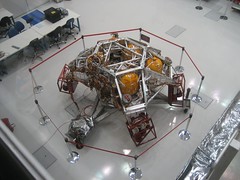
MSL Rocket Platform in JPL Clean Room
I was fortunate enough to see Curiosity in the flesh (so to speak) during assembly in the clean room at the JPL Open House I attended in May 2009. The picture above shows the "sky crane" rocket platform that will gently lower the rover to the surface in August 2012. More pix on Flickr.

Thursday, July 01, 2010

My Own Ariane 5 Launch

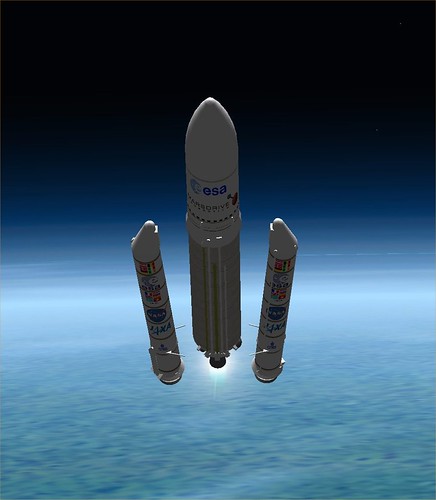
Ariane SRB Sep
Seeing the full-size Ariane 5 launcher at the space museum in Toulouse last week reminded me of my own Ariane 5 launching days back in 2006. Of course those were virtual launches in Orbiter, and at the time I was working with Andy McSorley, Mark Paton, and Grant Bonin on an Orbiter simulation of the proposed "Mars for Less" approach for getting humans to Mars sooner rather than later. This involves launching the Mars-bound spacecraft in modules using a "medium" booster (of which Ariane 5 is a good example, with a payload to LEO of around 20 metric tonnes).  The modules would be designed to assemble in orbit essentially by docking, without the complex, EVA-based construction methods used for the ISS. The whole project became a rather complex add-on for Orbiter (there's also an "extra" package for it here). Andy and Mark came up with some great models and programming for it.

I wrote a number of blog posts on this at the time and posted many pictures on Flickr. I also presented the technical paper (PDF, PDF slides here) that we wrote about this at the 2006 Mars Society Convention in Washington, DC. It was fun. The Orbiter screen shot shown here is one of my favorites. The Ariane 5 carries the logos of various space agencies since we assumed that a human Mars mission would be a multinational effort.

Friday, April 16, 2010

Asteroids & Mars on the Agenda

Orion CEV with Asteroid #2
After President Obama's speech at Kennedy Space Center, I think I'm pretty much with him and Buzz Aldrin on the new direction for NASA. I can understand the view of Neil Armstrong and others who feel that by not defining a specific near-term goal for NASA to accomplish (namely to return to the moon in a government spacecraft by some target date), Obama seems to be pulling the plug on human spaceflight for the USA. But the operative word there is seems - because a specific goal without the funding to achieve it is really not a goal at all, and certainly not a near-term one. It's more like a wish, accompanied in the case of the Constellation program by the hope of keeping many of the employees and contractors who now work on the shuttle employed for the many years it would take to get Ares I and Orion off the ground, at least until some cash-strapped future president finally cancels these programs. There was no serious plan or funding for the moon lander. But maybe if enough people believed in Constellation (like Tinkerbell the fairy), it wouldn't die.

I don't know. I love the Apollo program and all it accomplished, but it really doesn't seem like a sustainable approach absent a Cold War imperative and the willingness to pump a lot more money into NASA than anyone has done since probably 1967. And as Elon Musk of SpaceX said in this statement, "The President quite reasonably concluded that spending $50 billion to develop a vehicle that would cost 50% more to operate, but carry 50% less payload was perhaps not the best possible use of funds."

So what do we have now? A couple of specific human spaceflight goals for "the next decade" (visit an asteroid as shown above, and orbit Mars) that are quite far off (2025+) and not too detailed. A reinstated and scaled-back Orion capsule which will serve as a development platform for future human spacecraft and provide a government-built option for emergency escape from the ISS, which will be extended by five years to 2020. And a plan to develop the Ares V, a heavy lift vehicle that could support a variety of programs in future years. Plus more funding to encourage privately developed spacecraft and launch vehicles - call it the "private option" (you would think Republicans would be all over this - except that it conflicts with their Prime Directive, to oppose Obama on everything). And more funding for NASA to develop advanced propulsion systems and other technologies that will be needed for future missions but are too risky for companies to handle as "product development." Note that they are actually increasing NASA's budget by $6 billion over the next five years to help support these plans.

So all things considered, I think it's a pretty good plan, and President Obama summed it up pretty well in his speech:
Fifty years after the creation of NASA, our goal is no longer just a destination to reach. Our goal is the capacity for people to work and learn and operate and live safely beyond the Earth for extended periods of time, ultimately in ways that are more sustainable and even indefinite. And in fulfilling this task, we will not only extend humanity's reach in space -- we will strengthen America's leadership here on Earth.

Monday, March 01, 2010

Carnival of Space #143

Carnival of Space #143 is at Next Big Future. The amazing Mars avalanche picture above was created from HiRISE imagery by Bernhard Braun and is discussed in the carnival post from Universe Today.

Wednesday, February 24, 2010

Make Mars "The Destination?"

I really go back and forth on this. I've been a member of the Mars Society since 2005, I've read several of Robert Zubrin's books, and I even attended and presented a paper at the 2006 Mars Society Conference. I've spent a lot of time reading and simulating and thinking about Mars, and there's no doubt that as a non-Earth destination, Mars is as good as it gets in this particular star system.

So when I read Bob Zubrin's latest essay on why NASA needs a human spaceflight destination, and why that destination needs to be Mars, I want to believe. On some level, I do believe. I was a child of Apollo (and the Beatles) and I probably became an engineer because of it. I was inspired. Developing technologies that will someday be great building blocks for some TBD exploration program (as in the current Obama proposal for NASA) - that's maybe practical, but it's sure not inspirational. Developing a commercial space industry is an essential step in becoming a space-faring civilization, and it will probably create some pretty good high-tech jobs in the USA, but it's probably not inspirational at anywhere near the Apollo level.

On the other hand, Apollo was exceptionally non-sustainable, a proxy-for-war crash program to beat the Soviets to the Moon, and given the political climate and the cost of the Vietnam War, we were damn lucky that we got up to Apollo 17 - I'm sure there were plenty of people in Washington ready to pull the plug as soon as Neil and Buzz splashed down. It surely inspired a lot of people and left a legacy of technology that fueled the US economy for many years. But there's no single threat at the level of the Cold War around which you could build a political consensus for an intense Mars-focused program right now (unless you could somehow show that this would reduce short-term unemployment).

I guess I'm really hoping that the analogies between the early aviation industry and the early commercial space industry will come true. That someone will develop the DC-3 and later the 707 and 747 of commercial space, and that from these developments, the path to Mars (and to the Moon and the asteroids) will become clearer and easier than it is now. But is that a realistic hope? I don't know. Probably not in my lifetime (guess I better work on extending that).

Then there's the whole Lifeboat thing. What if we "sink" this planet? Yeah, I don't know. It's definitely easier to just have a glass of wine and watch American Idol. But I'm trying to avoid that (the Idol part anyway).

Monday, November 09, 2009

Carl Sagan and the Big Picture on Mars


I'm having a crazy week and shouldn't even be thinking about blogging. But here are two cool things courtesy of other bloggers.  Astropixie has a great quote from the late Carl Sagan in honor of his birthday on November 9 (he would have been 75). Carl Sagan was one of my favorite people, and while I hesitate to put myself in any category with him, his ability to make science accessible to everyone certainly inspired me in my attempts to do educational outreach using space and astronomy themes.

And here's another space-related post from The Big Picture - Mars from MRO. Incredible images. Carl liked to talk about how Mars and the other planets are places, and I'm sure he would be pleased with how intimately we've gotten to know the place called Mars over the last few years, thanks to the Mars Rovers, MRO, and other robotic explorers. Thanks to Bad Astronomy for the tip.

Wednesday, October 21, 2009

Warm-Blooded Plants and Freeze-Dried Fish


Somehow I stumbled on a 1997 Atlantic article by Freeman Dyson, "Warm-Blooded Plants and Freeze-Dried Fish." It's about space exploration and the prospects for humans to (eventually) explore and even colonize the solar system and beyond. Dyson is a distinguished scientist and writer and is well-known (I debated between renowned and notorious) for his independent and often contrary views on certain issues, most recently on the (possibly not-so-terrible) effects of climate change.

In the 1997 space article, I found myself agreeing with a lot of what he had to say (recall that 1997 was the year of Mars Pathfinder and NASA's period of "fast, cheap, and out of control" unmanned spacecraft, which clearly influenced some of his comments). For example, the case for continuing the shuttle and space station programs was not especially compelling (though they would go on for 12+ more years, even surviving a second shuttle disaster). But there are a lot of interesting things in the solar system, and with our rapidly advancing technologies and (eventual) ability to do things in space much more cheaply, places like Mars and Europa could (eventually) be well-worth exploring, though searching for freeze-dried fish orbiting in the vicinity of Europa is perhaps not the best strategy for finding life there (the Europafish would have been ejected by energetic objects crashing through the ice to Europa's hidden ocean - admittedly not a high-probability event). Warm-blooded plants and Mars plants that grow their own green-houses - if nature hasn't evolved them, we could (eventually) genetically engineer them. Maybe even really big ones to use as human shelters on Mars (greenhouse trees!).

Dyson ends up talking about harvesting comets and colonizing the Kuiper Belt - a pretty far-out notion indeed (though not as far as the Oort Cloud Housing Developments). I kept using the word "eventually" in the above discussion. Dyson's key point in all this is the need to be realistic about the goals and the timing. He says, "When emigration from Earth to a planet or a comet becomes cheap enough for ordinary people to afford, people will emigrate." But regardless of what Apollo accomplished in 10 years, the time scale for human expansion into the greater solar system is probably more like hundreds than tens of years.
No law of physics or biology forbids cheap travel and settlement all over the solar system and beyond. But it is impossible to predict how long this will take. Predictions of the dates of future achievements are notoriously fallible. My guess is that the era of cheap unmanned missions will be the next fifty years, and the era of cheap manned missions will start sometime late in the twenty-first century. The time these things will take depends on unforeseeable accidents of history and politics. My date for the beginning of cheap manned exploration and settlement is based on a historical analogy: from Columbus's first voyage across the Atlantic to the settlement of the Pilgrims in Massachusetts was 128 years. So I am guessing that in 2085, 128 years after the launch of the first Sputnik, the private settlement of pilgrims all over the solar system will begin.

This is where I'm afraid he may be right, though it's possible that accelerating technologies and/or one or more major global crises (man the lifeboats!) will speed things up a bit. But I still think it's right to aggressively pursue manned and unmanned space flight now, perhaps with more of it given over to the commercial side. As I wrote in 2007 in a discussion of John Barnes' "Kaleidoscope Century" SF series:
But space (private, public, whatever) could be part of a solution, could be a tool or a lifeboat or even a source of major help for this troubled Earth. Someday we may need every kind of tool we can get, and when we do, we will be glad for whatever preparation we have made in learning to live somewhere other than here. I don't expect everyone to get inspired by it - my most hopeful scenario for educational outreach is that a handful of kids get excited about learning something, get themselves educated, and start to tie a few knots for the flimsy rope bridge we are building toward the future, even while some other kids are playing with matches, trying to light the ropes on fire. And maybe some of the ropes are actually carbon nanotubes stretching thousands of kilometers into the sky.
The process of building and living for months aboard the ISS may seem expensive now, but if we ever do have a major crisis in which the survival of our species requires getting a small fraction of us off the planet in a hurry, we will be grateful for this experience when we are hollowing out our first asteroid and building our first housing project on Mars.

Monday, September 14, 2009

Nice to Know It Works!

A few years back, I worked with a few far-flung fellow Orbiter enthusiasts to develop an Orbiter add-on package called Mars for Less (MFL). I wrote about it quite a bit in 2006-2008 and even presented a paper (PDF) on it at the 2006 Mars Society Conference in Washington, DC. Fun stuff, especially since Andy McSorley and Mark Paton did most of the heavy lifting (and re-entering). I mostly did a lot of testing and writing (scenarios, blog posts, and the MSC paper). Mark has quite a knack for spacecraft design and especially for EDL (entry, descent, and landing in the trade). Since MFL is all about saving weight (well, it's also about medium-lift boosters, modular orbital construction, and living off the land on Mars), we wanted a very light heat shield. Mark decided to go with an inflatable one. He'd read some stuff about them, and since Orbiter isn't exactly rigorous about the structural integrity of spacecraft models anyway, he decided to give it a shot. It seemed to work within the aerodynamics of Orbiter. I entered the Mars atmosphere and safely landed dozens of times (mostly thanks to Mark's spiffy autopilot work).You can see a bunch of my Mars for Less screen shots on my Flickr site and a nice 7 minute video (not mine) of the MFL mission here.

So I was really pleased to learn recently that someone has actually tried out an inflatable heat shield. NASA did a suborbital flight test of a 10 foot (3 meter) inflatable heat shield and it worked. Of course this is a lot smaller than what we would need for our manned Mars lander, but hey, it's a start!  Thanks to Colony Worlds for the tip and the photo.

Saturday, September 05, 2009

My Brief Mars Vacation

Mars needs some work as a fun destination. Speaking in virtual terms, I've orbited and landed on Mars countless times in Orbiter, but once you land somewhere in Orbiter, there really isn't much to do (this is not always true - if you use the AMSO add-on to simulate Apollo Moon missions in Orbiter, you can do EVA's, drive the rover, and collect samples). That's OK - Orbiter is all about launches, orbits, and landings.

But what about living on and exploring Mars? I downloaded a free early alpha version of Mars Colony Simulator from HyperKat Games and spent a couple of hours playing with it on my own (there's a new multiplayer aspect that I didn't try). It seems to be directly inspired by Mars Direct, with a two-story tuna can COHAB and a nearby ERV (Earth Return Vehicle). It's got a 3D first-person interface that's fairly intuitive, and you start out in a space suit on the second floor of the COHAB, with several mission 1 objectives to complete.

You have to worry about things like making sure the water separator is running. Of course it's not (because it needs water), and you need to first find water you can drill for, which means you have to walk around outside and take a bunch of GPR (Ground Penetrating Radar) readings to find the water. So you go outside and start to do this for a few minutes, but watch out, dust storm warning! Get back inside, get out of your suit and top off the power and oxygen while waiting for the storm to pass. Suit up again and go out, but first you need to clean the dust off the solar panels (both units). Take a few GPR readings until, what's this? Another dust storm? It's accelerated time, but jeeze.

A real Mars crew would be 3 or more people, so I guess multiplayer is the way to go here, but I'm not ready for that. The simulation has food, water, and a bathroom, and you have to watch out for your player's health, sort of like the Sims (I guess). There's also agriculture (I only saw the algae tanks, but there's a greenhouse in mission 2, once you accomplish mission 1 and have a water supply - mission 2 also has a rover). There is some limited documentation. It looks like it will eventually be a cool and educational sim, but it's a bit too alpha for me right now. I'm not sure I'm cut out to be a virtual or real Mars colonist at this point in my life, but I'll keep an eye on this sim as development continues.

Friday, June 05, 2009

Why Mars? Why Now?

I don't remember how I came across this, but IEEE Spectrum (electrical engineering professional society journal) has a special feature this week called "Why Mars? Why Now?" with some 33 articles, features, and opinion pieces by a range of authors. With sections labeled Challenges, Business, Voyage, Strategy, Exploration, and Space Ambitions, this special feature covers a lot of ground. Articles include "Why a Manned Mission to Mars Seems as Far Away as Ever" (countered by an article "How to Go to Mars - Right Now!" by - you guessed it - Robert Zubrin - go Bob!), "Space is Risky Business" by Elon Musk (he should know), and "10 Favorite Mars Novels" by Kim Stanley Robinson (he should know). And many more, including an interview with Owen and Richard Garriott, father and son space travelers.

Great stuff, though I don't know how long the top level page will stay around since I've never looked at any IEEE special reports before (it's a generic "special-reports" URL), which is why I included some of the direct article links above. This may be a more permanent link, though it's hard to tell since I've had a lot of trouble accessing these articles for some reason (slow and/or very busy server?).

The upshot is that getting humans to Mars is a complex, multifaceted, interesting, and difficult problem, though opinions vary on just how difficult, with Robert Zubrin's "we have the technology - let's do it now" being the most optimistic (he's the president of the Mars Society, of which I am a card-carrying member).

There's also an opinion piece called "The Mars Challenge," by Dr. Leah H. Jamieson, an EE professor at Purdue University. She discusses how first year Purdue engineering students believe that sending people to Mars might be their generation's greatest technological legacy. Space can still inspire, and the long-run benefits of the original Space Race and of the Apollo program seem indisputable to me, more so in the people and the ventures it inspired than in the specific technologies, though there were many impressive and important "spin-offs."Like many other engineers and scientists of my generation, I was directly inspired by the space program of the 1960's to pursue a technical education and career, though I ended up an optical engineer rather than an aeronautical engineer and astronaut as I had planned in the sixth grade.

Could "energy" be the current or next generation's "Apollo program?" It's important enough, but I'm not so sure. I really think there is something magic about working to get people to another world. I know the Cold War was a big part of the Apollo program, and for Mars I would personally prefer that we do it cooperatively with other nations, not in competition. Maybe that's naive and a deal-breaker, I don't know. But I truly believe that a serious effort to get people to Mars sooner rather than later will reap great benefits in inspiration as well as in technology, jobs, and spin-offs. And who knows, maybe even peace. Yup, naive.