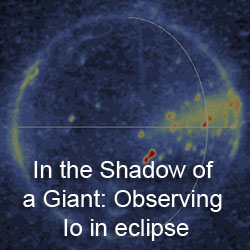
As Jupiter and Earth reached their closest approach for 2009 (also known as opposition when the Earth is between Jupiter and the Sun), Christopher Go captured a number of excellent views of Jupiter and its major satellites over the weekend with his telescope in the Philippines. Included in these images was an eclipse on Ganymede caused by the shadow of Io crossing the larger satellite's surface. This is the opposite of what I've been talking about for much of the summer, where the shadow of Ganymede crossed Io's surface.
The animated gif of the incredible imaging sequence is presented at right. Don't forget to check out the rest of Christopher Go's Jupiter images on his website.
Later this morning, Io's trailing hemisphere will experience a total solar eclipse when Ganymede passes between Io and the Sun. The eclipse runs roughly from 13:34 to 13:39 UTC (14:08-14:14 UTC as seen from Earth). The video below was created in Celestia and shows the eclipse both from above Io, showing the shadow of Ganymede cross Io's surface, and from the surface of Io, showing Ganymede pass in front of the Sun.
Computer Animation of the total eclipse of the Sun by Jupiter's moon Ganymede over the trailing hemisphere of Io on July 22, 2009. First half shows a view from 4500 miles above Io's trailing hemisphere. Second half zooms in on the sun from an unnamed volcanic pit showing the total eclipse. The animation runs from 13:30 to 13:40 UTC on July 22, 2009.
EDIT 07/22/2009 10:06 AM: Fixed the title of the article, changing Jupiter to Ganymede. Obviously, a Jupiter eclipse is nothing special. A Ganymede one is.
Tomorrow brings Io's most interesting eclipse this mutual event season as most of Io's trailing hemisphere (51° West-231° West) is plunged into darkness by Jupiter's largest moon, Ganymede. This is the culmination of a series of weekly eclipses by Ganymede on Io. With each weekly eclipse, the center of Ganymede's shadow appears further south on Io. Tomorrow, the center of Ganymede's shadow passes just north of Io's equator. The eclipse takes place tomorrow morning, July 15, between 10:45 and 10:50 UTC (3:45-4:50 MST) on Io. If you have a good telescope and want to try to observe this event, from Earth the penumbral shadow of Ganymede will reach Io at 11:19 UTC, totality will run from 11:21 to 11:25:28 UTC, and end of the eclipse comes at 11:27 UTC. The peak of the eclipse, as observed from Earth, comes at 11:23:14 UTC. The timing of this eclipse should make it a good observation target for observers in the western United States, western South America (like the European Southern Observatory), and Hawaii.
During the eclipse, Ganymede will appear 13' 17.2'' across in Io's sky (compared to our moon, which appears around 30' across in Earth's sky). The sun will appear 6' 19.9". Therefore, it is unlikely that the sun's corona would be seen during the eclipse except near the beginning and end. At its peak near Tol Ava Patera, the eclipse will last 1 minute and 55 seconds long.
For this eclipse, I've created a little fancier video using Celestia and Adobe Premiere. I think I am starting to get along with that latter software package...
Computer Animation of the total eclipse of the Sun by Jupiter's moon Ganymede over the trailing hemisphere of Io on July 15, 2009. First half shows a view from 4500 miles above Io's trailing hemisphere. Second half zooms in on the sun from east of Ra Patera showing the total eclipse. The animation runs from 10:40 to 10:55 UTC on July 15, 2009.
I have also created a nice map showing the area on Io that will experience this eclipse. You can download a full-res version here.
Over the last few weeks, I have been presenting some of the mutual events in the Jupiter system, particularly solar eclipses on Io by either Ganymede or Callisto from the perspective of Io. However, a pair of amateur astronomers, John Sussenbach and Marc Delcroix, captured numerous observations of the solar eclipse on Io by Ganymede on June 24. Delcroix even plotted the brightness of Io versus time as the eclipse progressed. John Sussenbach also took a look at one of the the solar eclipses by Callisto on June 20.
Plenty of important meetings related to the exploration of Io and the Jupiter system will be taking place this week. This includes a Europa/Jupiter System Mission Joint Science Definition Team (EJSM JSDT) meeting today, an Outer Planets Assessment Group (OPAG) meeting tomorrow, and the EJSM Instrument Workshop on Wednesday through Friday. I might be listening into the EJSM Instrument Workshop for at least some of the talks, but I haven't decided yet.
Van Kane has been keeping up with last week's Planetary Science Subcommittee and Decadal Survey Meetings. One of the key issues that seems to be coming to a head is the flat planetary science budget projected in the out years in the current budget proposal. This would cause increasing budget pressure on many projects, not only because of the lack of budget increases (resulting from the poor government revenues) and from cost overruns on some projects, including the albatross of planetary science, the Curiosity rover (née Mars Science Laboratory). According to Kane, Ed Weiler at the PSS meeting stated that there is not enough money in the Planetary Science Division budget projections to fund the Europa/Jupiter System Mission. As Kane stated in his blog, this is definitely bad news.
Celestia version 1.6 was officially released late last week. Celestia is definitely one of the space simulator, particularly thanks to its support for NAIF Spice kernel files for spacecraft and planetary body trajectories and orientations. The software also has built-in video and screenshot support, which I often take full advantage of for this blog.
Sorry I haven't covered the last two eclipses (June 24 and July 1), but taking a look at today's eclipse of Io by Ganymede we see as Ganymede's shadow is now reaching further south across Io's trailing hemisphere. The eclipse will take place in about 25 minutes from the time I am typing this, but you can still see an animation of it in the Youtube video I uploaded and embedded below:
Computer Animation of the total eclipse of the Sun by Jupiter's moon Ganymede over the trailing hemisphere of Io on July 8, 2009. First half shows a view from 7,317 km above Io's northern trailing hemisphere. Second half zooms in on the sun from the floor of Loki Patera showing the total eclipse. The animation runs from 07:30 to 08:20 UTC on July 8, 2009.
Here are two videos showing today's total eclipses of the Sun by Callisto on Io's south polar region:
Computer Animation of the first of two total eclipses of the Sun by Jupiter's moon Callisto over the south polar region of Io on June 20, 2009. First half shows a view from 7,317 km above Io's southern trailing hemisphere. Second half zooms in on the sun from near Kurdalagon Patera showing the total eclipse. The animation runs from 04:10 to 04:56 UTC on June 20, 2009.
Computer Animation of the second of two total eclipses of the Sun by Jupiter's moon Callisto over the south polar region of Io on June 20, 2009. First half shows a view from 7,317 km above Io's southern trailing hemisphere. Second half zooms in on the sun from near Svarog Patera showing the total eclipse. The animation runs from 08:40 to 09:20 UTC on June 20, 2009.
An earlier partial eclipse occurred on June 19 over Io's southern leading hemisphere as well.
Tomorrow (June 16), Io will experience three solar eclipses by its larger neighbor, Ganymede. Like those thattook place last week, these eclipses are mostly visible over the north polar region of Io, though totality could be observed much further south than those last week (I say could because, obviously, no one is there to experience them). Luckily, thanks to software like Celestia, we don't have to let a little thing like a few hundred million kilometers stop us. Below is a video of an eclipse over the northern part of Io's anti-Jovian hemisphere that will take place in about three hours (1:08 am MST). Yes, like the nerd I am, I will watch it live on Celestia...
And completely off topic for a second, I know I have a few Iranian readers. All I want to say is good luck and stay safe! The world is pulling for ya!
I completely forgot in my last post that there are TWO total solar eclipse by Ganymede tomorrow, in addition to the one around 08:50 UTC. The second, to occur around 18:50 UTC, will also cover the north polar region a little further to the west than the earlier eclipse, over the trailing hemisphere side of the north pole. Below is an animation of that eclipse:
Computer Animation of a second total eclipse of the Sun by Jupiter's moon Ganymede over the north polar region of Io on June 9, 2009. First half shows a view from 7,317 km above Io's northern trailing hemisphere. Second half zooms in on the sun from near the north pole showing the total eclipse. The animation runs from 18:30 to 19:15 UTC on June 9, 2009. This eclipse occurs nine hours after another total eclipse by Ganymede over a region to the east.
With the Jupiter system approaching vernal equinox on June 22, eclipses of the Sun on Io by the other satellites in the Jupiter system and other mutual events (such as occultations, when one satellite passes in front of another from Earth's perspective) have been occurring for the last few months. Tonight, the first total eclipse of the Sun by Ganymede this mutual event season will take place. A partial eclipse by Ganymede also occurred just 30 minutes ago (another partial eclipse occurred on June 1 as well). Below are two animations created in Celestia showing these two eclipses. For more information, check out my blog post from December about the mutual event season as well as my 365 Days of Astronomy podcast from last month.
Computer Animation of a partial eclipse of the Sun by Jupiter's moon Ganymede over the north polar region of Io on June 8, 2009. First half shows a view from 7,317 km above Io's northern leading hemisphere. Second half zooms in on the sun from near Io's north pole showing the partial eclipse. The animation runs from 20:38 to 21:08 UTC on June 8, 2009.
Computer Animation of a total eclipse of the Sun by Jupiter's moon Ganymede over the north polar region of Io on June 9, 2009. First half shows a view from 7,317 km above Io's northern anti-jovian hemisphere. Second half zooms in on the sun from near the eastern end of Lei-Kung Fluctus showing the total eclipse. The animation runs from 09:30 to 10:15 UTC on June 9, 2009.
These eclipses by Ganymede will occur every 8 days between now and mid-August with the most spectacular Ganymede eclipse occurring on July 15 when most of the trailing hemisphere of Io will be in the shadow of Ganymede.
Welcome to The Gish Bar Times, the only blog dedicated to Jupiter's volcanic moon, Io!
Here we cover Io-related news: new volcanic eruptions, published papers and conference abstracts, new images (or reprocessed older images), and news regarding upcoming missions to the Jupiter system.
I work for the Cassini Imaging team, usually processing Titan and Enceladus images and making maps of Titan based on our images. When I am not working or studying, I'm...I forget. I watch a lot of movies I guess.

 As Jupiter and Earth reached their closest approach for 2009 (also known as opposition when the Earth is between Jupiter and the Sun), Christopher Go captured a number of excellent views of Jupiter and its major satellites over the weekend with his telescope in the Philippines. Included in these images was an eclipse on Ganymede caused by the shadow of Io crossing the larger satellite's surface. This is the opposite of what I've been talking about for much of the summer, where the shadow of Ganymede crossed Io's surface.




 Posts
Posts